Key Startup and Venture Investment News for July 26, 2026: Record First Half, Capital Concentration, Liquidity Return through IPOs and M&A, Public Multipliers Correction, and Regional Market Restructuring
The venture capital market is entering the last week of July 2026 in a state unseen in any previous cycle: private capital is hitting historical records while public markets simultaneously conduct the most severe reevaluation of AI assets in two years. For venture investors and funds, this is not a contradiction but a new operational reality—and the main pricing factor for the upcoming quarters.
The first half of 2026 has rewritten industry statistics. Global venture investments reached $510 billion—more than the entire year of 2025 ($440 billion) and approximately one-third higher than the previous half-year record set in the second half of 2021. At the same time, the market structure has become unprecedentedly narrow: two issuers, OpenAI and Anthropic, have collectively raised about $217 billion, or 43% of all global venture financing in six months. Over 70% of the capital in the second quarter went to companies positioning themselves as AI-first, compared to less than 50% a year earlier.
Simultaneously, the stock market has started asking uncomfortable questions. The July correction in the semiconductor segment, accelerated by the launch of the Chinese model Kimi K3, and the Federal Reserve's stricter rhetoric, with ten-year Treasury yields around 4.48%, created the first sustained discount to public AI multipliers in a long time. The divergence between private startup valuations and public reevaluation is a key topic on the agenda by the end of July.
Key Takeaways for Venture Investors this Week
- Record and Concentration. $510 billion for the half-year with 43% of the capital in two companies represents the historical maximum inequality of the venture market.
- Mega Rounds as the Norm. Over 81% of American venture dollars in the first half of the year went to rounds of $100 million and above.
- Return of Liquidity. 32 IPOs valued over $1 billion and 24 M&A deals over $1 billion totaling $113 billion in the second quarter mark the best quarter for exits since 2021.
- Shift Down the Stack. Money is flowing into inference infrastructure, physical AI, sensors, and cybersecurity, rather than "wrapping" applications.
- LP Base Contraction. 16 mega funds raised nearly 70% of the $72.4 billion attracted by the venture industry during the half-year.
- Risk of Overvaluation. The public market has started discounting AI multipliers, which directly affects exit valuations in late rounds.
Half-Year Record: How $510 Billion Changed the Architecture of the Venture Market
The half-year divided into two quarters of different character. The first quarter generated $305 billion—the largest quarter in industry history—driven by four mega deals: OpenAI's round of $122 billion at a valuation of $852 billion, Anthropic's $30 billion round, xAI's $20 billion raise, and Waymo's $16 billion deal. The second quarter brought in $205 billion, distributed among over 5,000 companies—the second-best result in the history of observations.
For fund managers, the practical takeaway is simple: headline numbers no longer accurately describe real deal conditions. Mega-rounds in the late stage have risen year-on-year by more than 140%, while median early-stage checks and the number of deals have grown considerably more modestly. The venture market in 2026 is defined by high conviction and low tolerance for experimentation.
Public Market AI Reevaluation: The Key Risk Factor at the End of July
The key event of recent days is not a single deal but rather a shift in sentiment. The PHLX semiconductor index lost about 10% in a week, showing its worst performance since April 2025; the combined market capitalization of the global chip sector shrank by several trillion dollars. The trigger has been a combination of factors: competitive pressure from Chinese models, questions about the profitability of infrastructure capital expenditures, and a tightening monetary policy narrative.
For venture investors, the second-order consequences are important:
- The window for IPOs of companies with high private valuations and unproven unit economics is closing.
- The risk of down rounds is increasing as late rounds transition to public listings.
- LP demand for real liquidity, rather than paper portfolio revaluation, is growing.
Where the Money Went: Inference, Physical AI, and Cybersecurity
Deals from the past week illustrate precisely where the market identifies bottlenecks. Inference chip manufacturer Etched raised $300 million in a Series C round at a valuation of $10.3 billion—investors are financing not "more computation," but better economics of computation. The European developer of industrial humanoids, Humanoid, closed a Series A at $152 million at a valuation of $1.35 billion, becoming the first "pure" unicorn in humanoid robotics in the region with participation from industrial strategists.
Other noteworthy rounds include:
- CuspAI — $450 million Series B for AI-driven material discovery;
- AegisAI — $36 million Series A for email protection against AI phishing;
- Paper — $34 million Series A for a design layer for teams working with code agents;
- Ropedia (Singapore) — $30 million for multimodal data infrastructure for robots;
- Abstract — $25 million for a streaming architecture of security monitoring centers;
- Elio — $21 million for sensors designed for machine rather than human vision.
The common denominator here is a "bottleneck that can be summarized in one sentence." Startups without such a thesis in 2026 are attracting capital significantly more difficultly than what the record aggregated figures might suggest.
Exits: IPO Window is Open, but Selectively
The return of liquidity is the most significant structural news of the year. In the second quarter, 32 venture-backed companies went public with valuations exceeding $1 billion, while the M&A market exhibited record transactions totaling $113 billion over deals exceeding one billion. Nasdaq raised $129.3 billion through new listings for the half-year, and the average technology IPO gained around 44.5% on its first day of trading.
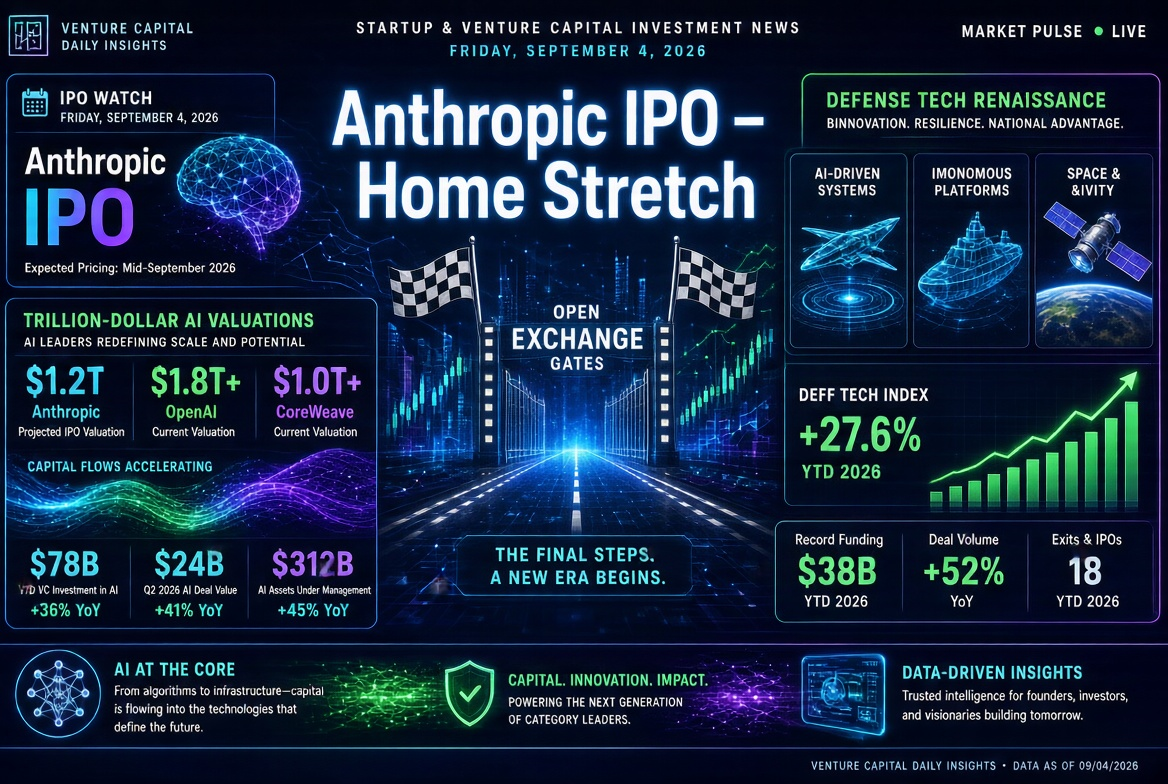
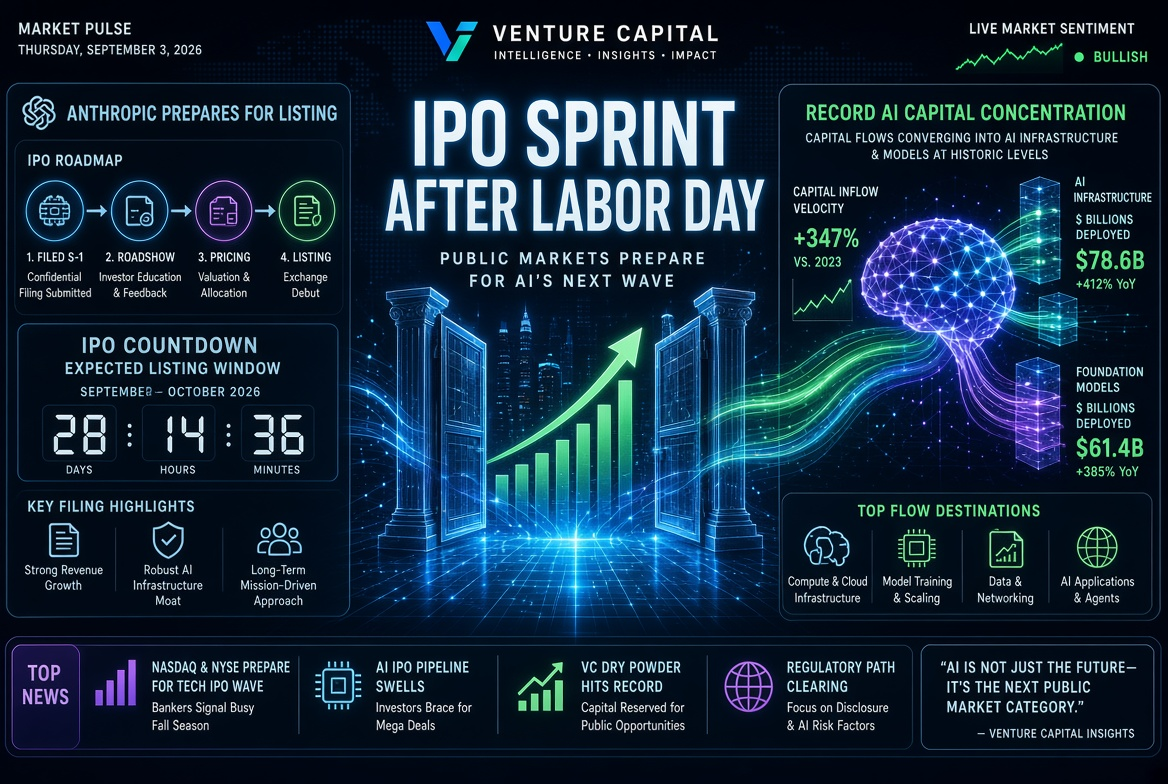
The pipeline remains dense: the aggregated valuation of private companies that have announced listing plans or filed documents is estimated at about $2.1 trillion. In the coming days, investor attention is likely to focus on the IPO of Chinese memory manufacturer CXMT in Shanghai, as well as the preparation for IPOs of major AI laboratories, including Anthropic’s confidential filing and a strengthened board at OpenAI ahead of a potential listing. However, market selectivity is increasing: premiums are awarded to issuers with predictable reporting and protected margins.
Venture Fundraising: The LP Market is Contracting
Fundraising by management firms reflects the same logic of concentration. In the first half of 2026, the venture industry raised approximately $72.4 billion, with nearly 70% of this amount attributed to 16 mega funds. Institutional partners remain cautious: distributions from previous vintages have not fully recovered, and allocations are increasingly directed toward platforms with full-cycle capabilities—from seed to pre-IPO and secondary transactions.
For mid-cap funds, this means three practical consequences: lengthened fundraising timelines, increased importance of cooperation in syndicates, and heightened demand for strategies explained in terms of liquidity rather than just paper IRR.
Geography of Venture Investments: North America Dominates, Europe Grows, MENA Contracts
- North America: $392 billion for the half-year, an approximately 158% year-on-year growth—absolute dominance reinforced by mega rounds from AI laboratories.
- Europe: $42 billion, +50% year-on-year; eight companies closed rounds exceeding $1 billion—a record for the region, while the number of seed deals is declining.
- Middle East and North Africa: $1.35–1.7 billion by different estimates, a decrease of 18–22% with a drop in the number of deals to the lowest level since 2022.
- Asia: India and Southeast Asia maintain activity in AI infrastructure and fintech, with the largest rounds concentrating in data centers and computing.
Russia and CIS: Market Returned to 2023 Levels
Local dynamics are moving against the global trend. In the first half of 2026, venture investments in Russia amounted to approximately 5.2 billion rubles—a decrease of about 39% year-on-year, accompanied by nearly a halving of the number of deals. Moscow accounts for about two-thirds of all investments, while corporate venture capital has contracted significantly. Industry forecasts suggest a market recovery of 10–15% by the end of the year, up to around 17 billion rubles, contingent on easing monetary conditions and sustained activity from development institutions. For international investors, the region remains niche, but with a growing share of transactions in industrial software, cybersecurity, and agrotechnology.
What This Means for Venture Investors and Funds
- Rebuild Exit Model. Exit valuations should be tested against public multipliers after the July reevaluation, rather than the last private round.
- Diversify Beyond AI Core. The concentration of 43% of capital in two companies creates systemic correlation risk for late-stage portfolios.
- Finance Bottlenecks. Inference, data center energy, sensors, data for physical AI, and agent system security are segments with the most stable demand.
- Utilize the Secondary Market. With an open yet selective IPO window, secondary transactions become a fully-fledged liquidity management tool.
- Tighten Valuation Discipline. The premium for the "AI narrative" is decreasing; premiums are now paid for data security, distribution, and switching costs.
Agenda for the Week of July 27 - August 2, 2026
In the upcoming week, the venture community will focus on three lines. The first is the market's reaction to listings in Asia and the US, which will test the resilience of the IPO window post-correction. The second is the reporting from major computing infrastructure providers: this will determine whether private capital will continue to finance the inference economy at the same pace. The third will be the release of quarterly venture data reviews, which will reveal whether early-stage growth is maintained outside of mega rounds.
The baseline scenario for the coming months suggests normalization rather than reversal: record venture investment volumes will persist, but the market structure will continue shifting from narrative to operational economics. For funds willing to address technology stack bottlenecks and manage valuations diligently, this represents more of an opportunity than a threat.