Global Overview of Startups and Venture Capital as of April 10, 2026, with a Focus on AI Infrastructure, Mega-Rounds, and Key Market Trends
As of April 10, 2026, the startup and venture capital market enters a new phase of growth, where artificial intelligence remains the primary capital magnet, but not just at the level of applications and interfaces. Infrastructure companies are taking center stage: developers of chips, networking solutions, computing platforms, next-generation robotics, and payment rails. For venture investors and funds, this marks a significant shift: the premium in the market is increasingly formed around fundamental technological layers capable of becoming standards for entire industries, rather than merely focusing on “stories.”
The market snapshot on Friday reveals several strong trends. Firstly, the largest rounds are concentrated in AI infrastructure and semiconductors. Secondly, funds are returning to active fundraising, creating new pools of capital for deep tech, robotics, and physical AI. Thirdly, regional competition for technological leadership is intensifying: the U.S. retains its lead in mega-rounds, China is accelerating its state-supported venture cycle, and Europe is striving to secure a foothold in chips, robotics, and industrial AI.
Key Takeaway: Capital is Flowing Back into the Fundamental Technological Layer
In previous cycles, the focus often shifted towards consumer applications. However, the venture market is now betting on the foundation. Investors are increasingly financing those who are building computational architecture, network infrastructure, new processor platforms, and automation tools for industrial environments. This signifies that the startup and venture capital market is becoming more capital-intensive, and the average valuation logic for companies is increasingly dependent on the technological moat rather than solely on revenue growth rates.
- AI remains the primary driver of venture investments;
- infrastructure model startups are highly sought after;
- funds are actively seeking assets with a long capitalization horizon;
- competition is intensifying in the sector for quality engineering teams.
SiFive Confirms Demand for AI Chips and Alternative Architectures
One of the key signals of the week was the significant round raised by SiFive. The company secured fresh capital to scale processor solutions for data centers, reinforcing the thesis that next-generation architectures are becoming a full-fledged focus for large venture bets. For the market, this represents not just another large round, but a confirmation that investors are willing to finance the lengthy cycle of creating a technological platform if it can occupy a strategic position in the future AI ecosystem.
It is particularly noteworthy that interest in such companies is rising amidst a restructuring of relationships between chip developers and their clients. Startups offering flexible, customizable, and open architectures are carving opportunities to integrate into corporate supply chains as alternatives to traditional closed ecosystems. For venture investors, this means growing interest in semiconductor startups, EDA tools, edge AI, and related segments, which were considered too heavy for classic VC only recently.
AI Networks and Data-Centric Infrastructure Are Becoming the New Frontier
Simultaneously, the network infrastructure segment for artificial intelligence is gaining momentum. New rounds in companies working on bandwidth, connectivity of compute clusters, and optimization of data transfer show that the next shortage in the AI market may arise not only in GPUs but also in networking, switching, and software orchestration of computations.
This enhances the investment attractiveness of startups addressing practical bottleneck issues:
- accelerating the deployment of AI clusters;
- reducing data transfer costs;
- improving data center efficiency;
- enabling corporate clients to deploy AI products more swiftly.
For funds, this shift is particularly intriguing, as it broadens the deal funnel: now not only model developers appear promising but also suppliers of the "bricks" for the entire AI economy. Against this backdrop, the startup market is expanding, and venture investments are becoming more diversified within the overarching AI trend.
Q1 2026 Shows That the Venture Capital Market Can Absorb Huge Amounts of Capital Again
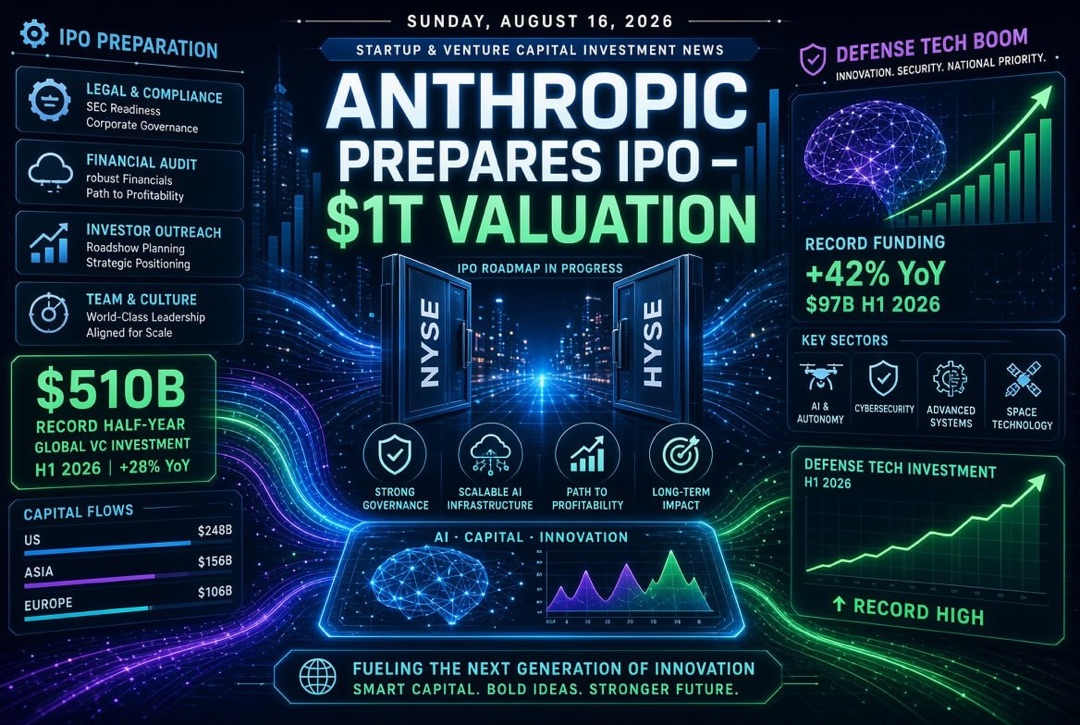
The first quarter of 2026 is already promising to be a turning point for the global venture market. Capital raised has surged sharply, and the largest deals have once again begun to set the tone for the entire sector. Notably, this growth is not due to a uniform recovery across all segments but is specifically concentrated in companies associated with AI, compute, robotics, and frontier technologies. This creates a dual narrative: while the overall market appears stronger, there is an increasing polarization between the leaders and the rest of the ecosystem.
For venture funds, this leads to two practical conclusions. First, investment discipline at early stages becomes even more crucial, as significant funds in later stages do not guarantee automatic success for weak business models. Second, the window of opportunity for quality startups widens if they build products in strategically scarce categories—from AI-chip design to enterprise automation and robotics software.
New Funds Confirm Appetite for Deep Tech, Physical AI, and Applied Automation
Alongside the growth of funding rounds, active fundraising by the investors themselves continues. New funds and mandates are emerging, focusing on physical AI, industrial automation, fintech, and the future of work. This is an important indicator: limited partners are once again willing to allocate capital to managers capable of finding assets not only in consumer tech but also in more complex engineering segments.
It is particularly telling that some of the new funds are being built around a long industrial logic. This means that startups in robotics, semiconductor tooling, industrial software, and climate-adjacent infrastructure are receiving more stable institutional support. For founders, this is a positive signal: the startup and venture capital market is becoming more favorable not just for quick SaaS stories but also for companies with a longer value creation cycle.
Fintech and Tokenization Remain Active Segments, But Capital Prefers Practical Models
Although AI garners significant attention, fintech has not vanished from the agenda. Investors continue to support startups addressing specific infrastructure challenges—from cross-border payments and FX operations to asset tokenization. This is no longer the speculative wave of previous years but a more mature stage where capital seeks businesses with clear monetization, institutional clients, and an infrastructural role within the financial system.
This trend is especially vital for funds focused on macro portfolio sustainability. Fintech startups with strong regulatory logic, B2B revenue, and ties to real cash flow can serve as a balancing factor in a portfolio amid expensive AI assets. In other words, venture investments in 2026 increasingly combine aggressive bets on artificial intelligence with more pragmatic investments in financial infrastructure.
China Accelerates the Venture Cycle and Alters Competitive Balance
China deserves special mention, where the venture market receives new momentum from state participation and a strategic focus on key technologies. Increased funding in AI, robotics, quantum, and related directions demonstrates that the global race for technological leadership is increasingly influencing capital distribution. For international investors, this indicates growing regional asymmetry: while the Western market still sets valuation benchmarks, Asian ecosystems are beginning to scale national technological priorities more rapidly.
This shift will intensify pressure on American and European funds. They will either need to accelerate their deal tempo or specialize more deeply in niches where they still hold a technological advantage. Consequently, the startup and venture capital markets are evolving into not just global entities but geopolitically structured frameworks.
What This Means for Venture Investors and Funds
As of April 10, 2026, the picture is quite clear: the venture market is growing again, but this growth no longer resembles the previous era of universal technological optimism. Money is concentrating in a few strategic themes, and the cost of mistakes for funds is increasing. Victory goes not to those who simply chase the hype but to those who understand where long-term infrastructural rents are forming in the new AI economy.
- high interest remains in AI infrastructure, chips, networks, and robotics;
- deep tech and physical AI are emerging as genuine capital magnets;
- fintech thrives where it addresses practical infrastructure challenges;
- China heightens competitive pressure through a state-supported venture cycle;
- new funds confirm that the market is ready for long-term technological bets.
For global venture investors and funds, the key takeaway is as follows: the next stage of the market will be determined not by the number of AI startups but by the quality of the infrastructure upon which they are built. This is where the main value is emerging, this is where the largest capital is heading, and this is where companies capable of shaping the architecture of the next technological cycle are being formed.