Fresh Startup and Venture Capital News as of April 11, 2026: Analysis of Trends in Infrastructure AI and the Global Capital Market
The global startup and venture capital market enters the second quarter of 2026 with increased momentum. The main theme of the week is not merely interest in artificial intelligence, but a pivot of capital towards infrastructure AI: chips, cloud capacities, alternative architectures, autonomy systems, and projects capable of scaling compute for enterprise clients. For venture funds, this signifies a return to larger bets, while for startups, it means heightened demands for technological depth; for investors, there is a necessity to more accurately differentiate between companies with a long-term moat and those caught in the general AI hype.
Against this backdrop, the venture market appears both strong and increasingly concentrated. Capital is once again flowing towards technology platforms, yet deal structures are evolving: there is less focus on "lightweight" applications and more on segments where control over the computing base, proprietary stacks, scarce competencies, and the chance to enter the strategic market before an IPO are paramount.
The Venture Capital Market Kicks Off 2026 with Historical Acceleration
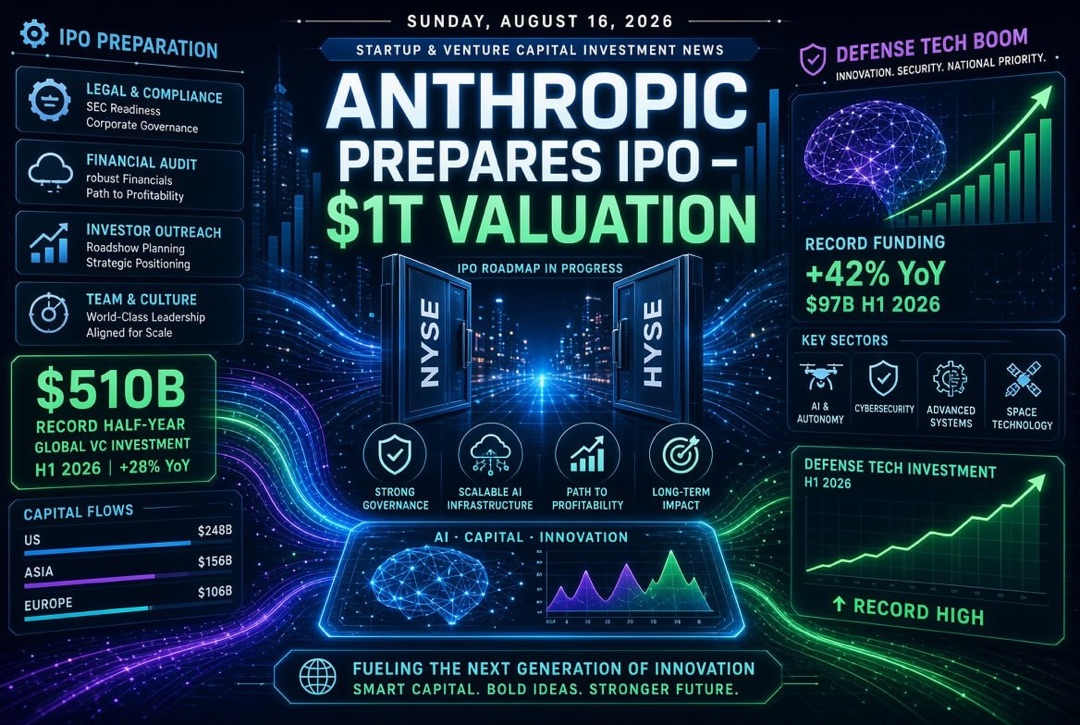
The first quarter of 2026 set a new scale for the market. Venture investors worldwide sharply increased their financing volumes, with a significant portion of capital concentrated in major AI deals. This reinforces two parallel trends:
- The market is once again poised to finance large technology platforms at both early and late stages;
- Competition for quality assets is intensifying, especially in the AI infrastructure, defense tech, robotics, and semiconductor design segments.
This creates a complex environment for venture funds. On one hand, the window for large deals has reopened. On the other, the valuation of many companies increasingly relies not on classical SaaS metrics but on their ability to access chips, energy, data centers, and corporate clients. In other words, the startup and venture capital market in 2026 is increasingly reminiscent of a race for infrastructure advantage rather than an era of cheap growth.
The Main Theme of the Week: Infrastructure AI Displaces Application Noise
In previous cycles, investors often sought quick growth stories within the software layer, but now venture capital is concentrating on the foundational architecture of the future AI market. The focus is on:
- Developers of new processor architectures;
- Cloud platforms for training and inference;
- Projects related to autonomous systems and robotics;
- Companies building their own research-first models.
This is particularly important for the evaluation of startups. In 2026, investors increasingly ask not whether a company has an AI function, but which part of the value chain it controls. This shift heightens interest in hardware, deep tech, and physical AI, and alters due diligence criteria. Simple user base growth is no longer sufficient—the market demands technical protection, access to capital, and the ability to withstand a long investment horizon.
SiFive Confirms the Strength of the Semiconductor Sector
One of the most notable deals in recent days has been the significant funding of SiFive— a company operating on a RISC-V architecture and strengthening its position in the data center segment. This story is important not only for the size of the round but also for how investors continue to seek alternatives to closed ecosystems in semiconductors.
For the startup market, this sends a strong signal in several directions:
- Chip design is re-emerging as a first-tier venture category;
- Open architectures are gaining additional investment legitimacy;
- Intellectual property providers for data centers are perceived as potential candidates for significant exits.
It is particularly significant that capital is flowing into this segment amid rising tensions surrounding supply chains and dependency on a limited circle of technology vendors. Venture investments are increasingly directed not towards "another AI product," but towards nodes without which the AI economy cannot expand.
China Intensifies its Bet on AI Startups and State-Supported Capital
The Asian market is also adding significant dynamics. China continues to accelerate capital mobilization in technology and AI sectors, with state entities increasingly influencing the venture landscape. Simultaneously, major private and quasi-government players are supporting local champions capable of competing in generative AI and applied models.
The recent round for ShengShu Technology indicates that the Chinese startup market is not falling behind in the global AI race. On the contrary, it aims to build its own vertical—from financing funds to directly supporting companies working on the next phase of intelligent systems. For global funds, this means that competition for technological leadership is no longer confined to the US, and future unicorns are increasingly likely to arise within parallel capital ecosystems.
Europe is also Raising Ambitions: A Focus on Research-First AI
The European venture market has long been considered more cautious, but in 2026 it is showing readiness to support truly large-scale projects. The growth of major seed and growth rounds in AI suggests that Europe no longer wants to remain solely a market for applied B2B products.
A key takeaway for venture investors here is that European startups are increasingly entering segments that were previously thought to be almost entirely dominated by American companies. This applies not only to next-generation models but also to AI chips, manufacturing automation, cybersecurity, and industrial software. In such an environment, venture investments in Europe can represent not geographical diversification but a means of accessing less overheated valuations while maintaining comparable technological quality.
Cloud, Compute, and Strategic Partnerships Become the New Currency of the Market
The enhancement of alliances between AI companies and cloud infrastructure providers deserves special attention. When major players sign long-term agreements for computing capacities, this impacts not only their operational capabilities but also the overall market perception. Today, access to compute is becoming as crucial an asset as revenue or a patent portfolio.
For startups, this creates a new reality:
- The cost of scaling increasingly depends on infrastructure contracts;
- The quality of an investor is determined not just by capital but also by their ability to open doors to cloud and chip partners;
- Partnerships are increasingly beginning to play the role of a hidden moat.
This is why the startup and venture capital market is more frequently evaluating companies through the lens of their position in the AI supply chain. If a startup can secure sustainable access to compute, it enhances their strategic attractiveness even before reaching stable monetization.
Funds are Also Changing Their Agenda: Capital Flows into Physical AI, Defense Tech, and Industrial Platforms
The launch of new large funds focused on physical AI demonstrates that investors no longer view artificial intelligence merely as a software narrative. The next cycle of venture capital will hinge on the intersection of AI with industry, transportation, logistics, energy, defense, and robotics.
Practically, this means three important changes for the market:
- Fund managers are willing to wait longer for liquidity if an asset controls critical technology;
- Startups with a hardware or industrial aspect stand a better chance of larger rounds;
- The boundary between venture, growth, and strategic capital is becoming less rigid.
For funds, this is a positive signal: the market is again ready to finance complex categories. For founders, it serves as a reminder that a superficial AI story is no longer sufficient. Winning teams will be those that can effectively integrate research, product, manufacturing, and commercialization.
Corporate Deals Confirm: Attention Among Investors is Contested Not Only in Rounds but also in Channels of Influence
Recent strategic acquisitions in the technology sector show that the competition is no longer solely over models, teams, and computing but also over channels of attention distribution. Major companies seek to control not just product infrastructure but also the ecosystems surrounding them—media, communities, corporate ties, and industry agendas.
This matters for the evaluation of venture assets, as in 2026 the valuation of a startup is increasingly determined not by a single growth metric but by a sum of factors:
- Technological stack;
- Access to compute;
- Investor syndicate;
- Speed to enterprise clients;
- Influence on the industry ecosystem.
This is precisely why venture investments are becoming increasingly less "universal." The market is again favoring complex yet strategically significant companies over simply rapidly growing interfaces.
What This Means for Venture Investors and Funds
In the coming months, the startup and venture capital market will likely maintain high activity, yet selectivity within it will intensify. The strongest positions will be retained by those categories where there is a real technology shortage and a capital-intensive barrier to entry.
Investors should pay particular attention to the following segments:
- AI infrastructure and cloud capacity;
- Semiconductor design and the RISC-V ecosystem;
- Robotics, autonomy, and physical AI;
- Defense tech and dual-use software;
- European and Asian deep tech projects with a global market.
The key takeaway for Saturday, April 11, 2026, is: the venture market has re-entered a phase of large bets, but these bets are becoming increasingly disciplined. Money is returning to technologies capable of becoming the infrastructure of the next decade. For startups, this is an opportunity window; for funds, a moment of rigorous selection; and for the global market, a sign that a new cycle of venture capital is forming around compute, chips, autonomy, and strategic AI.