At the same time, the market is preparing for an event that could redefine the entire industry: Anthropic is moving towards an initial public offering with a target valuation exceeding $1 trillion. In this context, venture capital funds are increasingly channeling investments into "hard" technologies — energy solutions for data centers, defense developments, and financial infrastructure. Below are the key events and trends in the venture market for Sunday, August 16, 2026.
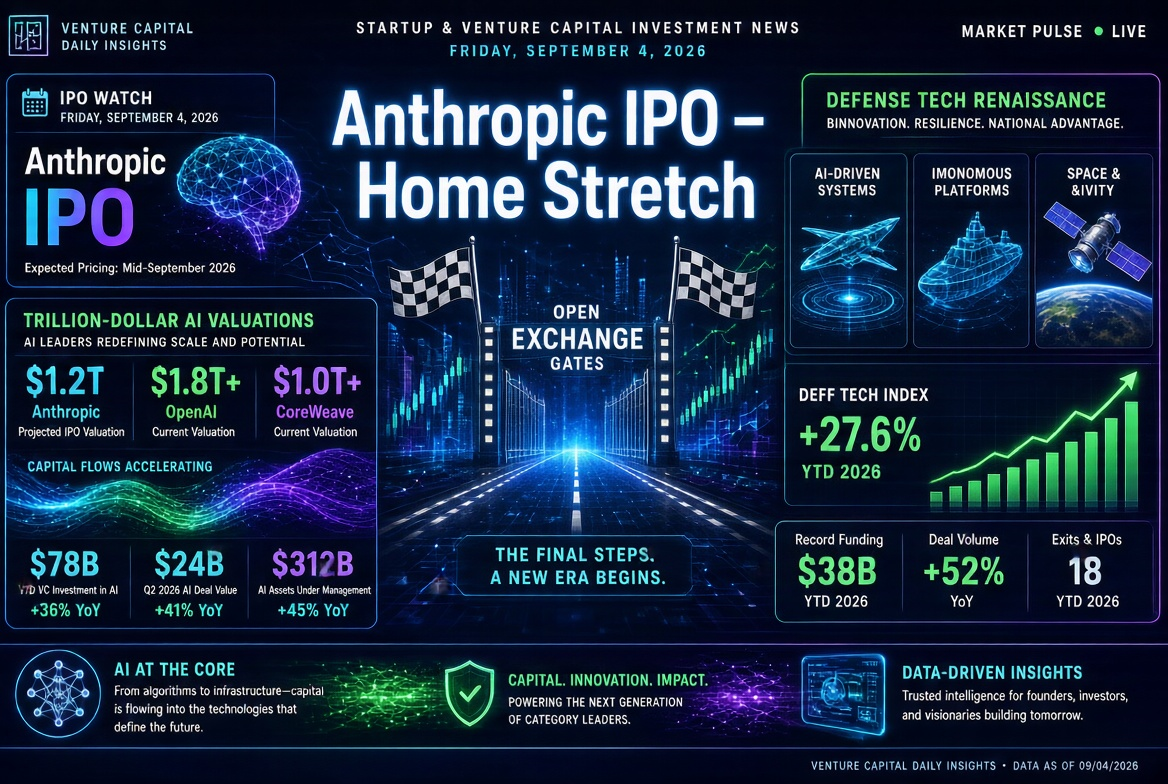
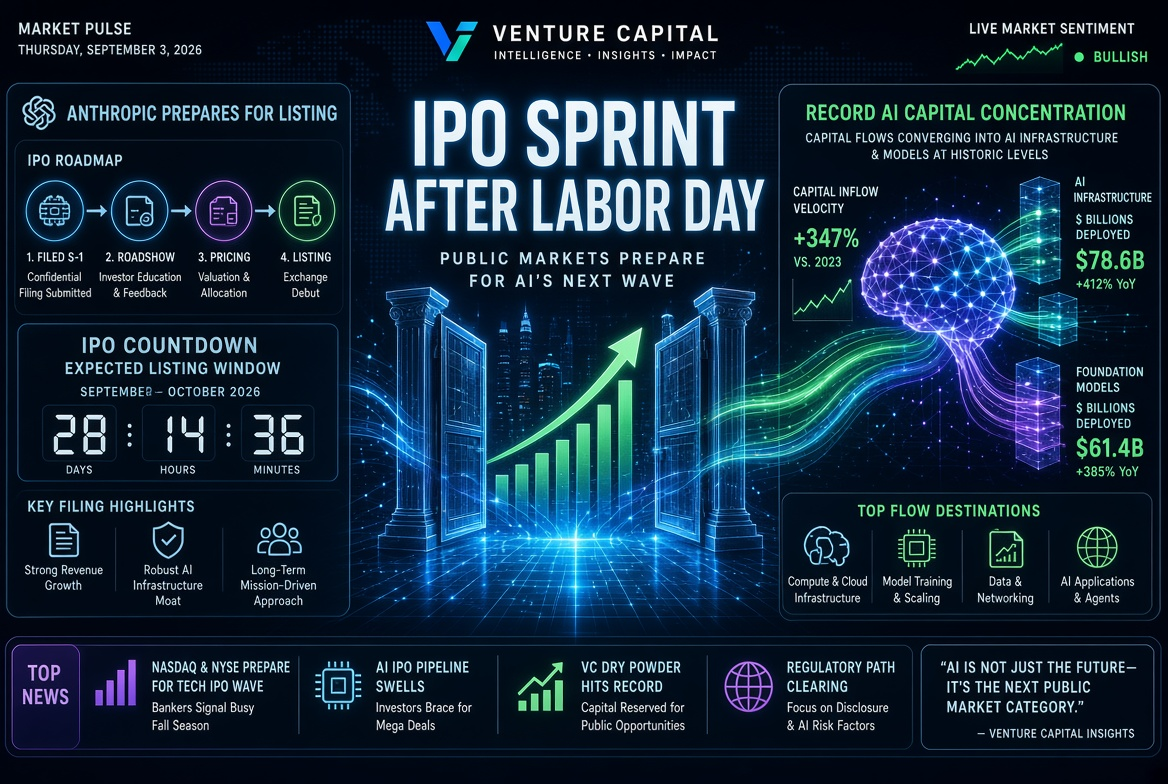
- Anthropic IPO reaches the finish line. Following a confidential S-1 filing, underwriting banks are conducting meetings with institutional investors; a listing on Nasdaq is expected this fall.
- Record capital concentration. The semiannual venture investment volume of $510 billion is accompanied by unprecedented deal concentration around AI sector leaders.
- Energy as the new AI trade. Billion-dollar rounds for Form Energy, Base Power, and Valar Atomics demonstrate that investors are financing the energy foundation for computational infrastructure.
- Boom in defense technologies. European startup Helsing has raised $1.8 billion, while drone and air taxi manufacturers are securing significant rounds amid a surge in defense budget reallocations.
- Restructuring fintech infrastructure. Banking and payment projects for the tech sector are regaining investor interest following the exit of niche players.
- Shift in geographic capital flow. Gulf and Indian funds are increasing their activity, while American investors continue to scale back their presence in China.
Anthropic IPO: a race for the first trillion on the public market
The central theme of the week for venture investors is Anthropic’s preparations for its initial public offering. The company submitted a confidential S-1 filing to the SEC on June 1 and subsequently closed a Series H round at $65 billion, with a valuation of $965 billion, featuring participation from Sequoia Capital, Coatue, Fidelity, Blackstone, and strategic semiconductor partners — Samsung, SK Hynix, and Micron. Currently, Goldman Sachs, Morgan Stanley, and JPMorgan are conducting preliminary meetings with institutional investors: the public prospectus is expected in August-September, and pricing is anticipated in October-November on Nasdaq.
The secondary market is already pricing in a premium: the implied valuation of Anthropic on over-the-counter trading platforms exceeds $1.2 trillion with an annual revenue (ARR) of around $70 billion. This IPO is doubly significant for the venture ecosystem: a successful debut would open an "exit window" for the entire cohort of AI companies, while a weak performance could dampen the overvalued segment. OpenAI, which filed its own S-1 a week later, is estimated to have shifted its listing to 2027, conceding first-mover advantage to its competitor.
Record $510 billion: capital is present, but it is concentrating
Global venture investments reached a historic high of around $510 billion in the first half of 2026. However, the market structure is concerning fund managers: a significant portion of capital is concentrated in a few mega-deals involving AI leaders. For companies outside the "magic circle," conditions are tougher — investors require technological barriers, proven unit economics, and a clear path to revenue. The gap between a "funded company" and "merely an interesting idea" continues to widen: universal AI products are quickly replicated, so money flows to projects with proprietary data, infrastructure, and unique distribution channels.
Energy and AI infrastructure: billions in "shovels and picks"
The largest rounds of the week confirm that energy has become a direct extension of AI investments amid record energy consumption in data centers.
- Form Energy raised $750 million in a Series G round led by T. Rowe Price, with participation from Sequoia Capital and Breakthrough Energy — the company is developing long-duration energy storage systems.
- Base Power from Austin closed a $1 billion Series D round at a $13 billion valuation — a bet on home energy storage amid overloaded electrical grids in the U.S.
- Valar Atomics raised $1 billion led by Sequoia Capital plus a $200 million credit line from a syndicate led by JPMorgan — nuclear energy is making a comeback on the venture agenda.
Of particular note is the Swedish startup Lovable: the "vibe-coding" platform confirmed a Series C round of $400 million at a valuation of $13.3 billion, solidifying its status as one of the fastest-growing European unicorns.
Defense technologies: the new mainstream of venture capital
The defense tech segment has officially transitioned from niche status to mainstream. European defense AI developer Helsing raised $1.8 billion with participation from JPMorgan Chase, Lightspeed, and Iconiq — the largest round in the history of the European defense industry. Drone manufacturer Neros and electric air taxi developer Vertical Aerospace also closed significant deals. For funds, this represents a structural shift: the growth of NATO defense budgets and demand for autonomous systems create a multi-year order cycle that venture investors are eager to monetize at early stages.
Fintech infrastructure: the market is building the "banking layer"
Following the collapse of niche banks, investors are funding a new generation of financial infrastructure for startups. The Ohio-based banking project Erebor, focused on servicing tech companies, is negotiating to raise approximately $1.5 billion with participation from Lux Capital, Andreessen Horowitz, and Valor Equity Partners. The restaurant financing platform inKind closed a credit line of $414 million from Citi and Cross River Bank. The essence of this trend is clear: banks that understand the cash cycles and risks of startups are becoming a strategic asset for the entire ecosystem.
Geographic capital flow: the Gulf and India against the contraction in China
The map of global venture flows continues to reshape. The MGX sovereign fund from Abu Dhabi has closed its first fund with a volume of $49 billion — above the targeted $45 billion — and is building the largest AI campus in Europe near Paris with a capacity of 3 GW. In India, Mirae Asset conducted the first close of a venture fund at 11.25 billion rupees, while Chennai-based Bluehill.VC fully raised its debut fund at 4 billion rupees with a focus on frontier tech. Conversely, in China, American SIG is winding down its venture team in Asia after over 20 years, continuing the trend of Sequoia and GGV to exit the region.
Russia and the CIS: the market is contracting but changing its structure
The Russian venture market is moving against the global trend. In the first half of 2026, the investment volume declined by approximately 39-48% year-on-year — to 4.6-5.2 billion rubles, while the number of deals fell almost by half, reaching levels seen during the crisis of 2023. The primary reason is the high key interest rate, which causes deposits to compete with long-term risky investments. Nevertheless, the median check has increased by 23% to 25 million rubles: investors are less frequent but investing more. An unexpected sector leader is industrial technologies, which showed growth of 58%, surpassing business software. Moscow concentrates up to 80% of all investments, highlighting the need for regional startup ecosystem development programs.
Investor outlook: discipline in an era of records
The venture market is entering autumn 2026 in a state of paradoxical equilibrium: record liquidity is paired with maximum selectivity. Key benchmarks for funds in the coming weeks include:
- the publication of the public S-1 for Anthropic and parameters for the book building — the main indicator of public market appetite for frontier AI;
- the dynamics of funding rounds in energy and defense technologies as a test of the durability of capital rotation from "pure" AI to infrastructure;
- the behavior of late-stage investors following the SpaceX correction — a test for the overvaluation of the pre-IPO segment.
The baseline scenario suggests continued growth accompanied by heightened concentration: capital will favor companies with technological barriers, real revenue, and a clear exit trajectory. For venture funds, this is a time for discipline: market records do not exempt the need for stringent deal selection.