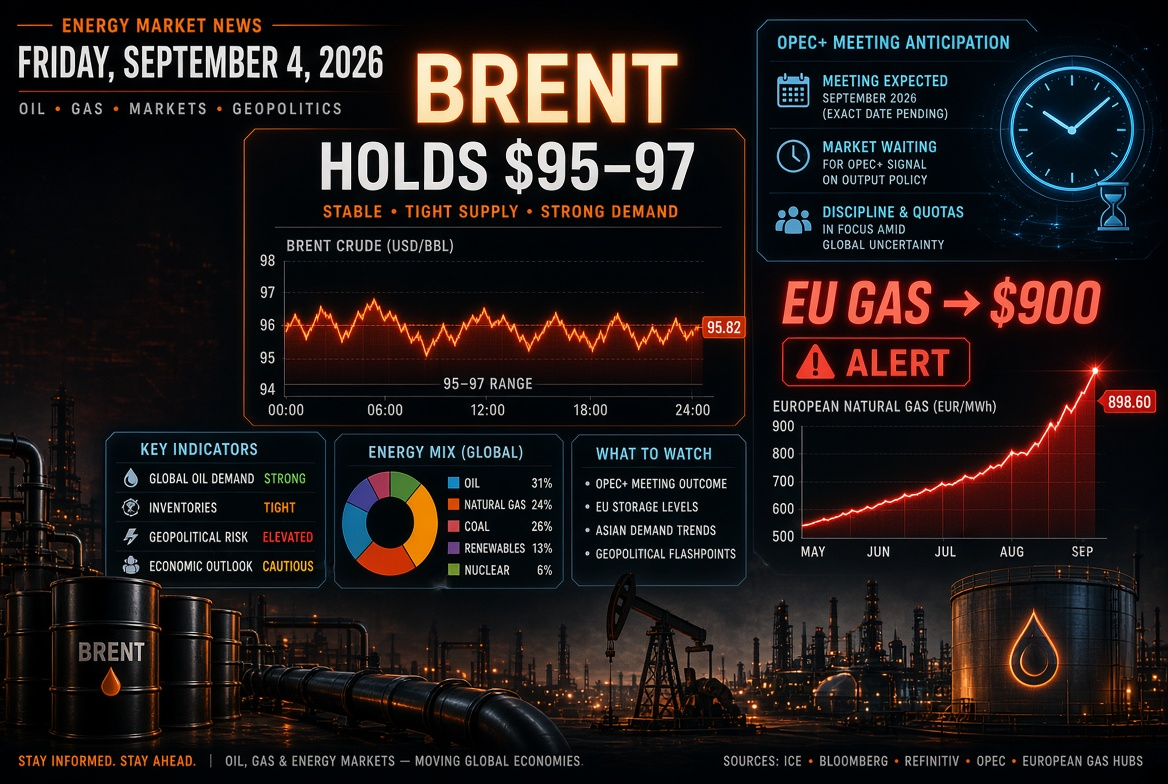
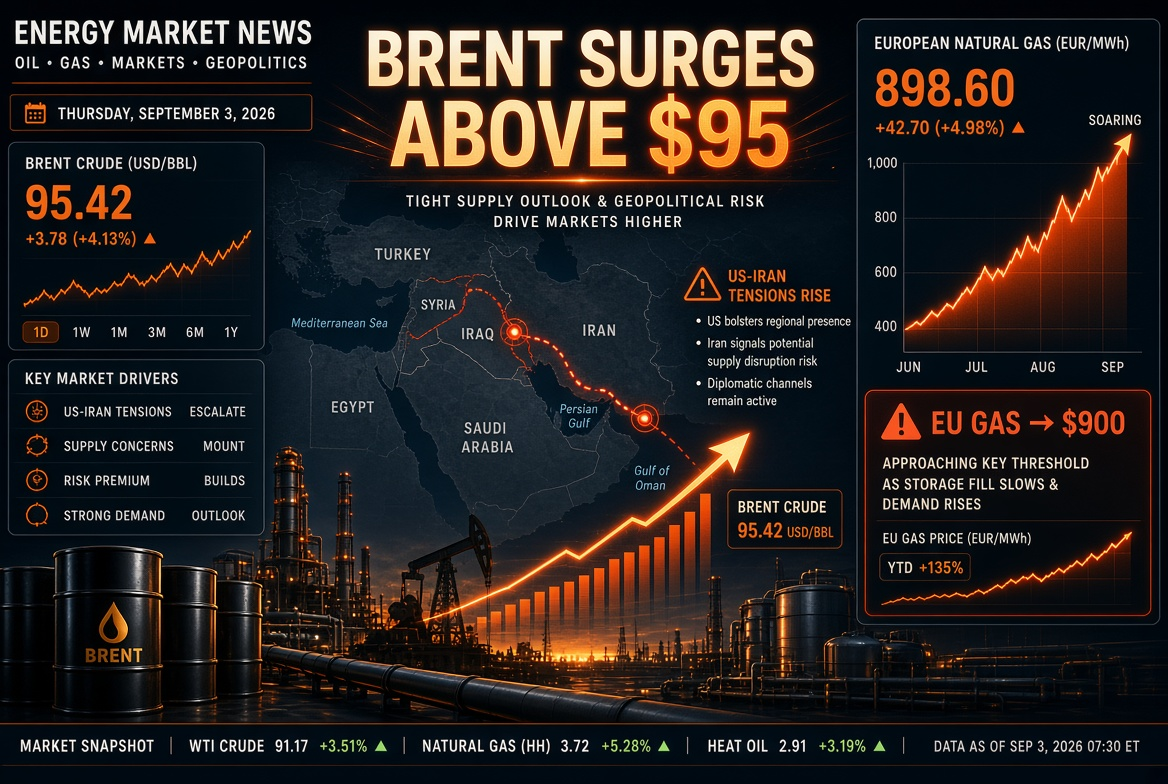
Oil Market: Brent at $87 — Market Awaits Deal on Hormuz
Oil prices are closing the week mixed. Brent is trading around $87 per barrel after a 2.2% drop on Thursday, while WTI hovers around $81. Since the onset of the US-Israel conflict with Iran in late February, the international benchmark has risen by approximately a quarter, with year-on-year growth exceeding 30%. Key factors influencing price dynamics include:
- Status of the Strait of Hormuz: This critical maritime corridor, through which about one-fifth of global oil supplies passed before the war, remains formally blocked. Iran and Oman are negotiating shipping routes, but no agreement has been reached yet: Tehran demands the lifting of the US naval blockade as a precondition for fully reopening the strait.
- Actual Flows: Despite the deadlock in negotiations, oil continues to flow out of the Persian Gulf — US estimates suggest that up to 9 million barrels per day transit through the strait, with some tankers operating with their transponders turned off, while US Navy escort capabilities are expanding. Attacks on tankers and energy infrastructure maintain a risk premium.
- Supply Deficit: The IEA estimates the oil shortage in the global market in the current quarter at 1.8 million barrels per day — twice the previous forecast; in July, supply remained 6.3 million bpd below last year’s level.
The US Energy Information Administration (EIA) does not expect Middle Eastern production to return to pre-war levels before early 2027 and forecasts an average Brent price of $87 per barrel in 2026.
Demand Under Pressure: IEA and OPEC Lower Forecasts
The flip side of the price shock is demand destruction. This week, the IEA lowered its global oil consumption forecast, warning that the prolonged conflict and high prices are increasingly pressuring economic activity. OPEC, for its part, has reduced its estimate of global demand growth in 2026 to 580,000 barrels per day — marking the fourth consecutive downward revision. A further bearish signal emerged from the US: commercial oil stocks rose by 17.4 million barrels over the week — a record weekly increase — amid significant drawdowns from the strategic reserve and a sharp rise in imports. Several analysts believe that the peak of the market deficit was reached in May-June, but the future price trajectory depends entirely on the course of the conflict and the status of the Strait of Hormuz.
Gas Market: Europe Enters Winter with Record Low Stocks
The European gas market remains the most vulnerable link in the global energy chain. TTF hub prices fluctuated between €56 and €62 per MWh over the week, surging more than 10% at the beginning of the week due to supply risk news. Key issues include:
- Low Stocks: EU underground storage facilities are only about 55–58% full — the lowest level for mid-August since monitoring began in 2009, and approximately 22 percentage points below the five-year average. Brussels has already reduced the mandatory filling target from 90% to 80% by November 1, but even this is at risk.
- LNG Shortage: Shipments of Qatari liquefied gas through the Strait of Hormuz are delayed significantly, while competition with Asia for available cargoes intensifies due to the hot summer.
- The Norwegian Factor: Extended maintenance at the Ormen Lange field until February 2027 could remove over 1 billion cubic meters of gas from the market during the heating season.
Banks and energy companies are raising price benchmarks: Commerzbank has increased its end-year forecast to €50 per MWh, while Uniper expects a range of €50–€60 as long as the strait remains closed. The heat in Europe further elevates demand for electricity for air conditioning, increasing pressure on the gas balance.
Power Generation and Renewables: Solar and Wind Set Records
Amid the hydrocarbon storm, renewable energy is experiencing a structural breakthrough. According to the Ember think tank, by 2026, the combined output of solar and wind plants in Europe could exceed gas generation for the longest period in history — monthly renewable output reached 80–110 TWh. The global picture is equally impressive: in 2025, the world added a record 800 GW of renewable capacity (+16% year-on-year), with over 600 GW coming from solar energy; China accounted for about 60% of the global growth. For the first time in history, solar has become the largest source of coverage for the growth of global energy consumption. In the US, wind and solar contributed a record 17% to electricity generation, while in 2026, virtually all net growth in generating capacity will come from renewables and storage. High prices for gas and oil are only accelerating investments in clean generation, storage systems, and grids.
Coal: Beneficiary of the Energy Crisis
The coal market is strengthening on the back of inter-fuel switching effects. Newcastle thermal coal futures have stabilized around $130 per ton — approximately 17% higher than last year’s level: expensive oil and gas enhance the attractiveness of coal generation in importing countries across Europe and Asia. China has published a five-year plan for the coal sector, focusing on consolidating and digitalizing mines while creating a reserve capacity of over 100 million tons annually. India is ramping up its own production — in July, output rose by 7.5% year-on-year, reducing dependence on imports. In the short term, coal remains a safety net for Asian energy systems against gas shortages and expensive oil.
Russia: Export Ban on Fuel Extended Until End of January 2027
The Russian oil products market continues to operate under manual control. The government has extended the complete ban on automotive gasoline exports — now until January 31, 2027, broadening restrictions to include both producers and traders; the regime for exporting diesel fuel, marine fuel, and gas oils has been tightened. Reasons and accompanying measures:
- The intensification of drone attacks on oil refineries at the beginning of August led to the shutdown of several plants and a reduction in gasoline sales on the exchanges;
- Exchange prices have stabilized at high levels: the AI-92 index is around 71,400 rubles per ton, and AI-95 is about 76,000 rubles per ton;
- Authorities have allowed the release of “Euro-3” class fuel and simplified the import of oil products from friendly countries;
- A mechanism for direct contracts between refineries and suppliers to bypass the exchange is being developed to reduce speculative pressure.
Experts expect a gradual normalization of supply by the end of August and do not rule out a significant drop in wholesale prices no earlier than the fourth quarter — provided there are no new unexpected shutdowns of refineries.
What This Means for Investors and Energy Market Participants
The market has entered a phase of fragile equilibrium: the geopolitical premium in oil faces increasing signs of demand destruction, while the European gas market is embedding the risk of a deficient winter into prices. For investors, key benchmarks for the coming weeks include:
- Negotiations on the Strait of Hormuz — any progress could plunge oil and gas prices by 10-15%, while a breakdown in dialogue could push Brent back to $90 and above.
- Gas Injection Rates in European UGS — falling behind schedule by the end of September could trigger early pricing for winter deficits on TTF.
- Data on Stocks and Demand in the US and China — confirmation of weakening consumption would reinforce the correction scenario in oil.
- Situation with Russian Refineries — the recovery of refining capacity depends on the balance of the domestic fuel market and the timing of easing export restrictions.
Daily Summary: Key Energy Sector Figures as of August 15, 2026
- Brent — around $87 per barrel; WTI — around $81;
- Global oil market deficit — 1.8 million bpd in the current quarter (IEA estimate);
- Forecast for oil demand growth in 2026 — 580,000 bpd (OPEC, fourth consecutive downward revision);
- Gas TTF — €56–€62 per MWh; EU UGS filling level — about 55–58%;
- Newcastle coal — around $130 per ton (+17% year-on-year);
- Gasoline export ban from Russia — extended until January 31, 2027.
Saturday in the energy markets will be marked by anticipation: the fate of the Strait of Hormuz remains the key pricing factor for oil, gas, coal, and electricity worldwide. Investors and energy companies should prepare for increased volatility — autumn 2026 promises to be a test of strength for the entire global energy system.