Startup and Venture Capital News — Wednesday, August 26, 2026: Anthropic Goes Public, Nvidia Acquires the Entire AI Stack, and Physical AI Becomes the New Mega Trend
Current startup and venture capital news for August 26, 2026: Anthropic prepares for a record IPO, Nvidia's strategic expansion, mega rounds in defense technology and robotics, as well as key trends in the venture market for funds and institutional investors.
The venture market is approaching the end of August 2026 in a state that is hard to encapsulate in a single word. On one hand, there are historic records: global venture capital investment in the first half of the year reached $510 billion, surpassing the entire 2025 figure ($440 billion) and exceeding the previous high of $375 billion set in the latter half of 2021. On the other hand, there is unprecedented capital concentration: OpenAI and Anthropic accounted for $217 billion, or 43% of all venture capital invested in startups worldwide.
For venture investors and funds, this means that traditional benchmarks no longer apply. The average round size has been distorted by deals in which most LPs will never receive allocations, while “normalcy” in the market must now be measured outside the top ten mega rounds. Below are the key events and trends shaping the venture market agenda for Wednesday, August 26, 2026.
Top Story of the Day: Anthropic on the Brink of the Largest IPO in Tech History
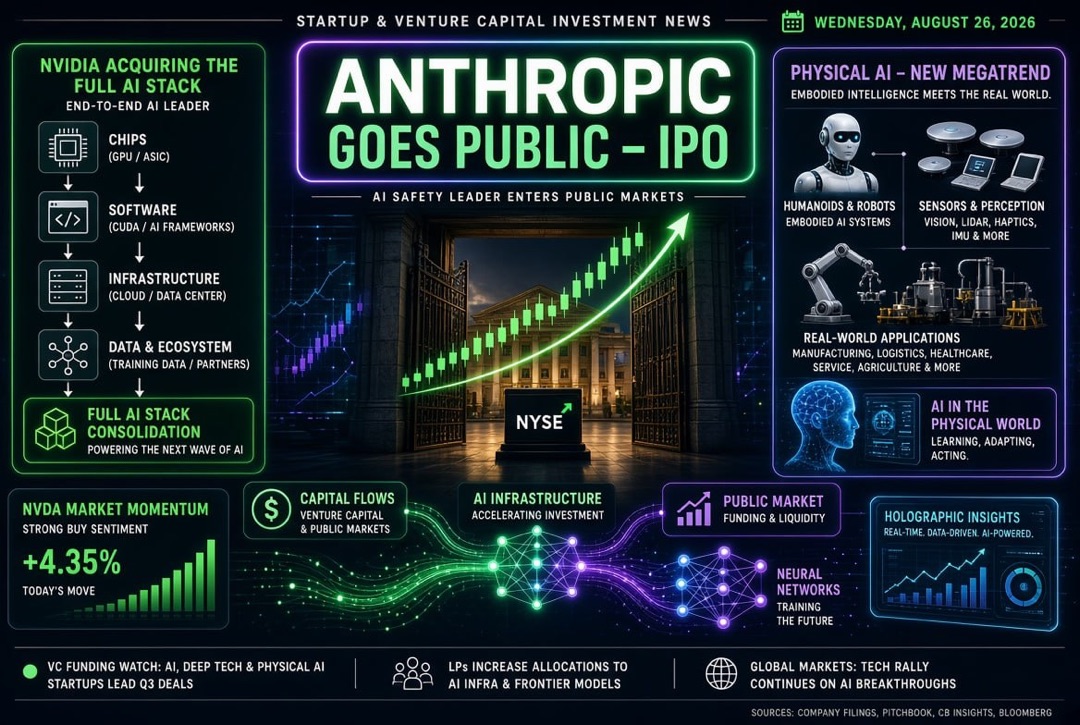
The central event of the week is Anthropic's preparation to publicly disclose its IPO paperwork. The company, which confidentially submitted its registration statement to the SEC back in June, is set to publish its prospectus by the end of August. The expected range for the offering volume is at or above the record IPO of SpaceX, which raised around $75 billion in June ($85.7 billion including underwriter options) at a valuation of $1.77 trillion.
What’s important for venture investors in this deal:
- Valuation. The latest private round — Series H at $65 billion — established a post-money valuation of approximately $965 billion. Market expectations for the IPO range from $1 trillion to $2 trillion.
- First disclosure of frontier lab economics. The prospectus will provide the market with insights into revenue structure, growth rates, business segmentation, and crucially, the actual cost of inference.
- Risk factors. According to sources, key risks will include rising public dissatisfaction with AI and data center construction, as well as concerns regarding AI's impact on employment.
- Governance structure. The status of a public benefit corporation and the Long-Term Benefit Trust, which grants the right to appoint an increasing share of the board of directors, will be topics of discussion among institutional buyers.
- Profitability. The gross margin forecast has been revised down from approximately 50% to 40% amid higher-than-expected computing costs.
Additional context is provided by Nvidia's quarterly results, which are set to be released on August 26. This serves as a key macro indicator for the resilience of the entire AI startup ecosystem.
Nvidia Builds a Vertical: From Chips to Models, Applications, and Talent
Nvidia has recently demonstrated how the largest beneficiary of the AI boom is converting cash flow into control over the entire stack. The company is discussing an investment in Perplexity as part of a round that could value the AI search startup at over $30 billion — compared to approximately $20 billion a year earlier. Perplexity's annual revenue reportedly grew from less than $250 million at the beginning of 2026 to over $750 million.
At the same time, Nvidia has entered into a $6 billion agreement with Poolside, including about $1 billion in direct investments, access to the startup's technology, and the transfer of over 100 engineers to the Nemotron project. The goal is to create a competitive American alternative to Chinese models with open weights.
For venture funds, this presents a new structural risk: strategic investors with such a scale of balance sheets are simultaneously acting as suppliers, shareholders, and potential competitors to portfolio companies. Classic licensing-investment-hiring structures are increasingly being replaced by full acquisitions, directly impacting exit scenarios.
Physical AI and Robotics: A New Category of Mega Rounds
The robotics division of Chinese automaker XPeng raised over $900 million in its first external round at a valuation of over $6.3 billion. The round was led by IDG Capital and Gaorong Ventures, with strategic investors including Tencent and Alibaba. The funds will be used for the development of humanoid robots, mass production, and models of physical AI.
A notable context: at the World Humanoid Robot Games in Beijing, two Chinese machines completed the 100-meter dash faster than Usain Bolt's record — 9.39 and 9.47 seconds compared to 9.58 seconds. A year earlier, the same platform recorded a time of 21.5 seconds.
Takeaways for investment committees:
- Physical AI has transitioned from a demonstration category to capital-intensive industrial bets.
- Automakers gain structural advantages over pure robotics startups through the reuse of chips, perceptual systems, and manufacturing capabilities.
- Chinese tech giants aggressively occupy positions in embodied AI as the next computing platform.
Biggest Rounds of the Week: Defense, Inference, and Infrastructure
The list of the largest American deals for the week confirms the capital shift into “hard” sectors:
- Castelion — $800 million (plus $250 million in debt financing), defense technology, hypersonic strike missile. The round was led by JPMorgan Chase, Andreessen Horowitz, and Carlyle, with a valuation of $13 billion.
- Etched — $700 million, semiconductors for accelerating inference, valuation of $21 billion, lead investor Jane Street.
- Higgsfield — $400 million, AI video generation platform, valuation of $5.4 billion, led by DST Global.
- Groq — $350 million, data centers, valuation of $3.5 billion, with Nvidia participating.
- Wispr Flow — $280 million, voice AI interfaces, valuation of $2 billion, led by Menlo Ventures.
- Muon Space — $250 million, satellite constellations, led by Eclipse.
The final rankings include Also ($150 million, micromobility), Velaura AI ($110 million, ultra-low power computing), Rillet ($100 million, agentic finance, valuation of $1 billion), and Happy Health ($75 million, apnea diagnostics).
Europe: Steady Deal Flow Amid Lack of Mega Rounds
This week, Europe recorded over 45 deals with a total volume exceeding €684 million. The leading sectors are fintech (€239.2 million), robotics (€178 million), and artificial intelligence (€99 million). By country, Switzerland led with €172.5 million, followed by France (€150 million) and the United Kingdom (€122.9 million).
The largest deals include a $200 million investment by SoftBank in Swiss Gravis Robotics, a €150 million raise by French Ingenico, a $100 million round for Rillet at a valuation of $1 billion, and a $100 million seed round for British Callosum — a rare example of nine-figure seed financing.
Context for the first half of the year: European tech companies raised €44.1 billion in 1,740 deals, with the UK accounting for €18.7 billion and AI startups receiving €5.92 billion. A total of 252 exits were recorded.
M&A Market and Liquidity: Power Infrastructure as a New Asset
The exit channel remains open, but is increasingly shifting toward infrastructure assets. nVent acquired Maverick Power for $1.75 billion, with a potential earnout of up to $550 million upon meeting targets in 2027–2028. Infineon acquired Indian C2i Semiconductors, specializing in power management for AI data centers.
A separate story is Hugging Face, which is exploring a sale possibility at a valuation of $13 billion and above, having hired a bank to gauge buyer interest. The company's last significant valuation in 2023 was approximately $4.5 billion.
In the second quarter of 2026, the exit market set records: 32 companies went public with valuations above $1 billion and 24 were acquired for prices starting at $1 billion, totaling $113 billion. For LPs, this means distributions have finally returned, fueling a new fundraising cycle for venture funds.
Market Structure: Record Without Breadth
The key analytical takeaway for investors: record absolute figures mask market bifurcation. Excluding the four largest deals — OpenAI, Anthropic, xAI, and Waymo — activity in the rest of the market is close to levels seen in 2024–2025.
Additional structural observations:
- Over 70% of Q2 capital was allocated to AI companies, compared to less than 50% a year earlier.
- 16 companies raised rounds exceeding $1 billion for a total of $108.6 billion — 53% of the quarterly volume.
- Late-stage financing grew by 141% year-over-year: capital is concentrating in proven winners.
- In the first half of the year, 195 companies joined the unicorn list — the highest since the second half of 2022.
- The share of the U.S. in global volume fell from 83% in Q1 to 67% in Q2.
Local Context: Russia and Markets with Limited Access to Capital
Amid the global boom, the Russian venture market is moving in the opposite direction. According to industry estimates, the market volume in the first half of 2026 shrank by almost 48% year-on-year to 4.6 billion rubles. The share of foreign investment has effectively reached zero, with Moscow accounting for about 64% of the volume and 63% of the deals.
The market structure has also changed: seed rounds constitute 62% of deals but only 8% of the volume, while late-stage rounds account for 8% of deals and 43% of all invested funds. Private investors showed the largest decline — down 59% in the number of deals. For global funds, this illustrates how quickly local ecosystems lose touch with the international capital flow amid a lack of exit channels.
What This Means for Venture Funds and Investors
The agenda for August 26, 2026, forms several practical takeaways for capital managers:
- The IPO of Anthropic will serve as the main valuation test in the AI sector. Public reaction to the prospectus will set a reference point for the entire private AI universe — from frontier labs to applied startups.
- The infrastructure layer continues to absorb capital. Energy, power distribution, cooling, inference chips — segments with the most predictable unit economics in the current cycle.
- Strategic investors are changing the rules of the game. The presence of Nvidia, Alibaba, Tencent, and hyperscalers on cap tables requires a re-evaluation of approaches to protecting minority positions.
- Defense technologies and physical AI are resilient categories for mega rounds. Geopolitics has turned them from niche topics into mainstream elements of the venture portfolio.
- The exit window is open, but selectively. Record IPOs and M&A are concentrated in the upper segment; median portfolio companies still require proven revenue.
The market has entered a phase where record levels of venture investment coexist with strict selectivity. Capital is available — but predominantly for those who control the technically, legally, or physically complex layers of the AI economy.