Current Startup and Venture Capital News for Tuesday, June 9, 2026: Major AI Rounds, Industrial AI, AI Infrastructure, Cybersecurity, Fintech, Climate Tech, and Biotech for Venture Investors and Funds
The global startup and venture capital market on Tuesday, June 9, 2026, is sending a clear signal to venture investors and funds: capital is increasingly shifting from abstract generative AI to applied technologies with measurable economic impact. Spotlighted areas include industrial AI, cost optimization in cloud computing, next-generation cybersecurity, energy software, biotechnology, and digital financial infrastructure.
This marks a significant shift for the venture market. While investors in 2023-2025 often assessed AI startups based on audience growth potential and the speed of model adoption, the key criterion has changed in 2026: funds are now seeking startups that reduce costs, accelerate engineering cycles, protect corporate infrastructure, or grant access to new financial markets. Today's startup news demonstrates that venture capital remains available but has become significantly more selective.
Industrial AI Takes Center Stage
The highlight of the day has been PhysicsX's Series C round, anLondon-based startup specializing in physical AI for industrial design. The company raised $300 million in a round led by Temasek, with participation from M&G Investments, Intrepid Growth Partners, Applied Materials, Atomico, General Catalyst, NVIDIA, Siemens, and other investors.
For the venture capital market, this is not just a major deal; it signifies a shift in investment logic. PhysicsX does not focus on mass consumer AI but tackles engineering challenges in sectors such as aerospace, defense, energy, automotive, semiconductors, and materials. Its platform accelerates physical modeling: instead of hours or days, engineering teams can obtain calculations in seconds and explore significantly more design options.
This segment is particularly interesting to funds for three reasons:
- the technology has clear corporate demand;
- the economic effect can be measured through development speed and cost reduction;
- the solution is embedded in critical industrial processes, where barriers to competitors are higher.
This is why industrial AI has become a central theme for 2026. Venture funds increasingly view deep tech not as a long scientific risk but as an infrastructural market tied to productivity in industry, energy, defense, and data center construction.
PointFive: Investors Focus on Controlling AI Costs, Not AI Itself
Another significant signal has come from PointFive. The startup raised $60 million in a Series B round led by Accel, with participation from Salesforce Ventures, Entrée Capital, Perpetual Growth, Vesey Ventures, Sheva Ventures, and Index Ventures. The company is developing a platform for managing costs associated with cloud infrastructure and AI workloads.
This round illustrates the market's transition into the second phase of AI implementation. In the first phase, companies were testing generative models, AI agents, programming tools, and corporate assistants on a mass scale. Now, the focus has shifted to the cost and management of expenses related to computing, tokens, GPU usage, data, and cloud services.
PointFive operates precisely in this area, helping businesses identify inefficiencies in AI infrastructure spending, automate optimization, and provide engineering teams with actionable recommendations. For venture investors, this segment is promising, as scaling AI products leads to infrastructure costs becoming a major component of corporate budgets.
Cybersecurity: A Security Raises $37 Million to Combat Weaponized AI
Cybersecurity continues to be one of the most resilient areas for venture capital. A Security has come out of stealth mode, announcing a $37 million raise from Lightspeed Venture Partners, Cyberstarts, and a group of private investors affiliated with significant players in the cybersecurity market.
The startup is developing an autonomous offensive security platform that identifies real attack chains, checks for vulnerabilities, and helps mitigate risks before they can be exploited by malicious actors. The essence of the trend is straightforward: as attackers begin using AI agents to find and exploit weaknesses, defenses must also become autonomous, fast, and context-aware.
For funds, this is one of the most logical markets for 2026. Cybersecurity combines several attractive traits: high corporate demand, consistent budgets, clear risks for clients, and the potential for rapid scaling in the enterprise software segment.
Fintech and Crypto Infrastructure: Edge Markets Shows Renewed Interest in Digital Financial Markets
Amidst growing institutional interest in digital assets, venture capital is continuing to support infrastructure fintech startups. Edge Markets raised $29.2 million in a Series A round. The company operates at the intersection of institutional crypto trading, prediction markets, and compliance tools.
For investors, this deal is significant not as a speculative bet on cryptocurrencies but as an investment in the infrastructure of regulated digital markets. Venture funds are increasingly cautious regarding consumer crypto products but continue to seek platforms for professional participants: hedge funds, asset managers, brokers, and market makers.
While in 2021, the market often financed audience growth, in 2026, capital flows toward areas with institutional infrastructure, regulatory compliance, and integration into the existing financial system.
Climate Tech and Energy: Companion.energy Strengthens the European Industrial Optimization Segment
The European climate and energy sector also remains in the sights of venture funds. The Belgian startup Companion.energy raised €7.8 million in a seed round led by Realyze Ventures and Pi Labs with participation from Asterion Ventures and existing investors.
The company is developing software for industrial and commercial enterprises that helps manage energy consumption in real-time. The platform connects energy contracts, operating systems, distributed assets, and forecasting to automate decisions on energy purchasing and utilization.
For venture investments, this is a representative example of new climate tech: less ideology, more economics. Investors are interested not only in decarbonization and ESG but also in the tangible reduction of enterprise costs amidst volatile electricity prices, developments in renewable energy, storage, and distributed generation.
Biotech and Longevity: Early Rounds Remain Small But Strategically Important
Against the backdrop of major AI deals, biotech startups continue to attract modest but meaningful rounds for the industry. Notable deals of the day include Rejuvenate Bio and Goldenrod Therapeutics, focusing on gene therapy, neuroinflammation, and longevity science.
For funds, biotechnology is distinct from SaaS and AI infrastructure due to longer hypothesis testing cycles, higher regulatory risks, and the need for specialized expertise. However, the potential returns remain high with successful clinical and commercial trajectories. Therefore, venture investors continue to show interest in biotech startups, especially if the team possesses strong scientific foundations and a clear research roadmap.
OpenAI, Anthropic, and SpaceX: IPO Expectations Shift Venture Market Sentiment
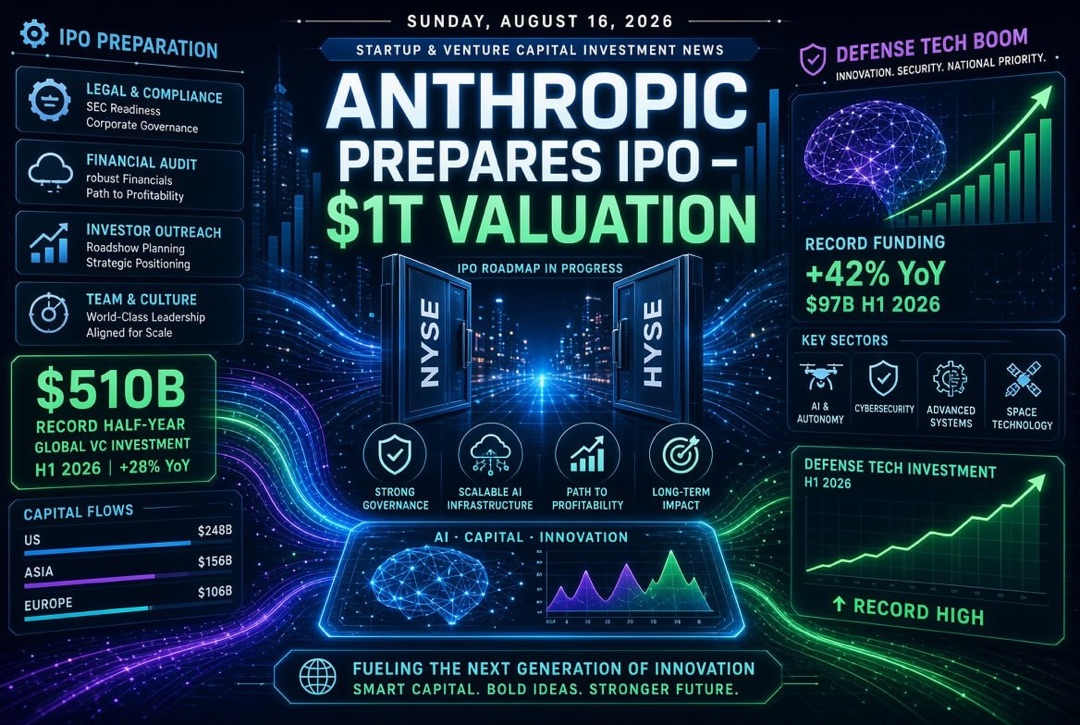
A separate factor for venture capital is the preparation of major technology companies for the public market. OpenAI, Anthropic, and SpaceX are shaping expectations for a potential wave of mega-listings, which could serve as a significant test of public investors' appetite for AI companies and next-generation technology platforms.
For venture funds, this presents a dual effect. On one hand, a strong IPO market could open a liquidity window, enhance portfolio valuations, and rekindle interest from LPs in new funds. On the other hand, overly large listings could siphon significant capital from smaller tech companies and intensify competition for investor attention.
In this environment, late-stage investments are becoming more stringent regarding financial performance. Investors will closely examine revenue, margin, computational costs, client concentration, dependence on cloud providers, and the ability to demonstrate sustained growth economics.
What This Means for Venture Funds and Startup Founders
The startup and venture investment news for June 9, 2026, indicates that the market is not stagnant but has become tougher. While capital is available, it is concentrating in companies with a strong technological foundation, clear ROI, and the ability to solve costly problems for corporate clients.
For venture funds, the key takeaways are:
- AI startups without deep industry integration will receive less attention;
- industrial AI, AI infrastructure, and cybersecurity are becoming priority areas;
- early-stage financing remains but due diligence is deepening;
- growth rounds will be available to companies with proven revenue and strong unit economics;
- the IPO window may improve liquidity but intensify competition among late private companies.
For startup founders, the main takeaway is even simpler: the market is no longer buying just a compelling AI story. Investors want to see a product that saves money, accelerates operations, mitigates risk, or opens new markets with a clear monetization strategy.
Forecast: Venture Capital Will Choose Fewer Companies But Invest More
The venture market of 2026 is becoming a market of concentration. Large funds and strategic investors are prepared to invest hundreds of millions of dollars in companies that can become infrastructural leaders in their niches. At the same time, weak startups, built around superficial AI wraparounds, will encounter more complex fundraising environments.
The primary theme for Tuesday, June 9, 2026, is venture capital's transition to applied artificial intelligence. PhysicsX, PointFive, A Security, Companion.energy, and other deals illustrate that investors are seeking not just growth but technology embedded in the economics of real businesses. For funds, this necessitates a deeper understanding of industry, energy, cybersecurity, and computing infrastructure. For startups, it means demonstrating not only innovation but also commercial value from the outset.