Current News in Startups and Venture Investments as of July 25, 2026: Record First Half, Week's Deals in AI Infrastructure and Cybersecurity, Mega Funds, IPO Window, and Key Risks for Venture Investors
The venture market is approaching the end of July 2026 in a state that is difficult to describe in a single word. Formally, this is the best year in the industry's history: global venture investments in the first half of the year reached a record $510 billion, surpassing the total volume of 2025 ($440 billion) and the previous semiannual peak from the second half of 2021. In reality, however, the market has become noticeably narrower: capital is concentrated in a limited number of companies, stages, and sectors, and the number of deals is growing much more slowly than the amounts per deal. For venture investors and funds, this signifies a shift in the very nature of the asset class—from diversified portfolio risk to concentrated bets on AI infrastructure.
Key Takeaways for Saturday Morning, July 25, 2026
- Half-Year Record. $510 billion in global venture investments in H1 2026: $305 billion in Q1 and $205 billion in Q2, with over 5,000 funded startups.
- Extreme Concentration. OpenAI and Anthropic raised a combined $217 billion—43% of the total global venture capital for the half-year.
- AI Dominance. Over 70% of global venture capital in Q2 went to AI startups compared to about 50% the previous year.
- Return of Exits. In Q2, 32 companies went public with valuations over $1 billion, and 24 M&A deals were closed worth $1 billion or more, totaling $113 billion—a record historical high.
- Mega Funds Claiming LP Capital. The 16 largest funds raised nearly 70% of the $72.4 billion attracted by the venture industry in the first half.
- Deals of the Week. Etched ($300 million), Humanoid ($152 million), Glow ($180 million), Cathedral ($160 million), CuspAI ($450 million)—AI silicon, physical AI, cybersecurity, and defense technologies.
Record First Half: New Mathematics of the Venture Market
Data from Crunchbase and PitchBook-NVCA describe the same phenomenon from different perspectives. In the US, venture investments in H1 2026 reached $412.7 billion—almost 30% higher than the total for 2025, with $355.9 billion, or 86% of every dollar, going to AI-related companies. More than 81% of US venture capital was invested in rounds of $100 million or more.
A key takeaway for fund managers: record amounts are driven not by an expansion of the funnel but by larger checks. The number of deals has hardly increased. The median pre-money valuation of AI companies at the Series D+ stage at the beginning of the year reached $4.7 billion—approximately four times that of comparable non-AI projects—and the median size of late-stage rounds approached $190 million. Late-stage funding in Q2 grew by 141% year-over-year: capital prefers proven leaders over new categories.
Capital Concentration: A Market of Two Companies
The main structural feature of 2026 is unprecedented concentration. Anthropic, after raising $65 billion in Q2, surpassed SpaceX to become the most valuable private company in the world, nearing a $1 trillion valuation. OpenAI closed a round in March at a valuation of around $852 billion. In Q1, the five largest deals in the US—OpenAI, Anthropic, xAI, Waymo, and Databricks—accounted for approximately 73% of the total volume of venture investments in the country.
For limited partners (LPs), this presents a clear problem: diversification at the fund level no longer guarantees diversification at the exposure level. If 43% of global half-year capital is in two cap tables, portfolio correlations sharply increase. This has led to an accelerated demand for co-investment rights, secondary deals, and structured access tools to "hot" names.
Deals of the Week: AI Infrastructure, Cybersecurity, Physical AI
The latest trading days of the week reaffirmed the market's industry priorities:
- Etched — $300 million, Series C. Developer of specialized chips for inference; among investors are Sequoia, Andreessen Horowitz, Jane Street, and SK hynix. The focus is on the economics of model output rather than universal flexibility.
- CuspAI — $450 million, Series B. A British company in AI for discovering new materials with participation from Kleiner Perkins, NEA, Bezos Expeditions, AMD Ventures, and UK state capital.
- Humanoid — $152 million, Series A at a valuation of $1.35 billion. London-based developer of humanoid robots, the first specialized «unicorn» in this segment in Europe; syndicate includes Bosch and Schaeffler.
- Glow — $180 million, Series A. Cybersecurity, Palo Alto; Sequoia, Cyberstarts, Greenoaks, Index Ventures, Redpoint.
- Cathedral — $160 million at a valuation of $1.4 billion. Military AI cybersecurity applications; the round was led by a16z and Sequoia.
- Neo — $100 million. Exit from stealth mode by former SentinelOne executives; protection of agent systems within corporate ecosystems.
- Wonder — $650 million, Series D. Foodtech and robotics, New York; entry of public managers, including ARK Invest, as a preparation for an IPO.
Common Thread in These Rounds
Capital is flowing into the "control layer" of AI—silicon, computing power, security of agent systems, and industrial automation—rather than into presentation layers. Earlier in July, the same logic was confirmed by Together AI ($800 million at a valuation of $8.3 billion), the first closing of Series F for SambaNova at $1 billion, Proxima Fusion (€411 million), and Quantum Systems ($1.2 billion with participation from Blackstone and Airbus).
Fundraising Landscape: Mega Funds vs. Emerging Managers
The LP market remains tough. Of the $72.4 billion attracted by the US venture industry in the first half, about 70% went to 16 mega funds. In Q1, five managers raised 73.1% of the total capital. Liquidity among institutional investors has only partially recovered, leading capital to flow to brands with proven access to deals. For new managers, this means a need for either niche industry specialization or aggressive co-investment terms.
Exits: IPO Window Open but Selectively
For the first time since 2021, the exit market has caught up to the funding market. SpaceX's public offering became the largest IPO in history, raising $75 billion, and the shares closed the debut day up about 19%; Cerebras Systems and Quantinuum followed in volume. Nasdaq reported $129.3 billion raised from new listings in the first half, with an average gain of 44.5% in technology stocks on the first trading day.
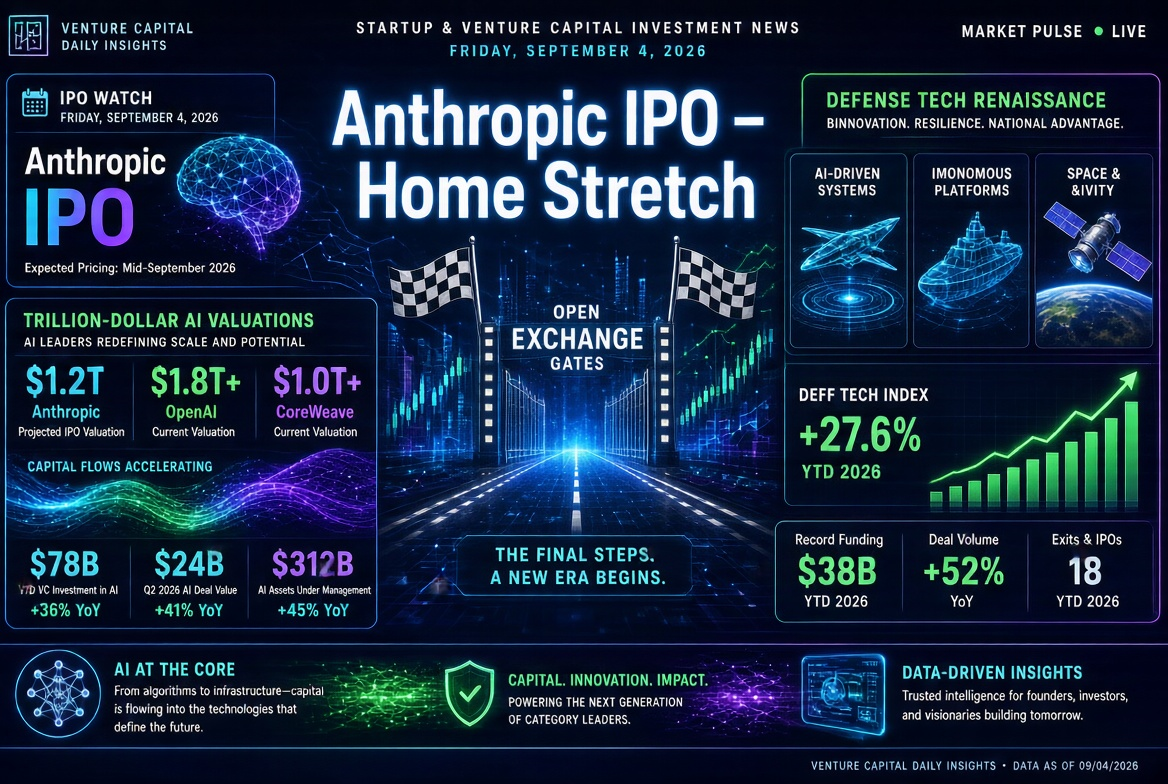
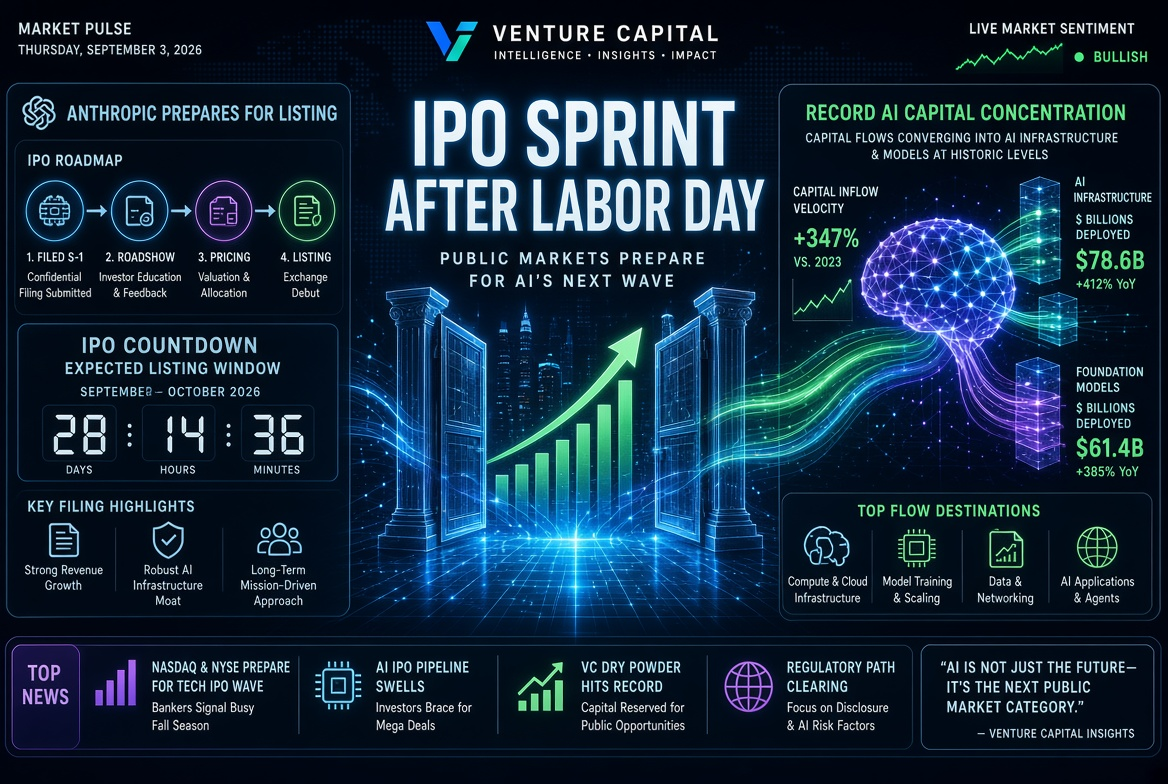
Nonetheless, the statistics reflect selectivity: of the 192 US IPOs in the first half, 118 were from SPACs, and only 74 were classic offerings, down from the previous year. The total valuation of the technology IPO pipeline as of July 22 reached $2.1 trillion. Among potential listings are Anthropic (confidential application submitted in June, expected to go public in the fall), Lambda, Plaid, and several fintech companies. Simultaneously, strategic M&A is reviving: SpaceX acquired Cursor in a fully stock-based deal worth $60 billion.
Geography: US Remains Core, Europe is Coming Back
- US. About 88% of global AI capital is accounted for by American companies, but the share of the US in the total volume for Q2 dropped from 83% to 66–67%.
- Europe. The strongest venture quarter in four years, strengthening in the UK, consistent activity in M&A; deep tech and defense technologies are key attractions.
- Asia. Major rounds in China (including about $3 billion for Kling AI at an $18 billion valuation), the rise of Singapore as a hub for robotics and data for physical AI.
- Middle East. Sovereign and corporate capital in the region increasingly acts as a leading investor in global AI infrastructure deals.
Russia and CIS: Local Landscape
The Russian venture ecosystem is developing its own logic: the primary volume of deals is formed by corporate funds, regional support programs, and syndicates of business angels, while access tools for private investors include venture ZPIFs, crowdfunding platforms, and digital financial assets. Industry platforms—from the Russian Venture Forum to regional investment intensives—remain key channels for deal flow. The global agenda is conveyed to the local context through the same question: where exactly in the AI value chain do local teams have a defensible advantage.
Risks: Concerns for Investors
- Concentration Risk. The fate of entire fund vintages is dependent on a few cap tables.
- Discrepancy Between Valuations and Revenue. The premium for AI companies over comparable assets reaches up to four times at late stages.
- Dependence on Hyper-Scaler Capex. Projected capital expenditures of about $700 billion in 2026 are a foundational demand driver but also a vulnerability point.
- Funding Gap for Mid-Stages. Rounds between Series A and mega-checks remain the most challenging to attract.
- Quality of Exits. High gains on the first trading day do not guarantee sustainable returns post-debut.
Takeaways for Venture Investors and Funds
The market at the end of July 2026 rewards conviction and punishes dispersion. Capital is available, but it is targeted: AI infrastructure, security of agent systems, defense technologies, physical AI, and energy for data centers. A strategically wise position is a mix of specific bets in the "control layer" of the tech stack with discipline regarding valuations, active engagement with the secondary market for liquidity management, and sober scenario analysis for potential multiple contractions. The half-year record is not a signal for relaxation but a reminder that in a concentrated market, the cost of errors in deal selection is higher than in any previous cycle.