Oil and Gas and Energy News for July 25, 2026: Brent Surpasses $100 per Barrel, TTF Gas at Highest Level Since January 2023, Cessation of Shipments by CPC, OPEC+ Quotas, Russia's Fuel Market, Coal, Electricity, and Renewable Energy. Review for Investors and Market Participants in the Fuel and Energy Complex
The global fuel and energy complex is entering the weekend in a state of maximum tension not seen in the last four years. The escalation of the conflict between the US and Iran, which has spread from the Strait of Hormuz to the Red Sea, has driven Brent oil prices above the psychological mark of $100 per barrel for the first time since May, while European gas on the TTF hub has reached its highest levels since January 2023. At the same time, shipments of Kazakh oil through the Caspian Pipeline Consortium have been suspended, and the Russian domestic petroleum products market is just beginning to emerge from a critical phase of shortage. Below is a detailed overview of key events in the oil and gas, coal, and electricity sectors for investors and market participants in the fuel and energy complex.
Key Updates as of Saturday Morning, July 25, 2026
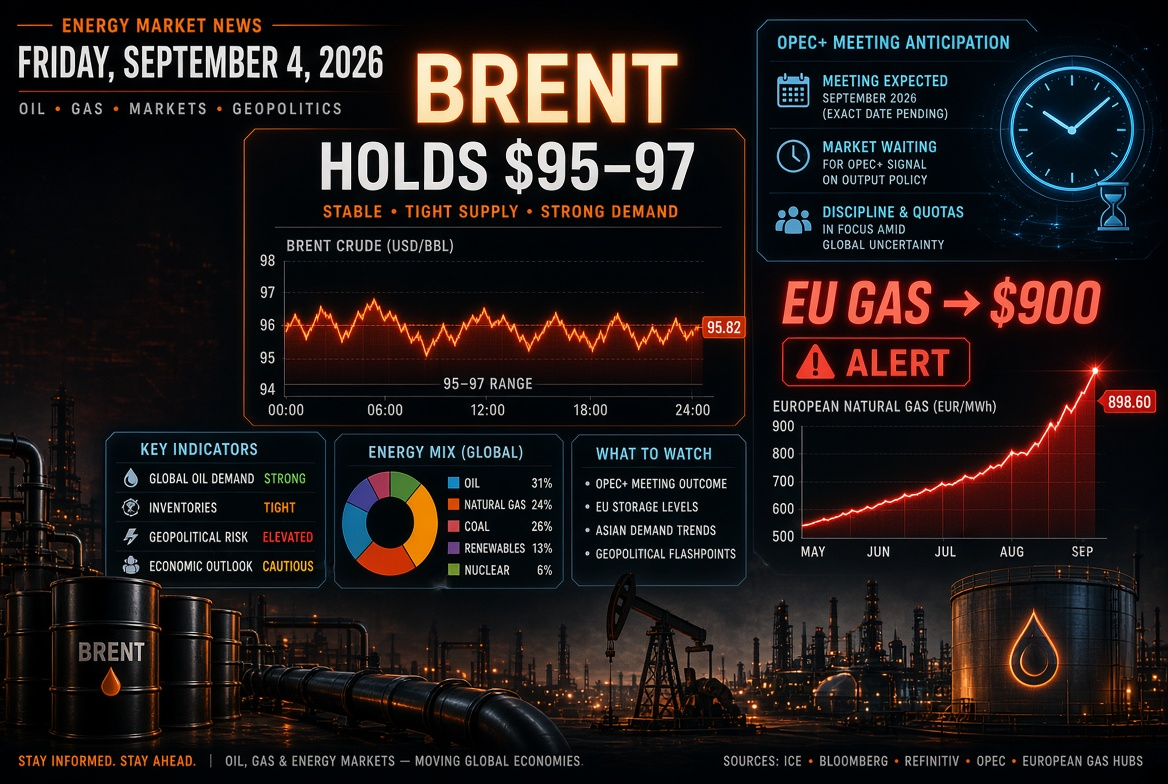
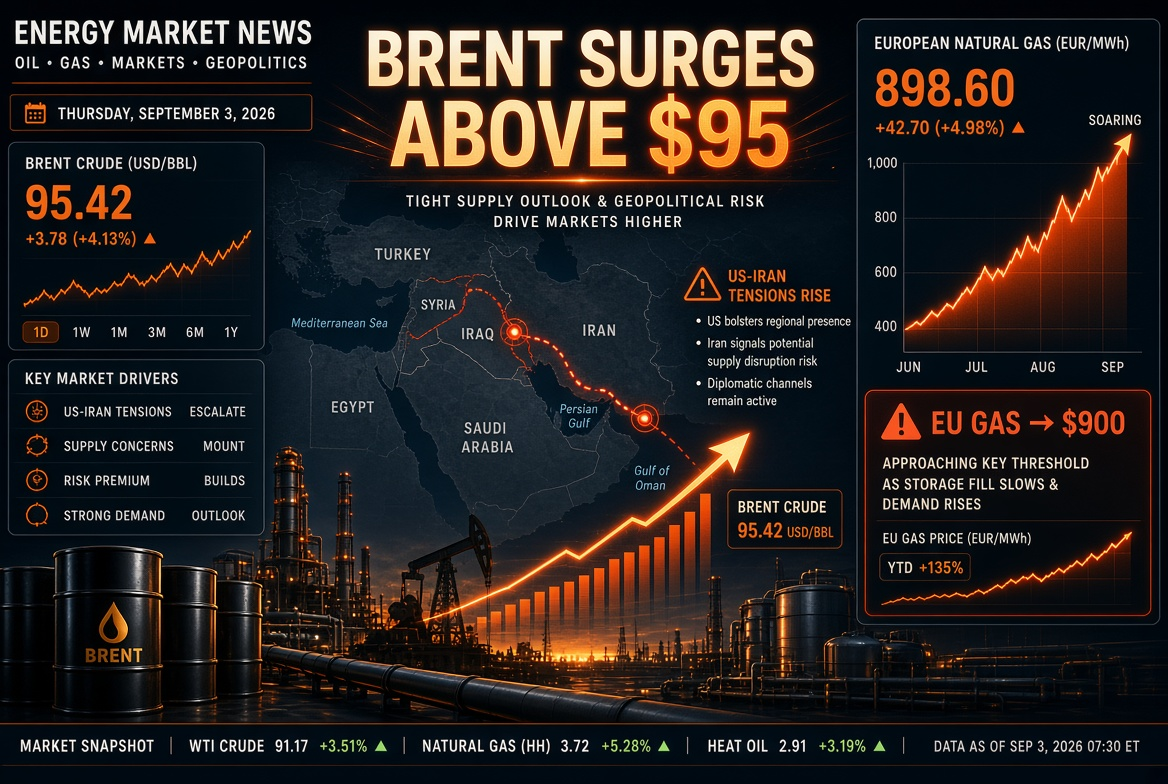
- Oil: Brent closed on Thursday at $100.69 per barrel (+7%), WTI at $92.19 (+6.2%). On Friday, the market corrected approximately 5%—Brent traded around $95–96, and WTI near $88.
- Monthly Dynamics: From $71.57 per barrel on July 1, Brent has gained over 30%—one of the sharpest monthly impulses since 2022.
- Gas: TTF futures rose above €63/MWh—the highest since January 2023; an increase of over 45% since early July and almost double year-on-year.
- Logistics: CPC has suspended shipments at Novorossiysk; Kazakhstan has reduced production.
- Coal: Newcastle is holding steady around $130 per ton amid the substitution of lost LNG.
- Electricity: IEA forecasts a global demand for electricity to grow by 3.6% in 2026.
Oil Market: Geopolitical Risk Premium Re-enters Pricing
The oil market has been in reactive mode for five weeks in response to military updates. The breakthrough of the $100 mark for Brent occurred after reports of attacks on two Saudi tankers in the Red Sea and statements regarding the US's readiness to launch a significant strike against Iran. This has culminated in a rally wherein the commodity sector increased by over 30% in three weeks.
Factors Driving Prices Upward
- Physical reduction of traffic through the Strait of Hormuz, which traditionally accounts for about one-fifth of global oil trade.
- Threat of a blockade of the Bab-el-Mandeb Strait—an alternative route for Saudi exports circumventing Hormuz.
- Suspension of Kazakh oil shipments to the Black Sea, removing over 1% of global supply from the market.
- Depleted commercial oil and petroleum product reserves in OECD countries following the spring phase of conflict.
- Increased freight and insurance costs, which are reflected in the final prices for refineries.
Factors Restraining Growth
- Diplomatic track: Reports of Pakistan's attempts, with the support of China, to revive US-Iran negotiations instantly removed about 5% of the premium from the market.
- China's interest in de-escalation: disturbances in the Persian Gulf negatively affect the interests of the world's largest oil importer.
- Unused OPEC+ capacities and the ongoing recovery of quotas.
The range of forecasts is record-wide. RBC Capital Markets posits that if escalation continues, Brent could surpass the 2022 peak of $128 per barrel. Conversely, UBS expects a pullback to $85 by the end of the year, emphasizing that the recovery of production in the Middle East is slower than market expectations, which will keep the oil market balanced in a deficit state.
OPEC+: Quotas Increase, but Actual Barrels Arrive Slower
The alliance continues to gradually restore production. The July quota for the "group of eight" stood at 30.633 million barrels per day, an increase of over 1 million barrels per day from June; the step of monthly easing of restrictions is maintained at 188,000 barrels per day. The overall policy of the alliance is confirmed until December 31, 2026, with the maximum allowable level of production fixed at 39.725 million barrels per day. At the same time, the assessment of the maximum production capacities of the participants continues, which will form the basis for the basic quotas for 2027.
The key issue for OPEC+ today is not in paper quotas, but in logistics: a significant portion of the unused capacities are located in Gulf countries and are physically dependent on the same Strait of Hormuz, the risks surrounding which are driving prices up. The UAE's exit from the alliance on May 1, 2026, further reduced the managed supply pool.
Gas Market: TTF at Highs, Europe Risks Not Filling UGS
The European gas market has become the second epicenter of the crisis. TTF prices have risen by more than 45% since early July and exceeded €63/MWh. The reasons are structural:
- Reduction in Qatari LNG supplies and export restrictions from the Persian Gulf;
- Redirection of American LNG shipments to Asian markets with higher prices;
- Abnormal heat in Europe, increasing demand for electricity for air conditioning and, consequently, gas for generation;
- Increased freight and insurance rates on routes through conflict zones.
Europe's largest gas supplier, Equinor, has warned that the region is highly unlikely to meet the target level of filling underground storage to 80% by the start of the heating season. The lag in injection rates compared to the five-year norm poses a major risk for the European industry in the 2026-2027 winter. An additional dimension of the problem is inflationary: amid the energy shock, the ECB maintained the deposit rate at 2.25% on July 23, but a significant number of economists expect another hike by the end of the year.
Caspian Pipeline Consortium: A Blow to Kazakh Exports
On July 19, the CPC suspended oil loading at its marine terminal near Novorossiysk following drone attacks on two tankers. Starting July 21, Kazakhstan halted the pumping of crude into the consortium system: shipowners are refusing to direct vessels to the terminal. CPC accounts for about 80-90% of Kazakh oil exports and over 1% of global oil supply; about 63 million tons of crude passed through the system in 2025.
On July 23, the Kazakhstan Ministry of Energy confirmed a forced reduction of daily production to prevent tank farm overflow. Some volumes are being redirected through the Baku-Tbilisi-Ceyhan pipeline; however, its capacities do not allow for complete compensation of the lost exports. For European refineries focusing on CPC Blend, this means an urgent need to search for substitute shipments of light low-sulfur oil.
Russia: Fuel Market Gradually Emerging from Acute Phase
The Russian petroleum products market is experiencing its most challenging summer in recent years. The gasoline and diesel fuel shortage observed since late May has been caused by a combination of factors: unscheduled refinery shutdowns, seasonal peak demand during vacations and harvesting, as well as logistical restrictions in southern regions.
A comprehensive set of measures includes:
- Complete ban on gasoline, diesel, marine fuel, jet fuel, and gasoil exports;
- Reduction of mandatory exchange sale quotas for gasoline from 15% to 10% for the period from July 1 to September 30;
- Zero import duties and increasing imports of petroleum products from Belarus;
- Maximal loading of existing capacities, shortening current repair times and shifting scheduled maintenance;
- Engaging the potential of medium and small refineries.
On July 21, Deputy Prime Minister Alexander Novak stated that market stabilization had begun, noting that in certain regions the situation is being resolved "in a manual, pinpoint manner." Priority is given to supplying agricultural workers during the harvesting period and northern deliveries. The FAS has initiated 15 cases against market participants, and on July 23, the Ministry of Energy instructed oil companies to work on the cancellation of regional limits on fuel sales of less than 50 liters—a signal that the authorities believe the peak crisis has passed.
Russian Oil Exports: Volatility of Discounts
The dynamics of the Russian export grade Urals in 2026 is demonstrating an unusual amplitude. In April-May, at the peak of the Middle Eastern crisis, Urals in supplies to India and China traded at a premium to Brent, reflecting a sharp shortage of sulfur-rich grades. By June-July, prices returned to a discount in the range of $2-3 per barrel amid decreased activity from Asian processors and squeeze on margins of independent Chinese refineries. The current rise in benchmark prices again improves export revenues; however, the sanctions infrastructure—limits on freight, insurance, and settlements—continues to keep realizable prices below market indicators.
Coal Market: Comeback Amid LNG Shortages
Coal is returning to the global energy agenda as the fuel of last resort. Australian thermal coal Newcastle is trading around $130 per ton. The loss of LNG shipments to Asia creates additional demand: industry analysts estimate that additional coal consumption in the Asia-Pacific region in 2026 could reach approximately 70 million tons, and with the resumption of full-scale fighting, up to 90 million tons.
The leader in coal generation growth is Japan, where output at coal-fired power plants is increasing at double-digit rates amid declining gas usage. South Korea and Taiwan are also scaling up utilization of coal capacities. India, on the other hand, is restraining imports due to increased domestic production and high stock levels, while China remains relatively insulated due to a low share of gas in its energy balance. Notably, major mining companies are hesitant to sanction new projects, viewing the spike in demand as cyclical rather than structural.
Electricity and Renewables: Record Year Amid Crisis
The paradox of 2026 is that the energy shock has not slowed down but rather accelerated the energy transition. According to the latest update from the International Energy Agency, global electricity demand is expected to grow by 3.6% in 2026 and another 3.8% in 2027—from 28,600 TWh in 2025 to 30,700 TWh by 2027. Drivers include industry, electric transport, air conditioning, and data centers.
Key takeaways from the generation forecast include:
- Renewable generation in 2026 will surpass coal generation globally for the first time in history.
- Renewable energy output will grow by over 8%, and its share in global generation will increase from 33% in 2025 to 37% by 2027.
- Solar generation will add approximately 600 TWh, surpassing wind energy to become the second largest source of renewable energy after hydropower.
- Electricity demand in India will increase by 7%; the country has crossed the threshold of 100 GW of variable renewable generation for the first time.
The investment landscape confirms the trend: total investments in global energy in 2026 are estimated at $3.4 trillion, of which about $2.2 trillion is directed toward low-carbon technologies and electric grid infrastructure. Renewables account for about $665 billion, including $365 billion in solar energy—essentially $1 billion daily, $200 billion in wind energy, and $75 billion in hydropower. Investments in energy storage systems will for the first time exceed $100 billion, increasing by over 35% year-on-year. The logic for investors is simple: own generation is a form of insurance against geopolitical shocks in hydrocarbon supply chains.
What This Means for Fuel and Energy Market Participants
The market has entered a phase where pricing is determined not by supply and demand balance but by probabilistic assessments of military scenarios. Practical conclusions for investors, fuel, and oil companies include:
- Hedging has become essential. Amplitude of 5-7% movements per session makes unhedged positions in oil, gas, and petroleum products a source of unacceptable risk.
- Refinery margins are under pressure from both sides. Rising raw material costs amid administrative or competitive restrictions on selling prices squeeze refinery crack spreads.
- Logistics are more important than geology. Hormuz, Bab-el-Mandeb, and Novorossiysk have shown that the cost of a barrel today is defined by the throughput of bottlenecks, not by the volume of reserves underground.
- Coal and nuclear receive a premium for predictability. Assets with long contractual horizons and domestic resource bases are being revalued upwards.
- Winter risk in Europe has not been alleviated. Delayed filling of underground storage facilities creates potential for another price spike in TTF in the fourth quarter.
Immediate benchmarks for the market include the dynamics of the diplomatic track around Iran, the resumption of CPC shipments, the pace of gas injection into European storage facilities, and another OPEC+ decision on quotas. Any of these events could shift prices by $5-10 per barrel within a single session. Investors and participants in the fuel and energy market should anticipate heightened volatility in the oil, gas, and energy sectors to persist at least until the end of the third quarter of 2026.