Current Startup and Venture Capital News as of April 8, 2026, Including Growth in AI Infrastructure, Defence Tech, and Capital Concentration
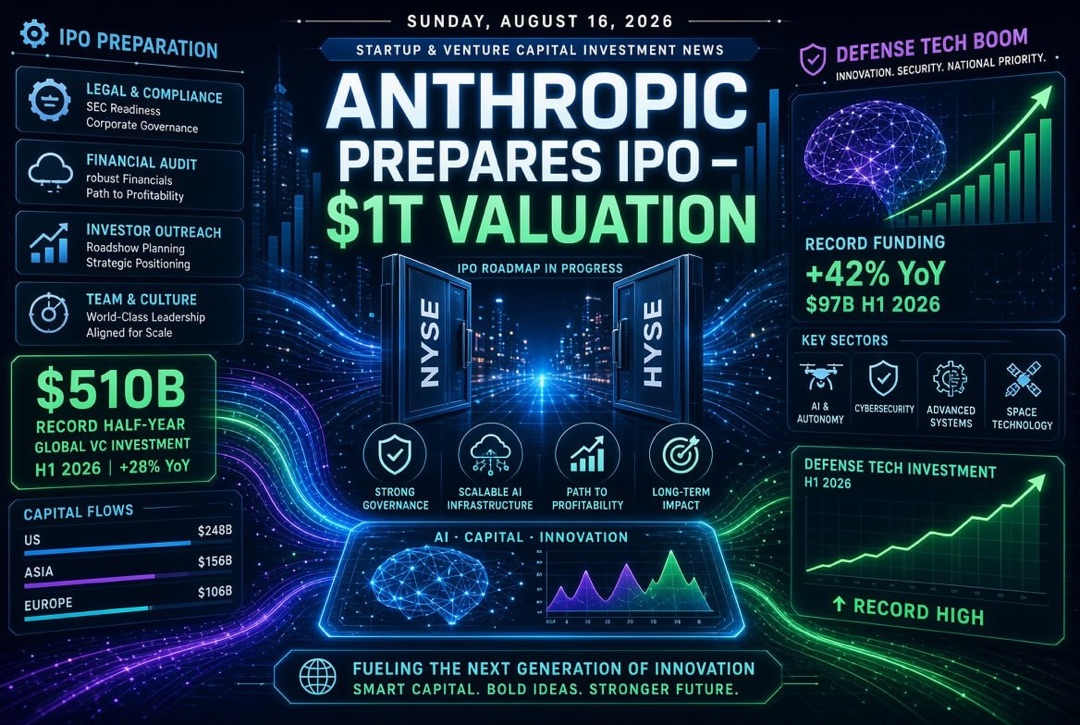
As we enter the second week of April, the global startup and venture capital market remains active, yet the structure of this growth is becoming increasingly stringent and selective. The main theme of the day is not merely an increase in deal volume, but an accelerated concentration of capital in several segments: AI infrastructure, defence technologies, cybersecurity, computing power, and platforms that could serve as the foundation for the next technology cycle.
For venture investors and funds, this signals a shift in selection logic. While previous periods saw the market seeking a broad array of growth stories, a significant portion of capital is now directed towards companies either building critical infrastructure for artificial intelligence or already perceived as industry leaders. Against this backdrop, deals in fintech, tokenization, enterprise software, and energy-intensive technologies persist, but competition for capital in these categories has noticeably increased.
Wednesday, April 8, 2026, opens with a market demonstrating both strength and underlying tension: the volume of money is substantial, but access to it is not universal. For funds, this is an environment where selection discipline, industry focus, and the quality of the technological asset are more critical than ever.
Main Market Signal: Venture Capital is Accelerating, but Becoming More Concentrated
The first quarter of 2026 has witnessed a sharp acceleration in global venture activity. However, significant aggregated figures hide an important detail: growth is unevenly distributed. The majority of capital is collected by the largest rounds, late-stage companies, and those perceived as infrastructure players of the new cycle.
This creates several consequences for the startup market:
- Early stages remain alive, but investors have become more demanding about product quality and unit economics;
- AI projects without infrastructure or applied advantages are beginning to lose the battle for investors' attention;
- Mega-rounds are reshaping the competitive landscape by raising expectations for scaling speed;
- The venture capital market is increasingly splitting into "capital attracts capital" and the rest of the ecosystem.
For venture funds, this suggests that 2026 is looking less like a recovery phase and more like a new cycle of leadership redistribution. The winners are not just interesting startups, but companies that can become systemic players in their verticals.
AI Infrastructure Establishes Itself as the Chief Object of Demand
The most significant trend for the global startup market as of April 8 is the shift in investor interest from "wrappers" around AI to computational, chip, network, and platform infrastructure. Money is flowing towards where the foundational layer for large-scale use of artificial intelligence is being created.
This logic can be seen in several types of deals:
- Investments in AI chips and inference infrastructure;
- Rounds in companies building scalable computing platforms;
- Funding for non-trivial infrastructure projects, including space tech;
- Growing interest in the software layer that makes using AI infrastructure commercially viable.
This is why the market is paying attention to substantial investments in Rebellions, which is doubling down on inference chips and international expansion, as well as Starcloud, promoting an extremely ambitious model of orbital data centers. Even if some of these stories appear aggressive in valuation, they are essential as indicators: venture capital is willing to finance not only applications but also the costly technological foundation for the next decade.
Defence Tech Emerges from Niche Category to Strategic Priority
The second most significant topic is the sharp strengthening of defence technologies in the global venture investment agenda. Not long ago, defence tech was viewed as a specialized branch of deep tech. Now, it has become one of the central categories for major funds, growth investors, and strategic capital.
Recent deals confirm this turnaround. Shield AI has reinforced its status as one of the flagships of the sector, while Saronic has become another example illustrating that autonomous platforms for sea, air, and border scenarios are no longer considered niche markets. For investors, several factors intersect here:
- Sustained demand from governments and defense contractors;
- High entry barriers and technological protection of the business;
- A direct link to AI, autonomy, and simulation environments;
- The ability to build companies with long contractual horizons.
For the venture market, this is an important signal: defence tech is transitioning from an exception to a fully-fledged segment where significant rounds, strategic acquisitions, and long-term platform exits are possible.
Cybersecurity and Agentic AI Moving Towards Consolidation
At the intersection of AI and enterprise software, another rapidly strengthening direction is cybersecurity. However, capital is flowing not just into security-as-a-service, but into products where artificial intelligence can autonomously perform analysis, response, and reduce the workload on teams.
Against this backdrop, a potential deal between Torq and Jit appears particularly illustrative. Even if it has not yet been finalized, the very fact of negotiations indicates the maturity of the segment. The venture market is beginning to transition from a phase of "many new security startups" to a phase where major players are consolidating platforms through M&A.
For investors, this creates two practical conclusions:
- Agentic security is becoming an independent investment theme rather than just a marketing slogan;
- The cybersecurity market is reopening an avenue for exits through acquisitions, especially for teams with strong engineering specialization.
In other words, security startups are now interesting not only as candidates for standalone growth but also as assets for consolidation within larger platforms.
Fintech and Tokenization Haven't Disappeared but Must Now Prove Institutional Value
Although AI infrastructure dominates the news agenda, the startup and venture capital market does not boil down to a single theme. Fintech retains investment appeal, but capital is increasingly flowing into companies capable of integrating into institutional financial frameworks.
A telling example is Midas. A round in the tokenization segment shows that even in the midst of the AI boom, investors are willing to support alternative verticals if they have a clear infrastructural logic, demand from major financial players, and potential for long-term integration into the capital market.
This shifts the selection criteria in fintech:
- Simply growing the user base is no longer sufficient;
- Investors require institutional applicability of the product;
- The technological layer and compliance are becoming part of the company's evaluation;
- The market is more favorable to those building new infrastructure rather than just an interface.
New AI Funds Are Creating a Secondary Wave of Venture Frenzy
Another crucial detail in April is the continued emergence of new specialized funds. There is a marked interest in structures associated with former employees and ecosystems of the largest AI companies. This indicates that the capitalization of the AI theme is now growing not just through deals with startups but also through the creation of new investment vehicles for the next wave of funding.
This is important for the market for three reasons:
- The number of specialized players willing to fund early-stage AI is increasing;
- Competition for the strongest teams and infrastructural assets is intensifying;
- An environment is forming where former operators of the largest AI companies are becoming the new gatekeepers of capital.
For venture investors and funds, this means: the startup market in artificial intelligence will remain overheated not only due to demand from LPs and strategists but also because the investment infrastructure for AI continues to expand.
China Intensifies State Vector in Venture Capital
China deserves special attention. In the context of global technological competition, the country is accelerating capital mobilization in AI, robotics, quantum technologies, and other strategic sectors. This is not merely a rise in venture activity but a deeper transformation of the financing model, where government and quasi-government structures play an increasingly prominent role.
For the global venture market, this creates a dual effect:
- On one hand, a substantial source of capital is emerging for hard tech and industrial innovations;
- On the other, there is a growing risk of distorted market valuations and concentration of funds in politically prioritized sectors.
As a result, for international funds, China remains a key indicator of how the structure of global technological financing is changing: private venture capital increasingly coexists with industrial and governmental strategies.
IPO Window Ajar, but Exit Market Remains Fragile
Despite the rise in valuations of private companies, the exit market does not yet provide grounds for declaring a comprehensive broad turnaround. The public market remains selective, and the largest potential placements are likely to crowd out smaller issuers rather than support them.
For venture investments, this means that the classic exit formula through IPO is currently only working for a limited number of truly outstanding companies. The rest must still rely on:
- Strategic acquisitions;
- Secondary transactions;
- Late-stage private rounds;
- A prolonged status as a private company.
This is why the startup market currently appears strong in terms of raised capital volume while being tense regarding exit liquidity. For funds, this heightens the importance of disciplined portfolio management and precise timing in entry choices.
What This Means for Venture Investors and Funds as of April 8, 2026
Today's snapshot of the startup and venture capital market allows for several practical conclusions. First, capital will continue to concentrate in large technological themes with infrastructure logic. Second, defence tech, cybersecurity, and AI infrastructure can no longer be considered peripheral categories — they are at the core of the new investment cycle. Third, fintech, tokenization, and enterprise software remain viable, provided they address institutional challenges rather than merely creating a user layer.
Key guidelines for investors in the near term:
- Search for startups that are building platform or infrastructure assets;
- Be cautious with companies that have an "AI narrative" without technological protection;
- Evaluate not only the growth rate but also the likelihood of a strategic exit;
- Monitor new funds and the niches they begin to penetrate ahead of the broader market.
As of April 8, 2026, the global venture market appears strong, yet uneven. It is a market of significant opportunities for the best assets and at the same time a market of heightened selectivity for all others. It is in such an environment that the next industry leaders are formed — and precisely in such an environment that venture funds can achieve maximum alpha through precision rather than breadth of bet.