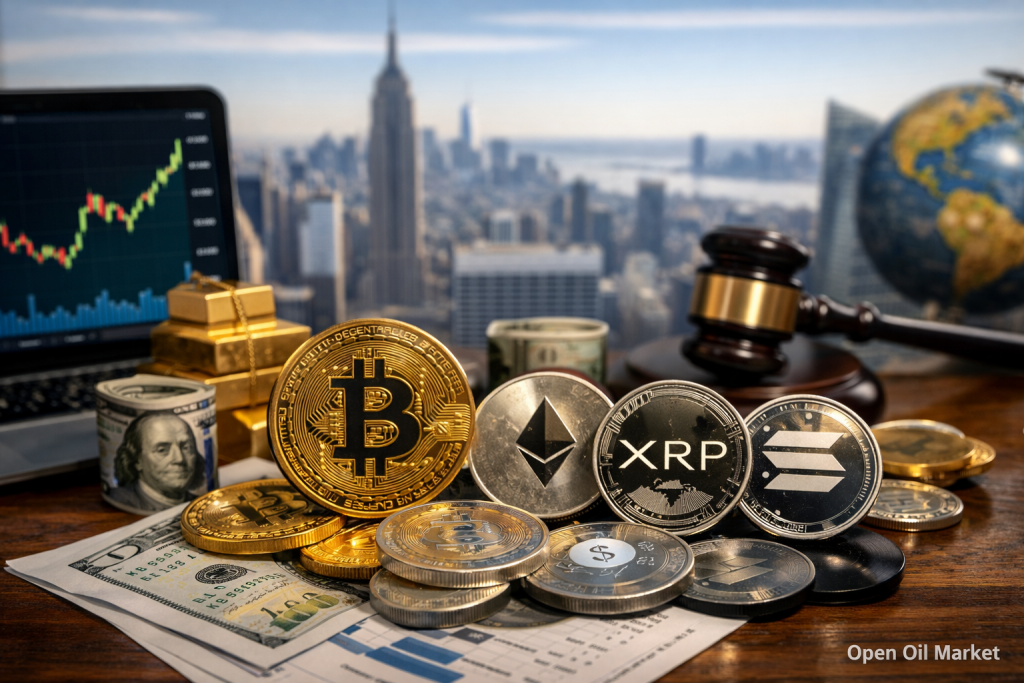
Cryptocurrency Market News as of April 8, 2026: Market Analysis, Institutional Flows, Regulation, and Key Trends in the Top 10 Digital Assets
As the cryptocurrency market approaches April 8, 2026, it exhibits heightened sensitivity to macroeconomic factors, geopolitics, and legislative changes. For global investors, this translates to a return to a more mature logic of valuing digital assets: the focus is no longer solely on short-term momentum, but also on the quality of capital inflows, infrastructure resilience, regulatory predictability, and the genuine role of the largest coins in institutional portfolios.
The defining feature of the current stage is that the cryptocurrency market is increasingly segmenting into several areas. The first segment consists of Bitcoin as the foundational asset of the digital market and as a macro hedge. The second includes Ethereum and platform blockchains, where investors are assessing not only price but also the business activity of the ecosystem. The third segment comprises XRP, Solana, and other major altcoins benefiting from the expansion of exchange instruments and changing sentiments in the institutional segment. Lastly, there are stablecoins, without which global cryptocurrency market liquidity would be unimaginable.
Overall Market Picture: Cryptocurrencies Remain a Global Risk Asset with Defensive Elements
At the beginning of April, the cryptocurrency market retains a large scale but trades without the previous euphoria. This signals a crucial change for investors who are focusing on medium-term strategies. After strong growth phases, the market has entered a period of more selective demand, where capital is being reallocated towards the most liquid and institutionally understandable assets.
In such an environment, the following factors come to the forefront:
- resilience of inflows into digital investment products;
- structure of demand for Bitcoin and Ethereum;
- dynamics of the largest altcoins in the top 10;
- pace of regulatory development in the U.S. and other key jurisdictions;
- role of stablecoins in international liquidity and settlements.
For the global market, this means a simple truth: cryptocurrencies are no longer traded solely as a speculative theme. They are increasingly being integrated into the financial system, and as a result, are reacting more strongly to policy, rates, risk appetite, and movements in institutional capital.
Bitcoin: The Main Attraction for Capital and a Barometer of Investor Confidence
Bitcoin remains the key benchmark for the entire cryptocurrency market. Its role is now twofold. On one hand, it is the most recognizable and liquid digital asset, around which institutional infrastructure is built. On the other, Bitcoin is the first to react to declining risk appetite, as investors reassess expectations around the economy, monetary policy, and geopolitics.
It is crucial for investors to consider the following points:
- Bitcoin maintains its leadership in market capitalization and dominance within the crypto market structure.
- Market assessments of the quality of new institutional demand are frequently based on Bitcoin.
- Even during correction phases, Bitcoin appears more resilient than most altcoins.
Essentially, Bitcoin remains the primary benchmark for digital assets as of April 8, 2026. If institutional capital continues to seek clear forms of participation in the cryptocurrency market, Bitcoin is likely to remain the first entry point.
Ethereum: Infrastructure Asset of the Market, but Demand Has Become More Demanding
Ethereum continues to occupy a central place in the cryptocurrency ecosystem due to smart contracts, DeFi, tokenization, and a wide range of application scenarios. However, in 2026, investors have started to evaluate Ethereum more critically than before. Just holding the status of a foundational platform is no longer sufficient; the market wants to see sustainable user activity, growth in the network economy, and a compelling investment thesis compared to Bitcoin.
This renders Ethereum both a strong and vulnerable asset. It is strong because a significant portion of the infrastructure of the digital economy flows through it. It is vulnerable because the market is no longer willing to automatically revalue platform assets without confirmation of fundamental demand.
For investors, Ethereum is now a bet not only on cryptocurrencies but also on the further development of tokenized finance, payment solutions, and next-generation digital applications.
XRP, Solana, and Major Altcoins: New Competition Within the Top 10 Cryptocurrencies
The segment of major altcoins appears more vibrant than in previous periods. Notable interest is particularly focused on XRP, which gains support from increased attention on investment products and a more matured market infrastructure. Solana, despite increased volatility, retains its status as one of the leading assets for investors seeking higher-risk growth.
The focus remains on the top 10 most popular cryptocurrencies:
- Bitcoin
- Ethereum
- Tether
- XRP
- BNB
- Solana
- USD Coin
- Dogecoin
- Cardano
- TRON
This list is significant not only as a ranking by market capitalization but also as an indicator of how global liquidity is distributed. Within the top 10, there are:
- Foundational settlement assets;
- Platform blockchains;
- Stablecoins;
- Tokens with strong communities and high trading activity.
For investors, this signifies that the cryptocurrency market in 2026 has become structurally more complex. Simple ownership of "everything" no longer appears optimal. The importance of selecting assets based on liquidity quality, investment thesis, and position within the global infrastructure of digital finance is increasing.
Institutional Flows: The Market is Watching Not the Noise But the Quality of Money
One of the main drivers of cryptocurrencies in 2026 remains institutional flows. Simply announcing the launch of new products is no longer sufficient in the market. Investors closely observe where capital is genuinely directed: into Bitcoin, Ethereum, XRP, Solana, or defensive strategies through stablecoins and hedging instruments.
Current dynamics indicate several trends:
- Flows have become more selective;
- Bitcoin remains the primary "recipient" of significant capital;
- XRP is distinguishing itself as an asset gaining additional attention amid the development of derivative instruments;
- Ethereum is facing a tougher reassessment of expectations;
- Solana retains potential but is more sensitive to shifts in market sentiment.
For professional market participants, this is more significant than any short-term price increases. It is the stability of institutional flows that will determine which cryptocurrencies can establish themselves in the portfolios of funds, banks, brokers, and large management firms.
Cryptocurrency Regulation: The Market is Moving Towards a More Communicative Game Model
Another key topic as of April 8, 2026, is cryptocurrency regulation. For global investors, legislative clarity is becoming nearly as important as price dynamics. If the previous years were marked by the conflict between innovation and oversight, the market is increasingly oriented towards establishing working rules that allow for the categorization of digital assets by economic nature and areas of control.
This influence on the market manifests in several ways:
- Legal uncertainty for institutional investors is decreasing;
- The probability of new regulated investment products emerging is increasing;
- Competition among jurisdictions for cryptocurrency business and infrastructure is intensifying;
- The significance of stablecoins as a regulated segment of digital finance is increasing.
Regulation is ceasing to be solely a restraining factor. Increasingly, it is becoming the foundation for the next phase of mature growth in the cryptocurrency market.
What Current Events Mean for the Global Investor
As of April 8, 2026, the cryptocurrency market is sending mixed yet entirely readable signals to investors. There is no mass exodus of capital from digital assets, but the regime of unconditional growth is also absent. This is a market where discipline, diversification, and an understanding of each asset's role in the portfolio take precedence.
Practical conclusions are as follows:
- Bitcoin remains the foundational benchmark and the main indicator of institutional interest.
- Ethereum requires a more careful fundamental analysis than a year ago.
- XRP and Solana deserve attention as part of tactical allocation to major altcoins.
- Stablecoins reinforce their significance as the infrastructure layer of the global crypto market.
- The regulatory agenda could become the main driver of the next major market movement.
That is why cryptocurrency news in the coming days should be viewed not as a series of isolated pieces of information, but rather as elements of a broader picture: the market for digital assets is gradually becoming a fully-fledged segment of global finance. For investors, this increases analytical demands while simultaneously opening up higher-quality and more long-term opportunities.
Conclusion: Cryptocurrencies Enter the Phase of Leader Selection
The main theme as of April 8, 2026, is the transition of the crypto market from overall growth to a phase of leader selection. The winners are not merely well-known coins but those cryptocurrencies backed by liquidity, infrastructure, institutional interest, and a clear application scenario. In this environment, the main assets to watch remain Bitcoin, Ethereum, XRP, Solana, and the largest stablecoins.
For the global investor, this indicates that 2026 could be a period of significant market restructuring. It is no longer about frenzy, but resilience. Not promises, but capital flows. Not the number of tokens, but the ability of specific cryptocurrencies to maintain the status of globally significant digital assets.