Top Startup and Venture Capital News for July 28, 2026: Record-Breaking Half-Year for the Global VC Market, Anthropic Prepares for Listing, Capital Concentrates in Megafunds, Capital Shifts to Physical AI and Inference Infrastructure, Exits Recover, and the Russian Market Contracts.
The venture capital market enters the final week of July 2026 in a state that is difficult to describe in a single word. By formal metrics, it is the best period in the industry's history: global venture investments in the first half of the year reached a record $510 billion according to Crunchbase, while the U.S. market, per PitchBook and NVCA calculations, amassed $412.7 billion — more than any full year prior to this. By internal structure, it is an extremely narrow market where money concentrates in a few dozen companies and a handful of funds, while the average founder experiences not a boom, but a filter.
Key Points for Tuesday Morning, July 28, 2026
- Record Half-Year. $510 billion in global venture investments for H1 2026 — a new all-time high for any half-year in the industry's history.
- AI Dominance. In Q2, AI startups accounted for over 70% of the global volume, compared to less than 50% a year earlier; in the U.S., the share of artificial intelligence reached $355.9 billion out of $412.7 billion.
- Capital Concentration. Over 81% of U.S. venture dollars went into rounds of $100 million or more.
- LP Market Tightening. 16 megafunds raised nearly 70% of the $72.4 billion in new venture fundraising for the half-year.
- Liquidity Return. 32 portfolio companies held IPOs with valuations above $1 billion, and another 24 were acquired for over $1 billion, totaling approximately $113 billion — a record quarter for M&A.
- Shift in Focus. Capital is moving from application software to "hardware": inference chips, robotics, sensors, data for physical AI, and data center energy infrastructure.
Macro Picture: Record Volume, Deficit in Breadth
The key paradox of the current cycle is that record-breaking startup and venture capital news describes an ever-smaller number of companies. In Q1 2026, the global investment volume was approximately $297 billion, yet four deals — OpenAI's $122 billion round at an $852 billion valuation, $30 billion for Anthropic, $20 billion for xAI, and $16 billion for Waymo — accounted for over 63% of the quarterly result. The distribution evened out only slightly in the second quarter.
For an investor, this means a shift in the working hypothesis. Aggregated venture market figures are no longer an indicator of capital availability for the average company in a portfolio. The median Series B round in non-infrastructure segments takes longer to close than in 2021, with stricter covenants and a more conservative structure of liquidation preferences. The early stage has held up: in North America, seed and early-stage funding volume in Q2 exceeded $31 billion — nearly double year-over-year — but the number of deals was the lowest in five quarters. Checks grew, while the number of recipients shrank.
Fundraising: A Two-Tier Market
A similar asymmetry is observed on the LP side. Of the $72.4 billion raised by venture funds in the first half of the year, approximately 70% went to 16 megafunds. Institutional investors are still under denominator pressure and have not fully restored liquidity after the 2022–2024 cycle, so they prefer to allocate capital to established franchises rather than expanding the number of managers.
Practical implications for the venture capital market:
- First and second vintage funds face increasing fundraising duration and declining target sizes.
- Emerging managers are increasingly transitioning to SPV and pledge fund models instead of classic blind pool structures.
- Megafunds gain the ability to lead rounds independently, reducing the role of syndicates and altering the negotiating position on valuation.
- The secondary market becomes the primary channel for interim liquidity for LPs before exits materialize.
Liquidity Window: Anthropic IPO and the SpaceX Effect
The main topic of the week for fund managers is the public market. Following SpaceX's June listing on Nasdaq, where shares closed above the target on debut but subsequently fell below the offering price, the industry learned an important lesson: the window is open, but the scarcity premium quickly disappears.
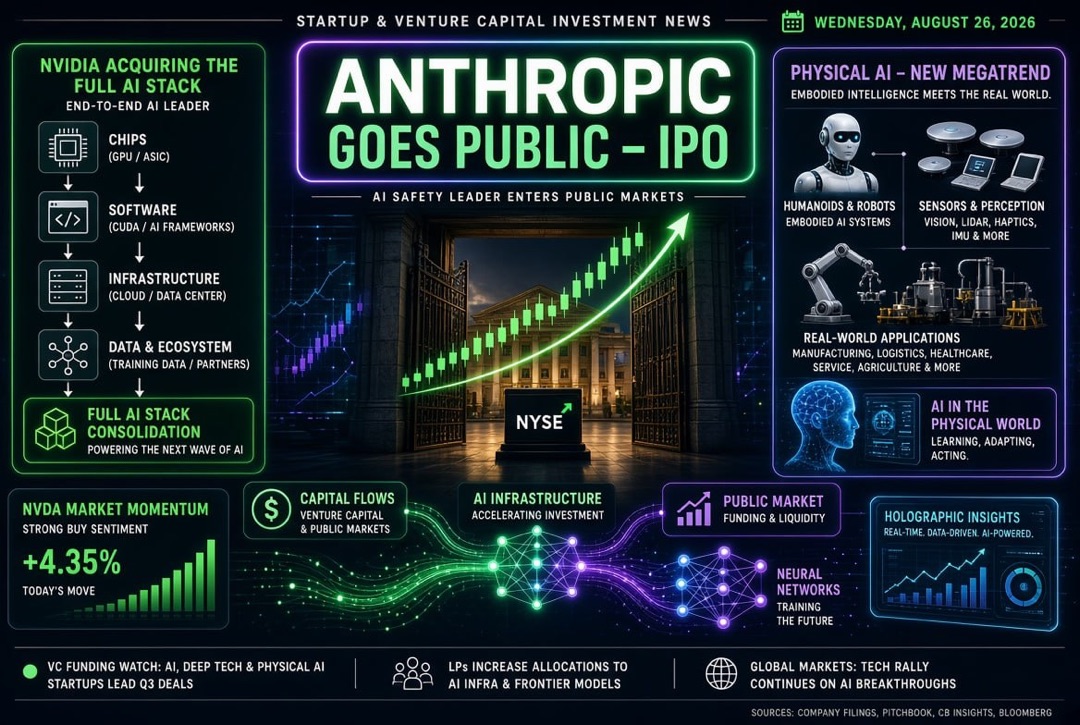
Attention now centers on Anthropic. The company confidentially filed an S-1 form in early June at a valuation of approximately $965 billion following its Series H round and, according to business media reports, held meetings with institutional investors in July; a listing is discussed within an October timeframe. Neither the price range nor the offering size have been officially confirmed. OpenAI, conversely, has pushed back its expected IPO timeline to 2027, while Databricks has publicly ruled out a listing in 2026, discussing a private round at a $165–175 billion valuation.
For venture funds, the return of exits is more important than any fundraising record. A record quarter for M&A and three dozen IPOs with valuations above $1 billion, for the first time since 2021, create conditions where LP distributions begin to catch up with capital calls. This cycle, rather than absolute investment volumes, will determine fundraising in 2027.
Physical AI and the Inference Economy: Where the Frontier Has Shifted
The most notable structural shift in recent weeks is the movement of capital "down the stack." Investors are funding not model-based applications, but what makes AI cheaper to operate and more applicable in the physical world.
A telling example is Etched's round: $300 million in Series C at a $10.3 billion valuation for developing specialized "hardware" for inference. The logic is simple: model training created the first investment cycle, but recurring demand, token cost, energy consumption, and latency are determined at the execution stage. Concurrently, European company Humanoid raised $152 million in Series A at a $1.35 billion valuation for industrial humanoid robots, with participation from Schaeffler and Bosch — strategic industrial investors are returning to venture capital as co-investors, not just as acquirers.
Physical AI is no longer a single category and has split into independent capital segments: inference compute and economics, hardware deployment and robotics, multimodal data on real-world interactions, and machine sensing. A separate track is data center energy — a segment where strategic minority investments are measured in billions of dollars.
Deals Shaping the Current News Feed
| Company | Round | Segment | Jurisdiction |
|---|---|---|---|
| Etched | $300M, Series C | AI semiconductors, inference | USA |
| Humanoid | $152M, Series A | Industrial robotics | United Kingdom |
| Together AI | $800M, Series C | GPU cloud, AI infrastructure | USA |
| SambaNova Systems | $1.0B, Series F | AI chips and systems | USA |
| Quantum Systems | $1.2B, Series D | Defense and autonomous systems | Germany |
| Proxima Fusion | €411M, Series A | Fusion energy | Germany |
| Norm AI | $120M, Series C | Compliance, agentic AI | USA |
| Ropedia | $30M, Pre-A | Data for physical AI | Singapore |
The common denominator of these deals is not industry fashion, but the presence of a bottleneck. Funding goes to companies that reduce the cost of operating AI, increase its reliability in production, or embed it into industries with large recurring budgets: cybersecurity, insurance, healthcare, and manufacturing.
Geography of Capital: USA, Europe, Asia, Middle East
The USA maintains dominance: approximately 88% of global AI capital goes to American companies. North America attracted $392 billion for the half-year. However, geography is diversifying by vertical rather than by volume.
- Europe is reclaiming positions in defense tech, fusion energy, and industrial robotics, relying on strategic capital from industrial corporations and state development institutions.
- Asia is strengthening in data infrastructure for robotics; Singapore is solidifying its role as a deep tech hub with global ambitions.
- The Middle East has transitioned from an LP role to a lead investor role: sovereign structures and corporate venture arms are directly leading rounds in AI infrastructure.
Russia and the CIS: Market Contracts Faster Than the Global Cycle
Russian dynamics are moving against the global trend. According to the Venture Guide platform, in the first half of 2026, investments in domestic startups totaled approximately 5.2 billion rubles — down 39% year-over-year, with the number of disclosed deals roughly halving to 52. Moscow concentrates about 64% of investments and 63% of deals, while the regional ecosystem is essentially stagnating. The largest volume goes to projects in artificial intelligence and machine learning. The consensus forecast for the year is 11–13 billion rubles across 110–130 disclosed deals, a level comparable to the record low of 2023.
A key feature of the local market is the shift towards full buyout deals and corporate demand for ready-made, integrable solutions, rather than the classic venture cycle with a series of rounds and subsequent public market exit.
Risks and Agenda for Fund Managers
- Concentration Risk. When 63–72% of quarterly volume comes from a handful of deals, industry indices cease to reflect the state of the median portfolio.
- Infrastructure Overvaluation Risk. Early contractual commitments in semiconductors are easier to obtain than to validate through production reliability.
- Post-Listing Dynamic Risk. Share price pullbacks following major offerings impact the mark-to-market of the entire late stage.
- LP Liquidity Risk. Until distributions fully recover, fundraising for new funds will remain two-tiered.
- Commoditization Risk. At the application layer, without proprietary data, distribution, or switching costs, defensibility erodes faster than revenues grow.
Frequently Asked Questions
What is the volume of the global venture market in 2026? In the first half of 2026, global venture investments reached a record $510 billion, surpassing any previous half-year result.
What share is attributed to artificial intelligence? In Q2, AI startups accounted for over 70% of the global volume; in the U.S., approximately 86% of all venture dollars for the half-year.
Is the IPO window open for technology companies? Yes, but selectively: more than 30 venture-backed companies went public with valuations above $1 billion, yet the post-listing dynamics of the largest deals show a rapid compression of the premium.
Where is the focus of venture investors shifting? Into inference infrastructure, semiconductors, robotics, sensors, data for physical AI, and energy for data centers.
Conclusion
The market on July 28, 2026, is characterized by record volumes amidst record selectivity. Capital is available, but it buys not an idea or growth rate, rather control over a bottleneck: the economics of computation, proprietary data, physical deployment, or a regulated process with a large budget. For venture funds, the coming months will be defined not by the next megaround, but by the industry's ability to convert record investments into real distributions — through the Anthropic IPO, a record M&A cycle, and the secondary market. It is at this intersection that the premium is being formed in 2026.