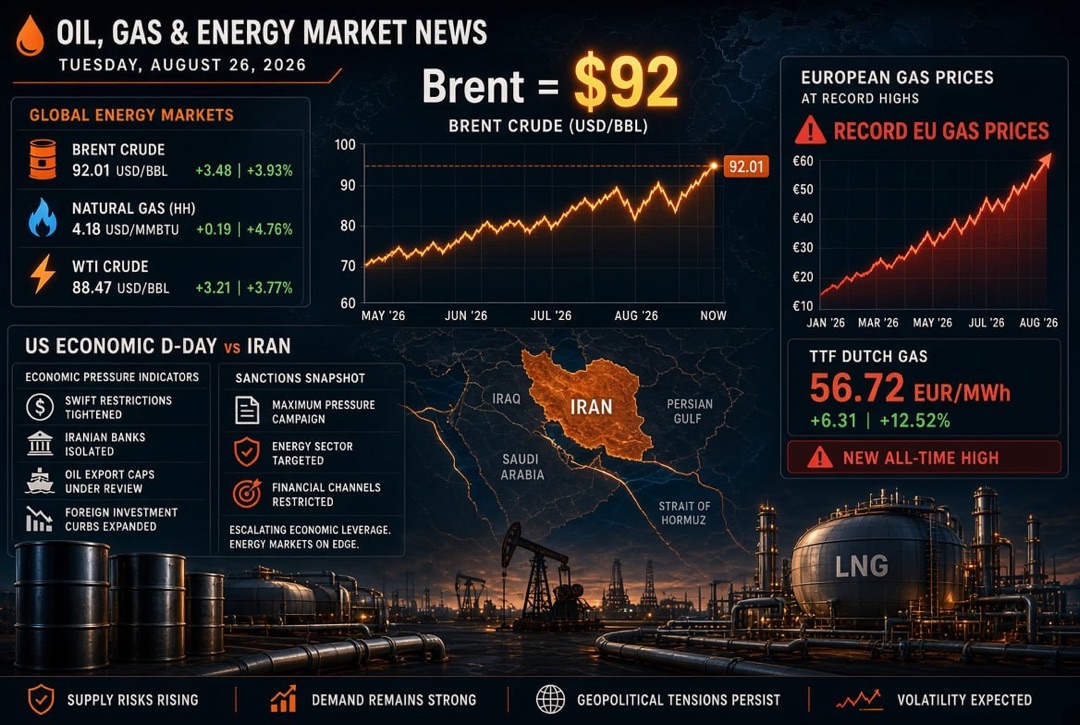
Oil & Gas and Energy News — Tuesday, July 28, 2026: Brent Collapses Below $85 on De-escalation Around the Strait of Hormuz, CPC Restart, TTF Gas Retreats, and API US Oil Inventory Data
The global fuel and energy complex enters Tuesday, July 28, 2026, in a mode of sharp geopolitical risk reassessment. The suspension of US strikes on Iran and progress in negotiations between Tehran and Muscat on shipping in the Strait of Hormuz, within a single day, have crashed Brent crude oil quotes by more than $15 from last week's peaks, brought European TTF gas back below $720 per thousand cubic meters, and unlocked Kazakh oil shipments via the Caspian Pipeline Consortium. For investors, fuel and oil companies, and energy market participants, this signals a regime change: the market is shifting from trading a military scenario to trading the fundamental supply-demand balance. Below is a detailed overview of the oil, gas, coal, and power sectors, as well as key calendar events for Tuesday, including the release of API US oil inventory data at 23:30 Moscow time.
Key Highlights as of Tuesday Morning, July 28, 2026
- Oil: At the week's open, Brent lost up to 11.6%, dropping to $85.5 per barrel, then stabilized in the $85–92 range; WTI traded near $84–85 per barrel.
- Trigger: Washington broke a two-week series of strikes on Iran after an Omani delegation arrived in Tehran; a mechanism to resume shipping in the Strait of Hormuz is under discussion.
- Logistics: CPC resumed crude reception and loading at its marine terminal near Novorossiysk after a week-long pause — tankers Seamajesty and Milos are under loading.
- Gas: Near-term TTF futures fell more than 8%, dropping below $700 per thousand cubic meters for the first time in a week; the September contract traded around €59.4/MWh.
- Coal: High-calorie Australian coal (6,000 kcal) holds near $133 per tonne; medium-calorie (5,500 kcal) above $95 per tonne FOB Newcastle.
- Russia: Exchange prices for AI-95 hit new highs (over 82,600 rubles per tonne on July 24) with trading volumes near six-year lows.
- Calendar: 23:30 Moscow time — weekly US oil inventories from API; July 29 — Fed decision and official EIA statistics.
Oil Market: Geopolitical Premium Deflates Faster Than It Built Up
The oil market is showing classic asymmetry: the risk premium that took three weeks to build was erased in a single trading session. Recall that on July 23, Brent closed above $100 per barrel, and since the start of the month, the contract had gained over 30% — one of the sharpest rallies since 2022. By mid-Monday, October futures had plunged to $84.6, more than 15% below the recent peak.
Factors Pressuring Quotes Downward
- A pause in the US military campaign against Iran and signals of parties' readiness for a technical agreement on the strait.
- Restoration of Black Sea logistics: the CPC restart brings back over 1% of global oil supply to the market.
- OPEC+ spare capacity, which physically could not be realized with the Strait of Hormuz closed, but becomes accessible upon its unblocking.
- Revision of demand forecasts: the July EIA Short-Term Energy Outlook indicates a decline in global oil consumption in 2026, mainly due to Asia, which is sensitive to expensive energy.
Factors Preventing Deeper Declines
- The Strait of Hormuz remains formally closed: the Iran-Oman agreements are still at the level of working consultations, not a signed shipping regime.
- Depleted commercial oil and petroleum product inventories in OECD countries following the spring and summer phases of the conflict.
- High freight and insurance rates, which continue to be passed through to refinery feedstock costs.
- The consensus analyst forecast for 2026 has shifted to $85 per barrel for Brent, close to current levels, limiting further sell-off potential.
Hormuz and CPC: Logistics as the Primary Price-Setting Factor
The Omani draft agreement proposes dividing the water area into two corridors: the southern one — with free transit under pre-war rules, and the northern one — under Tehran's control. The Iranian side confirms the "useful" nature of the discussions but emphasizes that talks with Oman are not equivalent to dialogue with Washington. For the market, this means the premium removal is provisional: any resumption of strikes could return Brent to triple-digit levels within a single session.
Simultaneously, a second logistical bottleneck has been cleared. The Caspian Pipeline Consortium, which suspended operations on July 20 after a series of drone attacks on vessels near Novorossiysk, has resumed crude intake from shippers and loading via its marine terminal. The CPC system handles about 80% of Kazakhstan's oil exports from the Tengiz, Kashagan, and Karachaganak fields; consortium shareholders include Russia, Kazakhstan, Chevron, and Mobil Caspian Pipeline Company. The resumption of flows removes the risk of tank farm overflow and forced production cuts in Kazakhstan, and returns light sweet CPC Blend crude to European refineries.
OPEC+: Paper Quotas Rise Faster Than Physical Barrels
The alliance maintains a cautious production normalization trajectory. The August quota for the "group of eight" was raised by 188 thousand barrels per day to a total of 36.019 million bpd; Kazakhstan was allowed to increase production by 10 thousand bpd to 1.618 million bpd. From February to August 2026, the total quota increased by approximately 940 thousand bpd, but actual OPEC+ production significantly lags allowed levels due to blocked Persian Gulf export routes. The UAE's exit from the alliance on May 1, 2026, further narrowed the managed supply pool. The upcoming meeting on September quotas will be the market's first test of how the alliance responds to de-escalation: accelerating the return of volumes with an open Hormuz could quickly shift the oil market balance from deficit to surplus.
Gas Market: TTF Retreats, but Winter Risk for Europe Remains
European gas is pricing in de-escalation in sync with oil, but the market's structural vulnerability persists. EU underground storage holds just over 59 billion cubic meters versus nearly 72 billion cubic meters a year earlier — a deficit exceeding 12.6 billion cubic meters. During the current season, about 29.4 billion cubic meters have been injected compared to 35.3 billion cubic meters at the same date in 2025.
- Germany: Storage is approximately 46% full.
- France: Around 54%.
- Austria: Around 59%.
- Italy: Around 74%.
The key reason for the shortfall is competition for LNG. EU liquefied natural gas imports in July may fall to a two-year low amid cargo diversion to Asian markets and reduced Qatari supplies. Wind power generation partially balances the system, providing on average about 15% of Europe's electricity needs since early July. Nevertheless, at current injection rates, European industry enters the 2026/27 heating season with the lowest buffer in several years, preserving the potential for a new TTF price spike in the fourth quarter.
Coal: Fuel of Last Resort Retains a Premium
The coal market remains a beneficiary of the LNG deficit. High-calorie Australian coal quotes strengthened to nearly $133 per tonne, medium-calorie above $95 per tonne FOB Newcastle; the European index edged up to $119 per tonne. Prices are supported by abnormal heat in Asian importing countries and increased air conditioning demand. Metallurgical coal shows a different dynamic: the HCC index fell to $222 per tonne amid oversupply and weak demand. Japan, South Korea, and Taiwan are increasing coal-fired power plant utilization, replacing expensive gas generation, while India and China remain relatively shielded by their own domestic production.
Russia: Fuel Market, Exchange, and Export Revenue
The domestic petroleum products market is experiencing its most challenging summer in recent years. According to exchange trading data for the week of July 20–27, the average price of AI-92 was about 70,300 rubles per tonne, AI-95 around 80,400 rubles per tonne, with the AI-95 index rising above 82,600 rubles per tonne on July 24. At the same time, primary sales volumes of high-octane gasoline remain near minimum levels for at least six years — buyers are reluctant to take product with deferred delivery, expecting a correction in the fall.
The regulatory package includes a complete ban on exports of gasoline, diesel, marine fuel, jet fuel, and gasoil; a reduction in the mandatory exchange sales quota for gasoline from 15% to 10% for the period July 1 to September 30; strict limits on daily quote changes; zeroing of import duties and ramping up petroleum product imports from Belarus; maximum utilization of existing refinery capacities and postponement of scheduled maintenance. The government notes partial stabilization: in several regions, fuel supply restrictions have been lifted, with priority given to agricultural producers during the harvest campaign and northern deliveries.
In the export segment, dynamics are mixed. Urals discounts widened in the first half of July after a spring period when the Russian grade traded at a premium to Brent in shipments to India and China due to a shortage of sour grades. The decline in benchmark quotes, combined with ongoing sanctions-related infrastructure constraints — shipping, insurance, and payments — again squeezes oil companies' export revenues.
Power and Renewables: Record Year Despite the Crisis
The energy shock accelerated, rather than slowed, the energy transition. According to an updated International Energy Agency forecast, global electricity demand will grow by 3.6% in 2026 and another 3.8% in 2027. Key takeaways for investors in power and renewables:
- Renewable generation in 2026 will surpass coal-fired generation globally for the first time in history.
- The share of renewables in global electricity generation will rise from 33% in 2025 to 37% by 2027.
- Solar generation will add about 600 TWh and become the second-largest renewable source after hydropower.
- CO₂ emissions from the power sector will rise by about 1% in 2026 due to replacing expensive gas with coal, but will stabilize in 2027.
- Nuclear generation will accelerate by over 4% in 2027 due to new reactor startups.
Calendar for Tuesday, July 28, 2026: What Energy Markets Are Watching
- 23:30 Moscow time — Weekly US oil inventories from API. The American Petroleum Institute report traditionally serves as a leading indicator ahead of official EIA data. Amid a sharp decline in quotes, the reaction to this data could be amplified: a notable draw in commercial crude inventories would support WTI and Brent, while a build would reinforce the downward momentum.
- Bank of Russia inflation expectations survey — important for assessing the key rate trajectory, currently at 14%, and funding costs for oil, gas, and energy companies.
- Preparation for the Fed decision on July 29 — the dollar and risk appetite remain a secondary but significant driver for commodity markets.
- Semi-annual reporting season: this week features results from major international oil and gas majors and Russian energy sector issuers.
- Diplomatic track: any news regarding the signing or collapse of an agreement on the Strait of Hormuz could shift quotes by $5–10 per barrel within a single session.
Conclusions for Investors and Energy Market Participants
- Volatility remains a structural market characteristic. The amplitude of 5–10% moves per session makes hedging positions in oil, gas, and petroleum products a mandatory element of risk management.
- Logistics matter more than geology. Hormuz, Bab-el-Mandeb, and Novorossiysk in 2026 determine the barrel price more than the volume of reserves underground.
- Refining margins face two-sided pressure. Lower feedstock costs improve refinery crack spreads, but administrative controls on selling prices and weak wholesale demand offset the effect.
- Gas risk is shifted to the fourth quarter. The shortfall in European gas storage fill is the main argument against betting on sustained TTF declines.
- Coal and nuclear generation are being revalued upward as assets with predictable costs and long contract horizons.
- Renewables benefit from the crisis. Corporate consumers increasingly view self-generation as insurance against geopolitical shocks in hydrocarbon supply chains.
The baseline scenario for the coming sessions is Brent consolidation in the $82–92 per barrel range with high sensitivity to news flow around the Strait of Hormuz. For energy market participants — fuel and oil companies, traders, refinery operators, and energy holdings — it is prudent to assume that heightened amplitude in commodity and energy market quotes will persist at least through the end of the third quarter of 2026.