Global Startup and Venture Capital News for Sunday, January 11, 2026: Mega Funds, Record Rounds in AI, IPO Revival, Market Consolidation, and Key Trends for Venture Investors and Funds.
At the beginning of 2026, the global venture capital market is confidently growing, having overcome a period of decline. It is estimated that over $100 billion was invested in technology startups in Q4 2025 (approximately 40% more than the previous year) – marking the best quarterly result since 2021. The prolonged "venture winter" of 2022-2023 is behind us, and private capital is rapidly returning to the technology sector. The largest funds are again actively investing in promising companies, and investors are willing to take risks for high potential returns. The industry is confidently entering a new phase of venture investment growth, although caution in project evaluations remains.
Venture activity is increasing across all regions of the world. The United States continues to lead (particularly due to colossal investments in artificial intelligence). In the Middle East, the volume of investments in startups has multiplied thanks to generous funding from government mega-funds. In Europe, Germany outranked the UK in the volume of venture deals for the first time in a decade, strengthening the positions of continental tech hubs. In Asia, growth is shifting from China to India and Southeast Asia, compensating for the relative cooling of the Chinese market. Africa and Latin America have also made their mark — these regions have seen the emergence of first "unicorns," indicating the truly global nature of the current venture capital boom. The startup ecosystems in Russia and the CIS are striving to keep pace: with support from the government and corporations, new funds, accelerators, and programs aimed at integrating local projects into global trends are being launched in the region.
Below are the key news and trends shaping the venture market as of January 11, 2026:
- The Return of Mega Funds and Large Investors. Leading venture players are forming unprecedentedly large funds and increasing investments, once again flooding the market with capital and reigniting the appetite for risk.
- Record Rounds in AI and New Unicorns. Massive investments in artificial intelligence are driving company valuations to unprecedented heights and generating a wave of unicorn startups.
- IPO Market Revival. Successful stock market debuts of technology companies and an increase in listing applications indicate that the long-awaited "window of opportunity" for exits is once again open.
- Diversification of Industry Focus. Venture capital is being directed not only to AI but also to fintech, climate tech, biotech, defense technologies, and other sectors, broadening the market's horizons.
- Wave of Consolidation and M&A Deals. Major mergers and acquisitions are reshaping the industry landscape, providing investors with exits and accelerating the growth of the combined companies.
- Global Expansion of Venture Capital. The investment boom is reaching new regions – in addition to the USA, Western Europe, and China, significant funding is being directed to startups in the Middle East, South Asia, Africa, and Latin America.
- Local Focus: Russia and the CIS. Despite limitations, new funds and initiatives for the development of local startup ecosystems are emerging in the region, maintaining investor interest in local projects.
The Return of Mega Funds: Big Money Back in the Market
The largest investment players are making a triumphant return to the venture arena, indicating a new surge in risk appetite. The Japanese conglomerate SoftBank has announced a new Vision Fund III worth approximately $40 billion, focused on advanced technologies (primarily artificial intelligence and robotics). Sovereign funds from the Gulf countries are also becoming more active: they are pouring billions into tech projects and launching large-scale programs to develop the startup sector, creating their own tech hubs in the Middle East. At the same time, numerous new venture funds are being established worldwide, attracting significant institutional capital for investments in high-tech areas.
Renowned Silicon Valley firms are also increasing their presence. In the US venture sector, funds have accumulated unprecedented reserves of uninvested capital ("dry powder") – hundreds of billions of dollars, ready to be deployed as confidence in the market strengthens. Several well-known venture firms that had previously slowed their activity are returning to the scene with new mega-rounds. For instance, the investor from the previous boom, Tiger Global, after a pause, has established a new $2.2 billion fund, promising a more selective and "humble" approach to investments. The flow of "big money" has noticeably invigorated the ecosystem: the market is again filled with liquidity, competition for the best deals intensifies, and the industry gains much-needed confidence in the continued influx of capital.
Record Investments in AI and a New Wave of Unicorns
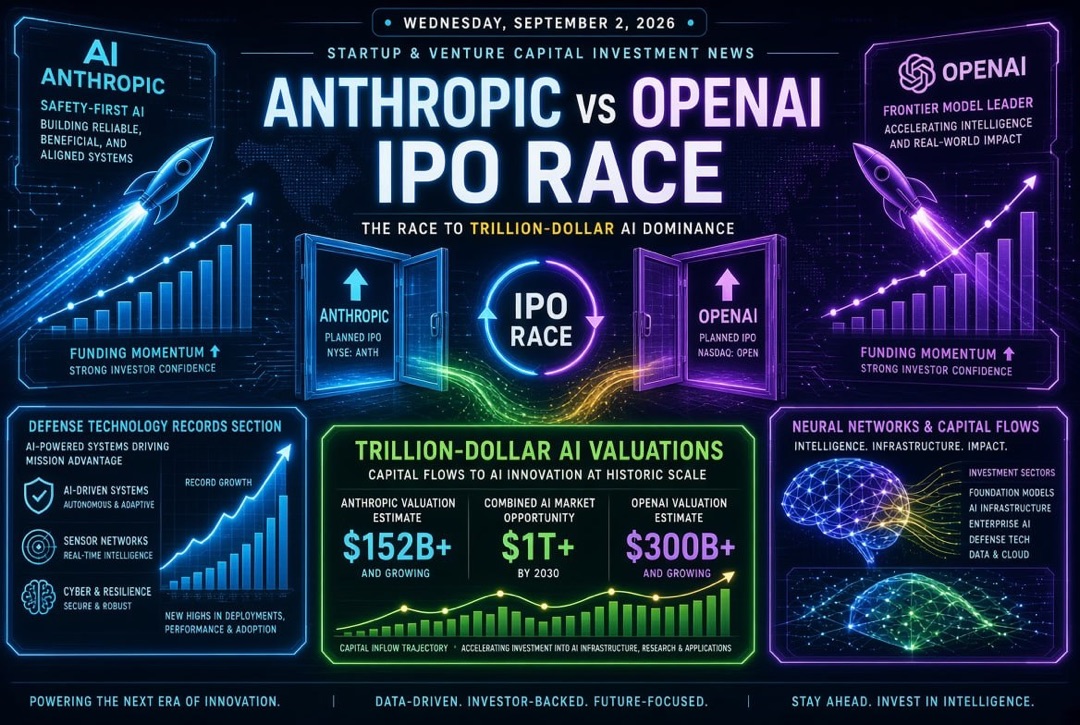
The field of artificial intelligence remains the main driver of the current venture surge, setting new records for funding volumes. Investors are eager to establish their presence among AI market leaders by directing colossal amounts into the most promising startups. In recent months, several AI companies have secured unprecedentedly large rounds. For example, the startup OpenAI raised a record private financing round of approximately $40 billion (the largest in history), the AI infrastructure developer Anthropic attracted about $13 billion in investments, and Elon Musk's xAI project sought around $10 billion. Such mega-rounds, often accompanied by multiple oversubscriptions from eager investors, confirm the hype surrounding AI companies.
Venture capital is not only directed to applied AI services but also to critically important infrastructure for them. Investors are willing to finance even the "shovels and pickaxes" of the new digital era – from the production of specialized chips and cloud platforms to tools for optimizing energy consumption in data centers. Analysts estimate that the total investment in the AI sector exceeded $150 billion for 2025. This current investment boom is giving rise to a wave of new unicorns — startups valued at over $1 billion. While experts warn of overheating risks, investors' appetite for AI startups remains strong.
The IPO Market Revives: A Window of Opportunity for Listings
The global market for initial public offerings is experiencing a long-awaited revival after a prolonged pause in recent years. Successful stock market debuts of several large tech companies in 2025 have demonstrated that the downturn is behind us. Fintech unicorn Chime, for example, had one of the year's most spectacular IPOs, with its shares soaring over 30% on the first trading day, bolstering investors' faith in new listings. In Asia, Hong Kong leads the IPO wave, with several large startups going public in recent months, collectively raising multi-billion sums. Following them, other well-known unicorns are preparing for the public market, creating an encouraging queue for IPOs in 2026.
The revival of activity in the IPO market is critically important for the venture ecosystem. Successful initial public offerings once again provide funds with opportunities to exit their investments profitably, freeing up capital for new projects. The number of listing applications has notably increased, and companies that have long postponed their public debuts are eager to take advantage of the opened "window." It is expected that 2026 will see new high-profile listings – among potential debutants are both AI leaders (OpenAI, Anthropic) and fintech unicorns, along with representatives from other sectors. The extended period of an open window for IPOs instills optimism in the industry, though investors continue to carefully evaluate the fundamentals of the companies going public.
Diversification of Industry Focus: New Investment Horizons
Venture investments are no longer focused exclusively on artificial intelligence – capital is actively being directed towards a wide spectrum of industries, making the market more balanced. Signs of revival are evident in fintech, climate tech, biotech, defense, and other segments. This shift means that the venture market encompasses a more diverse range of ideas and solutions, reducing dependence on a single dominant trend. Investors are diversifying their portfolios, distributing funds across different sectors of the economy.
- Fintech: Financial technologies are once again attracting capital due to adaptation to new regulatory conditions and integration with AI (for instance, in payment services and neobanks).
- Climate Projects: "Green" technologies are receiving heightened support in light of the global push for decarbonization – investors are financing innovations in renewable energy, emission reduction, and eco-friendly infrastructure.
- Biotechnology and Healthcare: Biotech is returning to focus thanks to breakthroughs in medicine (vaccine development, gene therapy) and the use of AI in pharmaceuticals, attracting new funding rounds.
- Defense and Aerospace Developments: Geopolitical factors are stimulating an increase in investments in military technologies, cybersecurity, space projects, and robotics, with both government and private funds jointly supporting dual-use startups.
The expansion of industry focus makes the venture market more resilient and multifaceted. The diversity of directions reduces the risks of overheating in any one sector and lays the groundwork for higher-quality, balanced growth of the startup ecosystem in the long term. Investors, in turn, have the opportunity to discover promising projects across a wide range of areas – from finance and energy to medicine and defense – thereby enhancing the overall effectiveness of their investments.
Wave of Consolidation and M&A: The Market Is Consolidating
Against the backdrop of the overall industry upturn, consolidation has intensified: the number of large mergers and acquisitions of startups significantly increased in 2025, reaching a peak in recent years. Tech giants and financial corporations are once again actively acquiring promising young companies, seeking to strengthen their presence in strategic niches. The scale of deals is impressive: the corporation Google, for instance, agreed to acquire the cloud cybersecurity startup Wiz for approximately $32 billion – one of the largest purchases in the history of the tech sector. In the crypto industry, there was a similarly significant deal: the South Korean exchange Upbit (operator Dunamu) was acquired by internet giant Naver for around $10 billion, marking the largest fintech exit in the region.
Consolidation is affecting other segments as well: in fintech, healthcare, AI – large players are purchasing startups to accelerate innovation and expand product lines. For venture investors, the wave of M&A means long-awaited exits (profits are being realized through company sales, not just IPOs). For the startups themselves, entering the ranks of corporations opens up access to vast resources, a global customer base, and infrastructure, accelerating their development. The activation of mergers and acquisitions is indicative of the maturity of certain market segments: the most successful companies are integrating into larger structures, while investors gain an additional tool for capital return beyond public offerings. Although some deals are driven by necessity (for instance, startups seek "rescue" through sale amid difficulties in maintaining growth), the overall trend toward consolidation adds dynamism to the venture market and creates new opportunities for all participants.
Global Expansion of Venture Capital: Emerging Regions on the Rise
The venture boom of recent months has acquired a truly global scale, extending far beyond traditional tech centers. More than half of global venture investments now come from countries outside the USA, reflecting the formation of new growth points. The Middle East is rapidly transforming into a powerful investment hub: funds from the Gulf countries are investing billions into creating local tech parks and developing startup ecosystems. India and Southeast Asia are setting records in venture deal volumes, annually giving birth to new unicorns and attracting global investors. The tech scenes in Africa and Latin America are also actively developing – startups in these regions have already emerged whose valuations exceed $1 billion, making them new global players.
Thus, venture capital has become more geographically distributed than ever before. Promising projects can receive funding regardless of their country of origin, as long as they demonstrate scalability potential. For investors, this opens up new horizons: the search for high-yield opportunities is now conducted around the world, and risks are diversified across different regions. The global expansion of the venture market is contributing to an influx of talent and an exchange of experience – the tech ecosystems of different countries are increasingly interconnected, enhancing the overall innovative potential of the planet. Enhanced competition for promising startups on a global level ultimately stimulates the quality of projects and creates a more balanced environment for the growth of new companies.
Russia and the CIS: Local Initiatives Amid Global Trends
Despite external constraints, there is a gradual revival of startup activity at the local level in Russia and neighboring countries. Although the total volume of venture investments in Russia has decreased in recent years, private investors and funds maintain cautious optimism. In 2025, new funds totaling tens of billions of rubles emerged in the region, aimed at financing early-stage tech projects. Large corporations are launching their own accelerators and venture divisions, and government programs are providing grants and investments for startups. For instance, in Moscow, one initiative attracted about 1 billion rubles in local IT projects – a significant signal of support for the market.
A shift in focus toward more mature and resilient companies is noted. Venture investors in Russia and the CIS prefer startups with proven revenue and a viable business model – those capable of growing even with limited new capital influx. The easing of several barriers has opened opportunities for investments from friendly countries, partially compensating for the outflow of Western capital. Several large tech companies in the region are considering going public: IPOs of individual IT divisions of major holdings are being discussed, which could breathe additional life into the local market given improved conditions. Gradually, a new local venture ecosystem is forming, relying on internal resources and regional players. The emergence of the first large deals and new funds instills cautious optimism: even amid limited connectivity to global financial flows, the Russian and neighboring markets are laying the groundwork for future growth of innovations.
Key Trends and Predictions
In the wake of 2025, the global startup market showed a vigorous recovery. In North America, the total volume of investments reached a record ~$280 billion (a 46% increase from the previous year), with approximately 60% of this amount directed towards AI companies. Similar trends can be observed in other regions. Investors are concentrating on large deals: the number of rounds decreased by about 15%, but the share of mega-rounds has significantly increased.
- North America: ~$280 billion – the highest figure in four years, primarily due to AI investments.
- AI Share: More than half of venture capital was directed towards companies utilizing AI technologies.
- Late-Stage Boom: Financing of late rounds increased by ~75%, reaching about $191 billion.
- Focus on Resilience: Funds are paying more attention to capital efficiency and quick paths to profitability when selecting projects.
Experts predict that in 2026, investments in infrastructure and AI will remain high, while successful startups will focus on discipline, efficiency, and quality execution of strategy. Thus, despite the general optimism in the market, the success of a startup in 2026 will depend on prudent management and a solid business foundation, even amid an abundance of new opportunities opening up during this wave of venture growth.