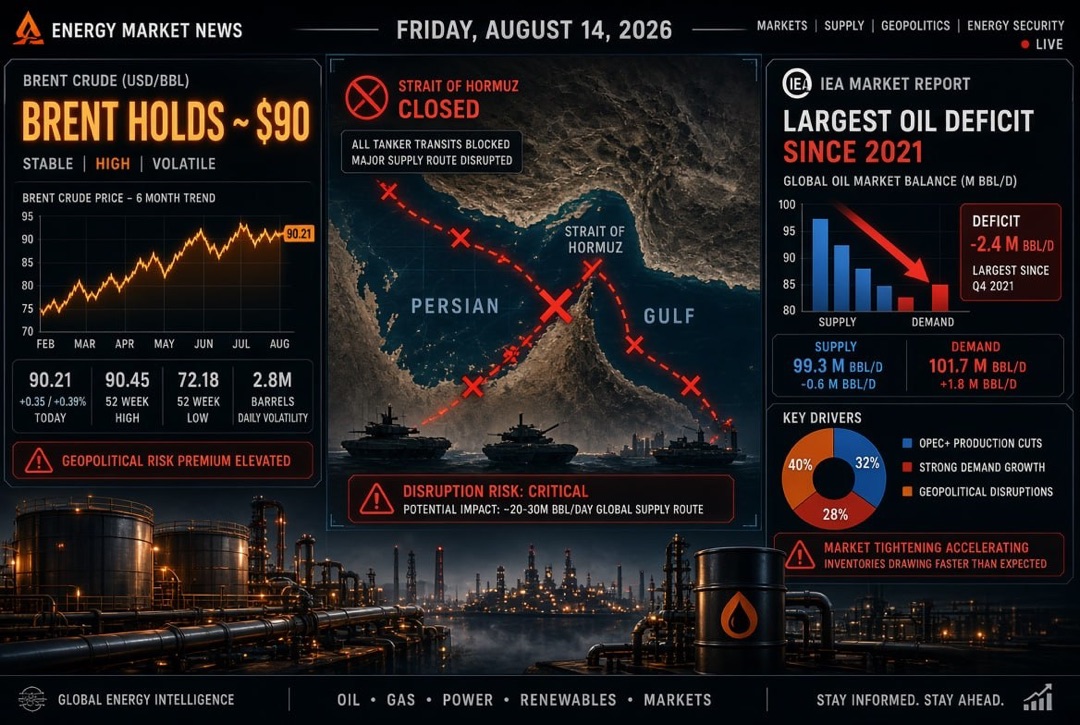
Global Fuel and Energy Complex on May 24, 2026: Oil, Gas, LNG, Refineries, Petroleum Products, Electricity, Renewables, and Coal Shape Key Risks and Opportunities for Investors
Sunday, May 24, 2026, marks a significant moment for the global fuel and energy complex. News from oil, gas, and energy is increasingly perceivable as an interconnected narrative: oil, gas, electricity, renewables, coal, petroleum products, and refineries today function as a unified system, where disruptions in one segment rapidly transfer to others. For investors, market participants in the energy sector, fuel companies, and oil companies, the crucial inquiry extends beyond Brent prices or gas dynamics; it encompasses the resilience of the entire supply chain — from extraction and transportation of raw materials to processing, petroleum product export, and electricity generation.
The primary theme of the day remains the sustained tension in the oil and petroleum product markets amidst declining inventories, high refinery utilization rates, a realignment of trade flows, and growing demand for diesel, gasoline, jet fuel, and LNG. Energy increasingly relies on infrastructure factors: port throughput, tanker availability, grid stability, construction rates of renewable energy sources, and energy storage systems.
Oil: The Market Remains Sensitive to Inventories and Logistics
As the global oil market enters the final week of May, it experiences heightened volatility. Investors are carefully assessing not only current quotes but also the balance of supply and demand. The reduction in commercial inventories in the U.S., high export activity, and logistical tensions enhance the role of U.S. oil as a flexible supply source for Europe and Asia.
For oil companies, this creates a dual effect. On one hand, high oil prices support cash flows in the upstream segment. On the other hand, excessively high oil prices pressure refining, industrial demand, and consumption of petroleum products. Consequently, the market increasingly turns its attention not only to production but also to:
- levels of crude oil and petroleum product inventories;
- refinery utilization rates in the U.S., China, Europe, and Asia;
- refining margins for diesel, gasoline, and jet fuel;
- availability of the tanker fleet and charter rates;
- risks of supply disruptions through key maritime routes.
For investors in oil and gas, the main takeaway remains unchanged: the oil market in 2026 is trading not solely on supply demand expectations but also on a premium for the reliability of supplies.
Refineries and Petroleum Products: Refining Becomes the Epicenter of Profit and Risk
The refinery sector remains one of the most crucial elements of the global energy complex. High demand for jet fuel, diesel, and gasoline sustains refining margins, particularly for export-oriented plants. Nonetheless, some Asian refiners face pressure due to high raw material costs, weak local margins, and export restrictions on petroleum products.
Chinese refineries, including major state-owned companies, scaled down processing in May due to supply disruptions and declining profitability. This is significant for the entire market: China remains one of the largest consumers of oil, and changes in its refinery utilization directly influence global flows of raw materials, petroleum products, and price spreads.
For fuel companies, the situation enhances the importance of operational flexibility. Plants capable of swiftly adjusting production between diesel, gasoline, jet fuel, and petrochemical feedstocks gain an advantage. Less flexible refineries may encounter margin declines even amidst high petroleum product prices.
Gas and LNG: The Global Market Once Again Becomes a Competitive Arena for Supplies
The gas market at the end of May maintains heightened sensitivity to LNG supplies. Europe, Asia, and emerging economies compete for the same flexible shipments of liquefied natural gas. This is particularly crucial for countries where gas serves simultaneously in power generation, industry, heating, and fertilizer production.
Rising LNG prices in Europe and Asia amplify the disparity with the domestic gas market in the U.S., where supply remains more stable. For energy companies, this creates various investment signals: in North America, there is growing attractiveness for LNG, NGL, and gas chemicals projects, while in Europe and Asia, the focus intensifies on supply diversification, renewables, energy storage, and long-term contracts.
Key factors in the gas market on May 24, 2026, include:
- competition between Europe and Asia for LNG;
- high reliance of importers on maritime logistics;
- growing role of the U.S. as a supplier of gas and natural gas liquids;
- strengthening correlation between gas, coal, and electricity prices;
- increased interest in long-term contracts to mitigate price volatility.
Electricity: Demand Grows Faster Than Networks Can Adapt
Electricity has become a central theme in global energy. Rising consumption from industry, electric vehicles, air conditioning, data centers, and artificial intelligence reshapes demand structures. For electricity markets, this indicates that the focus is no longer solely on generation volume, but also on the flexibility of energy systems.
Data centers are emerging as new significant electricity consumers. Their load is concentrated, sensitive to grid reliability, and requires stable power supply. In several countries, energy regulators are already discussing stricter technical requirements for large consumers to avert the risk of sudden power outages during voltage fluctuations.
For investors, this creates several areas of interest: network companies, equipment manufacturers, energy storage operators, gas generation as reserve power, as well as renewable energy projects with contracts for electricity supply to corporate clients.
Renewables and Storage: The Energy Transition Becomes a Matter of Security
In 2026, renewables are increasingly viewed not only as a climate tool but also as an element of energy security. Solar and wind generation help reduce dependence on imported fuels; however, without energy storage, network modernization, and flexible demand, their potential remains limited.
The market for battery energy storage systems is rapidly growing, particularly in the U.S., Europe, and Asia. Large storage projects are becoming integral to infrastructure for data centers, industrial zones, and energy systems with a high share of renewables. For energy companies, this signifies a transition from simple electricity sales to a more complex model: power management, balancing, reserving, and ensuring reliability.
The most promising areas in renewables and storage include:
- solar power plants with battery systems;
- wind generation with long-term corporate contracts;
- storage solutions for data centers and industrial consumers;
- hybrid projects combining gas generation with renewables;
- long-term energy storage technologies.
Coal: Its Role is Structurally Diminishing but Remains in Energy Security
Coal continues to be an integral part of the global energy complex, despite the rise of renewables and tightening climate policies. In Asia, coal continues to serve as a baseload fuel for power generation, particularly in countries with rising demand and limited gas infrastructure.
The market is particularly focused on Indonesia, one of the world's largest exporters of energy coal. Increasing government controls over the export of raw materials may alter trade flows, contractual terms, and price expectations for buyers in Asia. For coal companies and traders, this heightens the significance of regulatory risk alongside traditional supply and demand factors.
Investors need to consider that even if coal's share in global electricity generation gradually declines, its significance as a backup and accessible fuel during periods of expensive gas remains high.
Oil and Gas Companies: Capital Flows into Infrastructure, NGL, and Export Chains
Oil and gas companies are increasingly investing not only in oil and gas extraction but also in infrastructure: pipelines, gas processing, fractionation, export terminals, NGL, and petrochemicals. This reflects a broader trend: profitability in the energy sector is increasingly derived not only at the wellhead but also in the processing, transportation, and delivery chain to end consumers.
There is a particularly noticeable interest in natural gas liquids — ethane, propane, butane, and other fractions, which are used in the chemical industry, exports, and energy. Against the backdrop of growing global demand for petrochemical feedstocks, such projects become strategic assets.
For investors, companies that control multiple components of the chain — extraction, processing, transportation, export, and sales — are attractive. This vertical integration reduces dependence on a single market segment and enhances resilience to price shocks.
Market Geography: The U.S., Europe, Asia, and the Middle East Signal Differently
The global energy market on May 24, 2026, is developing unevenly. The U.S. is strengthening its role as an exporter of oil, gas, LNG, and petroleum products. Europe continues to seek a balance between energy security, renewables, LNG, and industrial competitiveness. Asia remains the primary center of demand for oil, gas, coal, and petroleum products, but increasingly grapples with price sensitivity and logistical risks.
The Middle East retains a key role in the supply of oil, gas, and petroleum products, where any disruptions in the region quickly reflect on prices, freight rates, and inventories. For fuel companies and energy market participants, this implies a continuous need to consider geopolitics, cargo insurance, alternative routes, and contract structures.
What is Important for Investors and Energy Companies in the Coming Days
For investors, oil companies, refineries, fuel traders, and energy holdings, the coming days will be defined not by a single indicator but by a set of interconnected factors. The oil market depends on inventories and exports, gas hinges on LNG and regional competition, electricity on data center demand and grid stability, renewables on connection rates and storage systems, and coal on Asian demand and export regulations.
Key monitoring points include:
- dynamics of commercial oil and petroleum product inventories;
- refinery margins for diesel, gasoline, and jet fuel;
- LNG prices in Europe and Asia;
- refinery utilization in China and the U.S.;
- investments in renewables, storage, and power grids;
- export policies of major coal and raw material suppliers;
- demand for electricity from data centers and industry.
The principal conclusion for the energy market on Sunday, May 24, 2026, is that the energy sector is entering a period where companies with access to raw materials, flexible infrastructure, reliable supply channels, and the ability to operate across multiple segments — oil, gas, electricity, renewables, coal, petroleum products, and refineries — will have the advantage. For global investors, this translates into a shift from merely assessing commodity prices to analyzing the entire energy value chain.