Global Fuel and Energy Market April 14, 2026: Rising Oil Prices, Supply Risks, Pressure on Gas and LNG, and the Situation in Electricity and Oil Refining
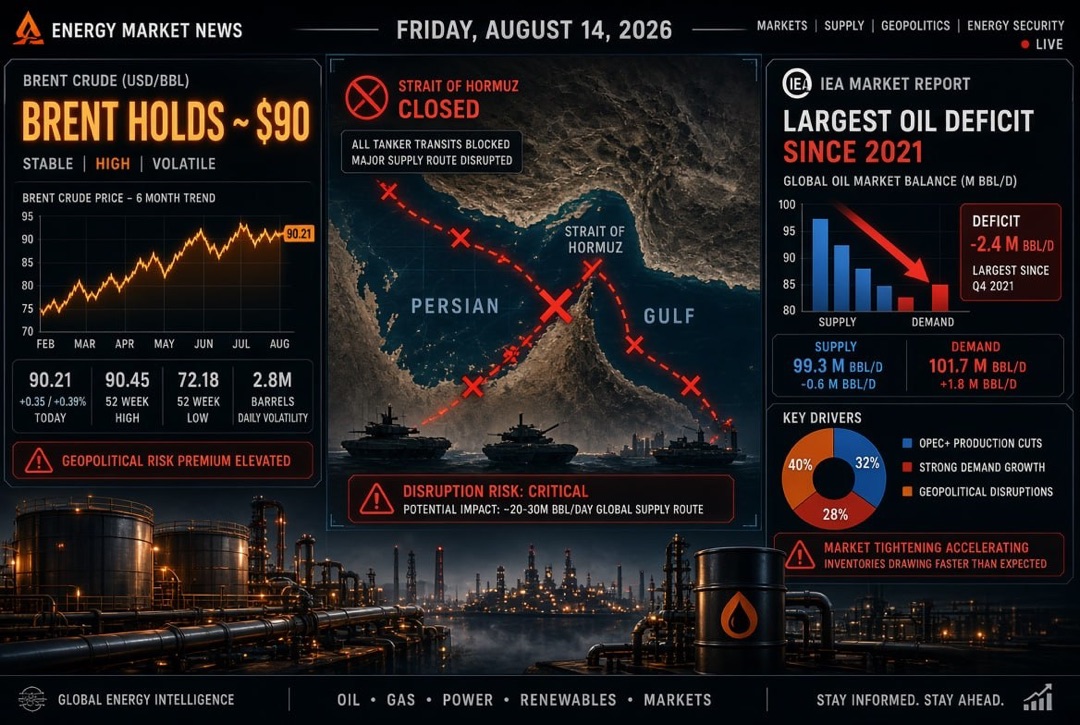
The global fuel and energy complex enters a phase of heightened turbulence on Tuesday, April 14, 2026. For investors, oil companies, refineries, petroleum traders, gas players, and the electricity sector, the paramount factor remains not only the price of oil but also the stability of the entire supply chain—from raw materials to end fuels and generation. While previous months primarily focused on the balance of supply and demand, the current spotlight is on the physical availability of barrels, LNG, and export infrastructure.
The key topic of the day is the sharp rise in geopolitical premiums on the global oil and gas market. The oil and gas sector, Europe's and Asia's energy markets, electricity, coal, renewables, and petroleum products are all interconnected by one logic: the longer the tension on key transport routes persists, the higher the risk for prices, refining margins, and energy security. This is no longer a local episode for the global energy market but a full-scale stress test.
Oil: The Market Pays a Premium for Physical Barrel Availability
On Tuesday, the oil market approaches trading after a new surge in prices. For the oil and gas sector, it is critical that not only futures are rising but also physical shipments of raw materials for prompt delivery. This fundamentally alters the landscape: the premium is formed not abstractly but through specific cargoes that refiners in Europe and Asia need right now.
- Brent has settled above the psychologically important mark of $100 per barrel.
- Physical grades for delivery to Europe are trading at extreme premiums, as refiners seek to replace Middle Eastern volumes.
- Global demand for oil from the North Sea, West Africa, and the U.S. is strengthening as the most accessible alternative.
For investors, this indicates that the oil market has temporarily ceased to be solely a story of fundamental oversupply. Operational logistics, insurance, freight, and accessibility of export routes are now more critical. This is why the global oil market appears tighter than would be suggested by consumption forecasts alone.
OPEC+ and Supply Balance: Formally Increasing Quotas, Factually a Deficit of Flexibility
Against this backdrop, the position of OPEC+ takes on special significance. The cartel and its allies continue to speak of market stabilization, but the actual situation indicates that even with political readiness to increase supplies, physically compensating for lost volumes is not straightforward. The oil market remains reliant on a limited number of countries capable of quickly ramping up exports.
OPEC has already lowered its demand forecast for the second quarter, yet retains a relatively stable outlook for the entirety of 2026. This suggests that, in the short term, the issue lies not only in demand but also in disrupted supply. Even the decision by some OPEC+ countries to adjust production for May does not alter the primary fact: as long as logistics and infrastructure remain under pressure, an increase in quotas alone will not guarantee a rise in actual supplies.
- The oil market will, in the coming weeks, operate under the logic of a physical deficit of available barrels.
- Any news regarding the restoration of routes could trigger a sharp price correction.
- However, until supply normalizes, oil, gas, and petroleum products will remain expensive for the final consumer.
Gas and LNG: The Global Market Returns to the Topic of Energy Security
If oil sets the tone for headlines, gas and LNG shape the depth of energy risk. This is especially sensitive for Europe and Asia, as the gas market does not tolerate sudden withdrawals of large volumes. Any disruption in LNG immediately reflects on electricity prices, industrial demand, and purchasing strategies for the coming months.
The LNG segment remains vulnerable across several fronts. First, supplies from key export centers are recovering more slowly than consumers would like. Second, there are few available capacities in the global market. Third, Asian importers are already beginning to look ahead to the summer cooling season, which increases competition for every available cargo. For the energy markets of Japan, South Korea, India, and Southeast Asia, this translates into stricter purchasing conditions and an increasing risk of strain in electricity supply.
It is also important to note that even at maximum utilization of American LNG facilities, the problem is not fully resolved. The U.S. remains a crucial stabilizer, but the reserve for quickly ramping up exports is limited. Consequently, the global gas market enters the second quarter with an extremely low safety cushion.
Petroleum Products and Refineries: The Main Deficit Shifts to Refining
For refineries, fuel companies, and the petroleum products market, the current week is as significant as it is for the upstream segment. The weak point of the global energy sector now lies not only in production but also in refining. Diesel, jet fuel, and certain mid-distillates—critical for transport, logistics, aviation, and industry—are under pressure.
Refining margins remain high in several regions, and the diesel market appears especially tight. European and Asian refiners are feeling pressure due to expensive raw materials and the need to rapidly replace familiar supply flows. In contrast, some refineries in the U.S., especially along the Gulf Coast, are benefiting from increased export demand. This creates asymmetry: some players face rising costs while others enjoy improved profitability.
- For the petroleum products market, the key risk is not a shortage of crude oil as such, but specifically of finished fuels.
- For refineries, access to raw materials and the ability to quickly adjust sourcing baskets remain crucial.
- For air transport and heavy logistics, expensive jet fuel and diesel become direct inflationary factors.
Electricity, Coal, and Renewables: The Energy Transition is Unabated, but the System Seeks Reserves
In electricity, the picture is becoming more complex. On one hand, renewables continue to strengthen their positions in the energy balance, with solar and wind generation playing a structurally important role, particularly in Europe. On the other hand, every major external trade or geopolitical shock reminds the market that the reliability of energy systems still requires backup capacity.
This is why coal and gas are not disappearing from the agenda. In Asia, coal is once again seen as insurance against disruptions in gas and LNG. In India, where authorities emphasize the adequacy of fuel supplies for power plants, this creates an additional buffer of resilience. In Europe, the energy sector is forced to juggle two processes simultaneously: accelerating the energy transition while maintaining adequate thermal generation to cope with peak load demands.
For the renewables market, the current situation is paradoxically beneficial from a strategic standpoint. The higher the volatility in the oil and gas markets, the stronger the argument for investments in solar generation, wind, energy storage, grid modernization, and local energy projects. However, in the short term, electricity still remains tied to the costs of gas, coal, and backup generation.
Europe: Between Decarbonization, Expensive Gas, and Energy Security Policy
For Europe, Tuesday, April 14, begins with a challenging balance. The region continues to advance its climate and investment agenda, yet the current reality necessitates a focus on energy security. This is reflected in the discussions around gas strategy, fiscal measures, and the caution surrounding new restrictions on energy resource imports.
Some European governments are already betting on mitigating the impact on consumers through tax and budgetary measures. Simultaneously, companies warn that the gas market remains tense, and replacing specific volumes of imported fuel may prove more expensive and complex than initially anticipated this year. For industry, this means continued high uncertainty regarding costs, while for investors, it increases attention on companies with strong vertical integration and stable raw material bases.
Nevertheless, the structural trend remains unchanged: Europe is still one of the key centers for demand for renewables, electricity modernization, storage, and flexible gas capacity. However, in the short term, the priority is singular—preventing fuel shortages and price spikes that would impact inflation and industrial competitiveness.
Logistics and New Growth Points: The Middle East, Russia, Africa
The global energy market is increasingly dependent on how quickly producers can realign their routes. Saudi Arabia, following the restoration of key pipeline infrastructure, is enhancing the role of the western export corridor, which partially reduces risks for the global oil market. However, the recent attacks on bypass routes demonstrated that even alternative logistics are not completely secure.
Russia, for its part, is facing risks to port infrastructure in the Black Sea and is reallocating flows to domestic refining and alternative directions. For the petroleum products market, this is an important signal: export routes may change faster than buyers can adapt.
Against this backdrop, Africa’s significance as a source of additional barrels is increasing. The growing interest in West African oil and new discoveries in Congo confirm that players will invest more actively in projects that can be relatively quickly connected to existing infrastructure. For the oil and gas sector, this means a return of capital to projects with short lead times and clear export logistics.
What This Means for Investors and Participants in the Energy Market
As of April 14, 2026, the fundamental takeaway for the global market is as follows: oil, gas, electricity, and petroleum products are moving not in the logic of the usual commodity cycle, but in the logic of supply risk management. This alters the assessment of companies throughout the value chain.
- For oil companies, producers with stable exports outside narrow logistical chokepoints are the winners.
- For refineries, access to raw materials and the ability to swiftly shift between shale, Atlantic, and African supply baskets become key.
- For the gas sector, the focus remains on LNG, storage, terminals, and long-term contracts.
- For electricity companies, the importance of backup generation, grids, and storage is increasing.
- For renewables, the ongoing crisis strengthens long-term investment appeal, even as short-term volatility persists.
This is why, on Tuesday, investors will be watching not only Brent quotes but also signals about LNG, reserves, refineries, pipeline logistics, coal stocks, and government actions. For the global energy sector, currently, no single indicator is sufficient; rather, an entire system of interrelated risks is crucial.
What to Monitor on April 14
- further dynamics of Brent oil prices and premiums on physical grades;
- news regarding the restoration of export routes and pipeline infrastructure;
- signals from the LNG market and demand from Asia;
- the state of refinery margins and prices for diesel and jet fuel;
- actions by OPEC+, IEA, and national governments to stabilize the market;
- the response of European and Asian electricity sectors, including coal, gas, and renewables.
The conclusion for Tuesday is as follows: the global energy sector is entering a new phase where the main value is not simply derived from oil and gas production but from the ability to guarantee supply, processing, and affordable electricity amidst disrupted trade geography. For participants in the energy market, this is an environment of heightened risks, but also a period of significant capital, margin, and strategic advantage redistribution.