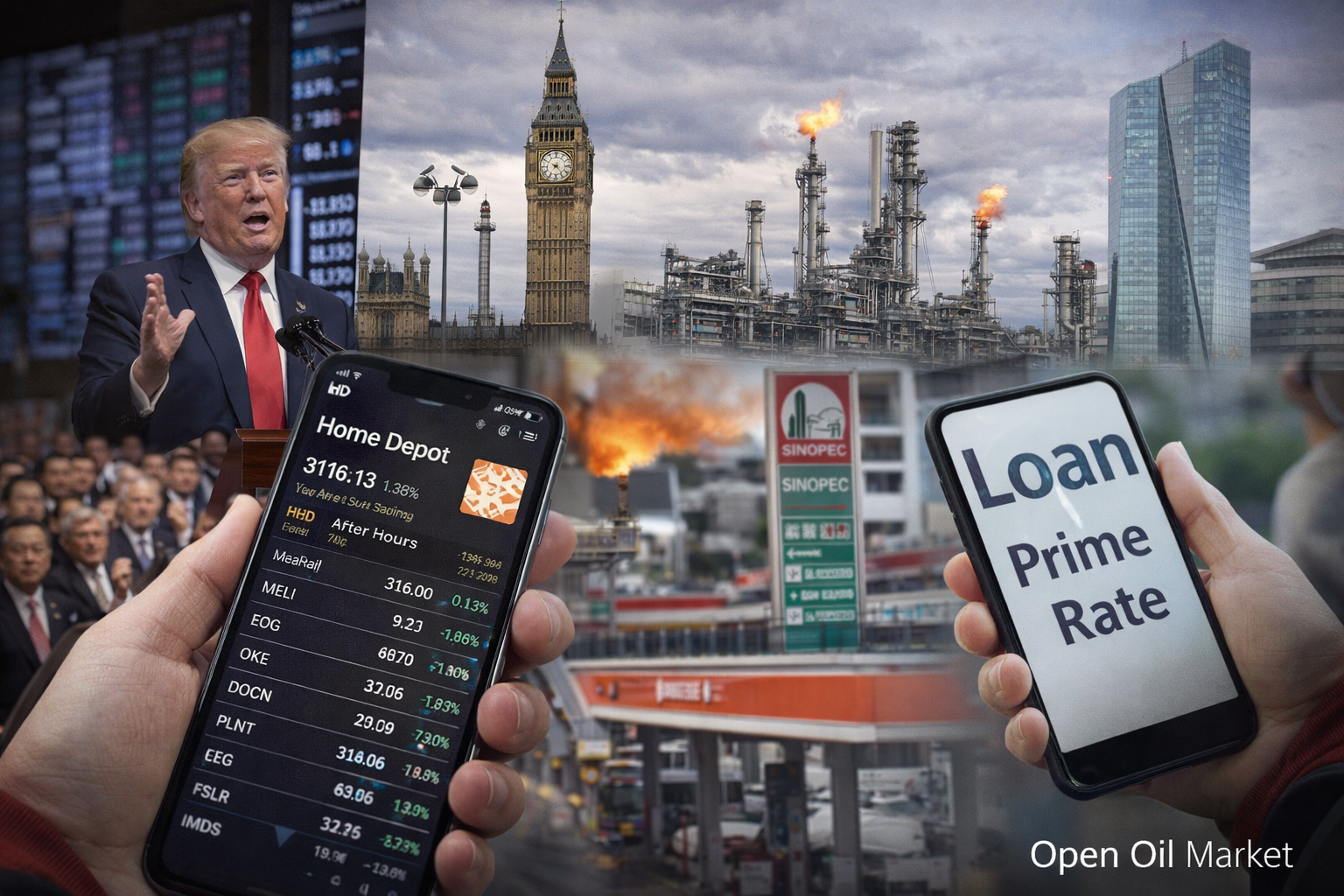
Key Economic Events and Corporate Reports for Tuesday, February 24, 2026: Implementation of the U.S. Import Tariff, LPR Rate in China, U.S. Macroeconomic Statistics, and the Peak of Q4 2025 Earnings Season. Analysis for Global Investors.
Tuesday, February 24, presents investors with a confluence of macroeconomics, trade policy, and corporate reporting. The U.S. continues its Q4 2025 earnings season, with results and forecasts from companies across various sectors including consumer goods, infrastructure, energy, and green generation being published today. In this context, market sensitivity to any signals regarding inflation dynamics, interest rates, and demand resilience in the U.S., Europe, and Asia is heightened.
U.S. Trade Policy: Import Tariff as a Factor of Inflation and Yield
The key storyline of the day is the implementation of a temporary U.S. import tariff on a broad range of goods. For the markets, this presents a dual signal: first, the potential pressure on import prices and inflation expectations; second, the risk of a tighter rate trajectory and a reevaluation of the yield curve. Practical reactions are often expressed through dollar strengthening, increased volatility in cyclical sectors, and a rotation towards defensive stocks.
- Investor Focus: how quickly trade costs translate to consumer prices and company margins.
- Markets Under Pressure: import-dependent sectors, retail, and parts of industry; support lies with local manufacturers and companies with significant pricing power.
- Practice: on days with trade-related decisions, the likelihood of "sharp movements" in the currency and commodity markets rises, especially when U.S. consumer data is released concurrently.
The U.S.: Presidential Address to Congress and Political Risk Premium
An additional driver is the annual State of the Union address by the U.S. President to Congress, outlining the country's situation and the administration’s plans. For the markets, this primarily translates into the risk of unexpected rhetoric regarding tariffs, the budget, regulation, and sanctions policy. Such speeches typically amplify intraday volatility in the S&P 500 and Nasdaq indices, as well as in sectors sensitive to government spending and regulation (defense, healthcare, energy, technology).
Macroeconomic Calendar: Key Releases and Speeches (MSK Time)
- 04:15 — China: LPR (Loan Prime Rate).
- 16:15 — U.S.: ADP Employment (private sector employment).
- 17:00 — U.S.: S&P/Case-Shiller Index (December).
- 17:15 — UK: Speech by Bank of England Governor Andrew Bailey.
- 18:00 — U.S.: Consumer Confidence (February).
- 18:00 — U.S.: Richmond Manufacturing Index (February).
- 20:45 — Eurozone: Speech by ECB President Christine Lagarde.
- 00:30 — U.S.: API Oil Inventories (transitioning to Wednesday).
China and Asia: LPR Rate and Assessment of Regional Demand
The decision on the LPR in China serves as a fundamental reference for evaluating credit costs, real estate activity, and domestic demand dynamics. For the global market, this is a crucial entry parameter for commodity currencies, industrial metals, and Asian equities. Combined with the U.S. trade agenda, the reaction may be asymmetric: even a neutral rate amidst "hawkish" signals from the U.S. can heighten caution in risk assets and boost demand for safe-haven instruments.
Commodities and Oil: Attention to API and Energy Reports
Late in the evening (MSK), API data on U.S. oil inventories will be released, serving as one of the fastest indicators of supply-demand balance ahead of official statistics. On days when energy company reports are published simultaneously, market attention shifts not only to inventory levels but also to management commentary on production, capital expenditures, and hedging strategies. For CIS investors, the connection between "oil — currencies of commodity-exporting countries — risk appetite" is crucial, as it also impacts regional indices, including MOEX.
Corporate Reports: U.S. Pre-Market (Before Market Opens)
Major public companies on which the market will focus:
- Home Depot (HD) — Q4 and fiscal year 2025 report; key focus on repair/construction demand and the 2026 outlook (conference call at 17:00 MSK).
- Keurig Dr Pepper (KDP) — report before market opens; emphasis on sales dynamics and pricing mix in FMCG.
- NRG Energy (NRG) — results and updated guidance; the market typically evaluates margins, generation structure, and debt load.
- American Tower (AMT) — results and comments on telecom infrastructure; revenue growth rates, leasing, and capital expenditures are important (call at 16:30 MSK).
- Diamondback Energy (FANG) — energy report and commentary on production/capex (market timing reference is 17:00 MSK).
- Planet Fitness (PLNT) — report before market opens; focus on LFL dynamics and network expansion.
- Constellation Energy (CEG) — quarterly/yearly materials publication; investors look for generation stability and comments on capacity and fuel prices.
Investor logic in the pre-market is straightforward: retail and consumer companies signal household strength, infrastructure firms reflect the state of capital cycles, while energy companies indicate the balance of raw materials and investment plans.
Corporate Reports: U.S. After Market Close and Evening Events (After Close)
- Realty Income (O) — report after NYSE close; important factors include rental income, funding costs, and comments on rates (call late at night MSK).
- MercadoLibre (MELI) — results publication and conference call; focus on e-commerce and fintech segment growth rates (timing reference — night MSK).
- EOG Resources (EOG) — anticipated publication from the energy giant; the market will compare investment discipline and free cash flow.
- ONEOK (OKE) — quarterly results discussion on the conference call; tariff income and comments on volumes in midstream are important (19:00 MSK).
- First Solar (FSLR) — report and 2026 guidance update; crucial how the company describes demand and pricing for capacity.
- DigitalOcean (DOCN) and several second-tier tech issuers focus on ARR/margins and commentary on demand for cloud infrastructure.
After market close, the "tone of the environment" often forms: if reports and forecasts confirm demand resilience, index futures may turn around even before Asia opens. Conversely, if margin anxiety rises due to trade costs, markets may swiftly move towards safe-haven assets.
Europe and Asia: Notable Earnings and Corporate Publications
In Europe, the annual results season continues, with investors comparing corporate reports to ECB rhetoric. In the Asian direction, significant releases from commodity and semiconductor companies gauge the investment cycle and external demand.
- Croda International — annual results for 2025; focus on chemistry and margins.
- Société BIC — 2025 results; important how the company describes demand in the U.S. and Europe.
- Woodside Energy (WDS) — annual materials for 2025; crucial for the market are production forecasts, cash flows, and priorities for capital projects.
- ChipMOS (IMOS) — report and conference call; an indicator of the state of supply chains and demand in semiconductors.
Conclusion: What Investors Should Pay Attention To
- U.S. Trade Policy: monitor currency and yield reactions — this directly impacts the valuation of global equities and the cost of capital.
- U.S. Data at 18:00 MSK: consumer confidence and the Richmond index can sharply alter intraday risk appetite.
- Chinese LPR: significant for commodities and Asian markets; the reaction may be stronger than usual due to trade context.
- U.S. Earnings: Home Depot as a barometer of the consumer/housing cycle; energy (EOG, Diamondback) and infrastructure (American Tower) as tests of cash flow resilience amidst high funding costs.
- Oil and API: evening inventory statistics can set the tone for the commodity sector for the next session, especially with strong company commentary on capex and production.




