Cryptocurrency Market Update for December 31, 2025: Bitcoin and Altcoin Dynamics, Year-End Summary, Key Trends, and Top 10 Cryptocurrencies. An Analytical Overview of the Global Market for Investors.
The cryptocurrency market is concluding the year amid mixed trends. Bitcoin, which reached $126,000 in October 2025, is now stabilizing around $90,000, while leading altcoins show moderate growth. The total market capitalization stands at approximately $3 trillion. Institutional investors continue to accumulate cryptocurrency: major companies collectively acquired Bitcoin worth over $95 billion, despite recent sell-offs.
2025 Year-End Results and Market Condition
The year 2025 has been characterized by record highs followed by corrections. Since the beginning of the year, Bitcoin has more than doubled, but it decreased by about a quarter in the fourth quarter. Since early October, the BTC price has fallen by approximately 23%, dropping from $126,000 to the current approximate $90,000. Nevertheless, "digital gold" still holds around 60% of the total market capitalization (over $2.4 trillion). Ethereum and other major altcoins have also corrected but show signs of recovery by the end of December: ETH is trading around $3,000, and many top-10 tokens have increased by 1-3%. The overall capitalization remains at record levels despite investor caution.
Spot ETFs for Bitcoin and Ether have recorded significant outflows. In December, approximately $1 billion was withdrawn from Bitcoin ETFs in the U.S., and about $0.6 billion from Ether ETFs. As a result of the quarter, Bitcoin holders incurred losses: since early October, BTC has posted its worst performance in 2.5 years. Price recovery at the end of the year has only partially mitigated the autumn decline.
Bitcoin: Dynamics, Cycles, and Forecasts
Current Bitcoin Dynamics
Bitcoin is trading within the range of $88,000 to $90,000, attempting to surpass the $90,000 mark. On December 30, the BTC price reached a weekly high above $90,300, gaining over $3,000 in a day. Technical indicators suggest oversold conditions: the RSI is around 33, which may indicate a short-term bounce if support holds at $89,000–$90,000. Resistance is found in the $100,000–$106,000 range.
Cycles and Perspectives
According to the classic four-year model, the next phase is expected following the April 2024 halving. The historical minimum of the current cycle is estimated to occur in the second half of 2026. Forecasts for 2026 vary: optimists project a BTC price ranging from $150,000 to $250,000, while pessimists predict a drop below $70,000. Analysts believe Bitcoin needs new investment flows (including through ETFs), advancements in cryptocurrency market regulations (especially in the U.S.), and a favorable macroeconomic environment to resume long-term growth.
Ethereum and Altcoins
Ethereum and leading altcoins remain in the spotlight. Ethereum is trading around $3,000, stabilizing after a sharp autumn correction. The ETH platform still serves as the backbone for DeFi and NFT, and the development of asset tokenization supports demand. A significant upgrade dubbed "Hegota" aimed at enhancing network scalability is anticipated by the end of 2026.
Major Altcoins
Bitcoin's market share is gradually declining, which may foreshadow a new "alt season." Leading altcoins have shown moderate growth: Solana, Cardano, BNB, XRP, and other top-10 coins gained 1-3% in December. Stablecoins Tether (USDT) and USD Coin (USDC) consistently occupy the third and sixth positions by market capitalization, providing market liquidity: billions of dollars in transactions occur daily through these assets.
Institutional Strategies for Altcoins
Institutional investors are exploring new tools to engage with altcoins. Large funds are increasingly utilizing options and other derivatives on leading tokens, similarly to methods employed for Bitcoin. According to CoinDesk (STS Digital), this approach allows for effective risk management and portfolio yield. Such strategies highlight the growing interest among major players in alternative crypto assets.
Institutional Investments
Institutional funds and corporations are increasingly influencing the market. In 2025, the total volume of corporate Bitcoin reserves exceeded $95 billion, setting a record. However, months of volatility led to significant outflows from ETFs: approximately $1 billion was withdrawn from Bitcoin ETFs in December, and about $0.6 billion from Ether ETFs. Nevertheless, many analysts emphasize that long-term investors continue to accumulate cryptocurrency, viewing it as a strategic asset class.
Regulation and Traditional Finance
Global Regulatory Trends
In 2025, the legal framework for digital currencies has strengthened in many countries. In the EU, the MiCA regulation has fully entered into force, standardizing rules for the issuance of crypto assets and stablecoins. In the U.S., the "GENIUS Act" has been passed, which sets requirements for issuers of the digital dollar. Asian countries are developing their own solutions: Hong Kong has introduced stablecoin legislation since August 2025, while Japan and Singapore are creating national digital currencies (such as the digital yen) and multi-currency stablecoins.
Traditional Finance and Cryptocurrencies
The banking sector is gradually integrating into the crypto industry. In 2025, American regulators granted banks more freedom: financial institutions were authorized to issue stablecoins, hold digital assets, and participate in crypto transactions. In particular, the U.S. Office of the Comptroller of the Currency (OCC) issued a clarification affirming the right of national banks to act as intermediaries ("risk-free counterparties") in cryptocurrency transactions. International regulatory bodies are also easing their regulations: for example, the Basel Committee plans to relax capital requirements for banks dealing with crypto assets.
Outlook for 2026
Analysts highlight that 2025 has been a turning point: the crypto market has solidified its institutional foundation and is preparing for a new growth cycle. Key trends for 2026 are emerging. Firstly, further expansion of market infrastructure: growth in volumes of spot and derivative products, and advancements in DeFi, NFTs, and staking. Secondly, an acceleration in the tokenization of real assets (funds, commodities) and the integration of digital currencies into traditional payment systems is expected. Thirdly, the integration of advanced technologies (artificial intelligence, blockchain) into the financial sector and an increased focus on sustainability and ESG projects are anticipated.
Top 10 Largest Cryptocurrencies
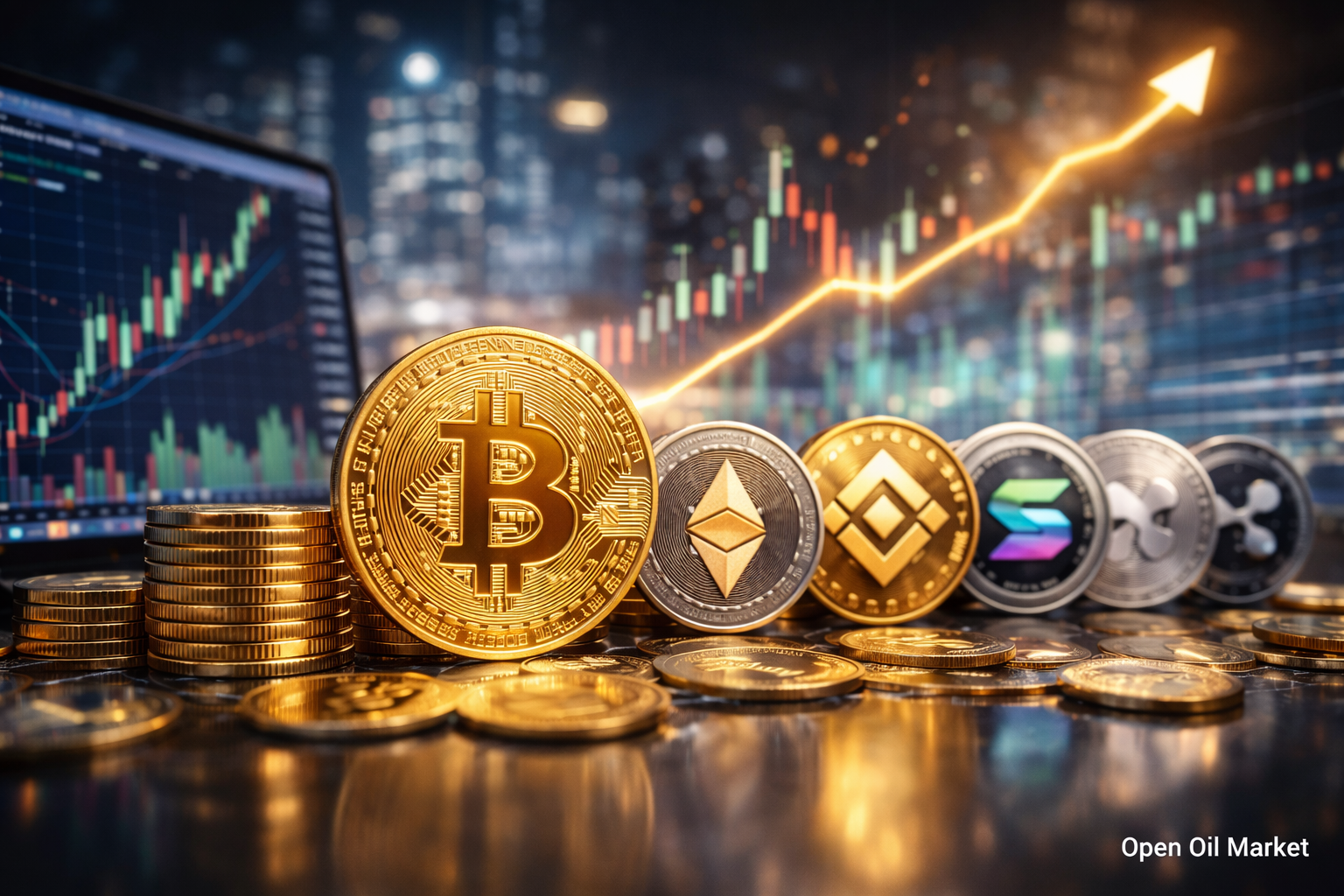
- Bitcoin (BTC) — the largest and most liquid cryptocurrency, often referred to as "digital gold." Used as a means of saving and capital protection. In 2025, Bitcoin reached historic highs due to institutional demand.
- Ethereum (ETH) — the second-largest cryptocurrency by market capitalization, serving as a platform for smart contracts and decentralized applications (DeFi, NFT). It serves as the foundation for the issuance of numerous tokens. The network's transition to Proof-of-Stake and ongoing upgrades improve Ethereum's scalability.
- Tether (USDT) — the largest stablecoin pegged to the U.S. dollar. Provides stability in cryptocurrency prices and serves as a medium of exchange between fiat and digital assets. Daily volumes of USDT amount to tens of billions of dollars.
- BNB (Binance Coin) — the token of the largest exchange, Binance. Offers discounts on trading fees and is used within the Binance Smart Chain ecosystem. Supported by a broad infrastructure of centralized and decentralized applications.
- XRP (Ripple) — the token of the Ripple platform for rapid cross-border payments. Despite regulatory uncertainty, XRP maintains high liquidity and continues to be utilized by banks for international transfers.
- USD Coin (USDC) — a major regulated stablecoin backed by Circle (Circle and Coinbase). Fully backed by reserves in U.S. dollars and undergoes regular audits, making USDC a reliable means for value preservation and transactions.
- Solana (SOL) — a high-performance blockchain platform with very low fees. Attracts developers and users due to its high transaction speed. SOL has emerged as one of the leaders in project engagement growth in 2025.
- TRON (TRX) — a blockchain focused on entertainment and social applications. Provides high throughput and low fees. The TRON ecosystem is actively growing, attracting decentralized services.
- Dogecoin (DOGE) — one of the most well-known "meme" cryptocurrencies. Originally created as a joke, it has gained a large audience due to its simplicity and support from prominent figures. Despite its speculative nature, DOGE remains among the top ten in terms of market capitalization.
- Cardano (ADA) — a blockchain developed with a scientifically backed approach. Utilizes delegated Proof-of-Stake and aims for ecological sustainability and security of the network. Cardano strengthens its position through the growth of its partner ecosystem and the implementation of new features.