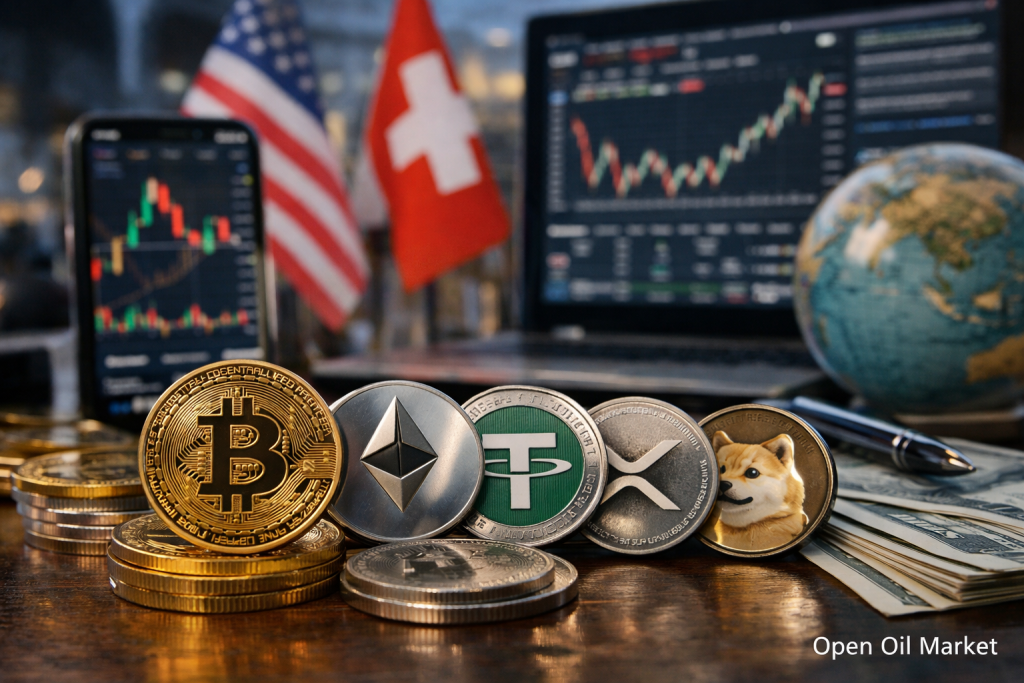
Current Cryptocurrency News as of April 12, 2026: Bitcoin, Ethereum, Stablecoins, and Key Global Market Trends
The cryptocurrency market approaches Sunday, April 12, 2026, with a sense of cautious optimism. After several months of volatility, three key themes are back in focus: the resilience of Bitcoin as the primary benchmark for digital assets, the impact of regulatory pressures on institutional capital flows, and the rapid expansion of the stablecoin segment. For global investors, this indicates that the market is now moving not only on speculative impulses but also on infrastructural changes, with the rules of the game becoming more significant than short-term noise.
The main takeaway as we begin a new day is that cryptocurrencies are becoming increasingly integrated into the global financial system. While previous cycles were marked by hype-driven dynamics, the market is now responding more to the decisions of regulators, banks, stablecoin issuers, and major institutional players. For investors, this means a shift from merely betting on the rise of individual coins to evaluating ecosystems, liquidity, legal frameworks, and the quality of capital flowing into the sector.
Bitcoin Remains the Key Barometer of Sentiment
Bitcoin continues to play a dominant role in the crypto market, serving as the principal indicator of risk appetite for digital assets. The current market structure indicates that capital still prefers the largest and most liquid crypto asset during times when the macroeconomic landscape remains uncertain. This reinforces Bitcoin's status as the first-choice tool for institutional and large private investors.
This is important for the market for several reasons:
- Bitcoin maintains leadership in terms of capitalization and liquidity;
- Bitcoin's dominance remains high, which curbs aggressive capital shifts into riskier altcoins;
- Bitcoin's price movement continues to dictate the short-term dynamics of nearly the entire cryptocurrency segment.
Practically, this means that Sunday’s agenda for investors begins with Bitcoin. As long as it maintains a constructive structure and does not enter into a deep correction, the market has a chance for selective recovery in Ethereum, Solana, XRP, and other major assets. However, a full-fledged alt season on a global scale still seems premature.
Ethereum and Major Altcoins Seek New Growth Drivers
Ethereum remains the second most significant asset in the market, but it is currently at the center of one of the main questions for 2026: can the network regain stronger user dynamics and return to being the unquestionable hub of the crypto economy? For institutional capital, Ethereum is still important as a foundational infrastructure for tokenization, DeFi, and engaging with stablecoins. However, investors are now looking not just at the network's status but also at the actual activity within the ecosystem.
Major altcoins approach the new day with varying investment logics:
- XRP is appealing as an asset associated with cross-border payments and payment infrastructure.
- BNB remains a bet on the resilience of one of the largest trading and infrastructure ecosystems.
- Solana retains attractiveness due to network speed, an active ecosystem, and a more speculative growth profile.
- TRON solidifies its position as a key blockchain for stablecoin transactions.
- Dogecoin continues to serve as an indicator of retail demand and meme-driven speculation, rather than a fundamental institutional trend.
This is why, at the beginning of the second half of April, it is particularly critical for investors to differentiate between two types of assets: infrastructural cryptocurrencies and purely speculative stories. In the current cycle, this distinction is once again becoming crucial.
US Regulation Becomes a Price Factor
One of the central themes in the market remains U.S. cryptocurrency regulation. Investors are increasingly viewing legislative and regulatory decisions as not merely a backdrop but as direct drivers of market movement. When regulatory clarity expands, institutional capital feels more confident. When the process drags on, some of the optimism quickly dissipates from quotes.
Currently, the market finds the following elements particularly important:
- advancement of bills regarding the structure of the digital asset market;
- emergence of clearer classifications of tokens and their legal status;
- the question of how quickly the U.S. can create a framework suitable for the development of the crypto business and institutional products.
This has global significance. If the U.S. can accelerate legal clarity, it may strengthen capital flows into Bitcoin, Ethereum, and infrastructure projects. If the process drags on again, investors will be more inclined to look at alternative jurisdictions, including Hong Kong, Singapore, Abu Dhabi, and European financial centers.
Stablecoins Become the Most Important Story of 2026
While Bitcoin remains the face of the market, stablecoins are becoming its new circulatory system. This segment currently appears to be the most strategically important for banks, regulators, crypto exchanges, and payment ecosystems. In practice, it is no longer merely a trading instrument within the crypto market but also the future of international digital payments.
The reasons why the topic of stablecoins is coming to the forefront include:
- they provide liquidity for cryptocurrency trading;
- they act as a bridge between traditional finance and blockchain infrastructure;
- banks and financial centers are beginning to view them as competitive tools in the payment business;
- regulators are increasingly scrutinizing issues related to reserves, compliance, and anti-money laundering efforts.
Amid this backdrop, the gap is widening between two models: global private crypto stablecoins and regulated banking or quasi-banking solutions. For investors, this means that capitalization and volumes within the stablecoin segment are becoming one of the essential leading indicators of the overall health of the crypto market.
Banks and Financial Centers Accelerate Their Push into Digital Money
The new week begins with a particularly noticeable trend: traditional financial institutions are increasingly entering the realm of digital currencies. The market sees that banks are no longer just observing the crypto industry but are building their own products, testing infrastructure, and preparing for real competition for payment flows.
In the global picture, this manifests as follows:
- European banks are ramping up efforts on their own stablecoin solutions;
- Switzerland is testing scenarios for the use of a Swiss franc stablecoin;
- Hong Kong is promoting the licensing of fiat stablecoins and strengthening its status as an Asian crypto hub;
- Major players in traditional finance view blockchain as a settlement infrastructure and not merely a speculative market.
This is particularly important for long-term investors. The wider participation of banks and regulated platforms increases the likelihood that the crypto market will receive more sustainable liquidity and become less dependent on retail-driven excitement.
Top 10 Popular Cryptocurrencies as of April 12, 2026
As of the beginning of the day, global market attention is focused on the largest digital assets. For the publication structure and investor focus, the key list looks like this:
- Bitcoin (BTC)
- Ethereum (ETH)
- Tether (USDT)
- XRP (XRP)
- BNB (BNB)
- USDC (USDC)
- Solana (SOL)
- TRON (TRX)
- Dogecoin (DOGE)
- Hyperliquid (HYPE)
This list itself reflects significant market shifts. The role of not only classic cryptocurrencies but also stablecoins, as well as infrastructure and exchange ecosystems, is growing among the top ten. This indicates that the market is becoming more application-driven, as investors are looking not only at the concept of an asset but also at its function in liquidity, payments, and trading infrastructure.
Risks Not to Ignore This Sunday
Despite the constructive backdrop, the cryptocurrency market remains high-risk. For investors on April 12, 2026, it is crucial to consider that even with an outwardly calm price structure, significant changes can occur under the influence of news, regulatory signals, and the overall global risk appetite.
The key risks at this stage include:
- delays or politicization of cryptocurrency regulation in the U.S.;
- weakness in user activity within certain ecosystems;
- increased scrutiny concerning the circulation of stablecoins and compliance;
- growing dependency of the crypto market on overall macroeconomic conditions;
- rapid corrections in assets where a significant portion of demand is speculative in nature.
The quality of liquidity also deserves separate attention. A seemingly strong market does not always equate to a stable market; if growth is supported by a narrow set of assets, this increases the vulnerability of the entire structure.
What This Means for Investors
For global investors, Sunday, April 12, 2026, is not a day for loud slogans but a moment for precise re-evaluation of positions. The strongest signals are coming from Bitcoin, major infrastructure projects, and the entire theme of stablecoins. It is here that the long-term logic of the market is being established.
Practically, this can be distilled into three key conclusions:
- Bitcoin remains the main protective and guiding asset within the crypto market.
- Ethereum and major altcoins retain potential but require a more selective approach.
- Stablecoins and regulation are becoming the central themes of this cycle, meaning that investors must monitor not only charts but also institutional infrastructure.
Thus, the main narrative for April 12 is as follows: the crypto market is increasingly moving away from merely anticipating the next speculative impulse and is restructuring around capital, rules, and financial infrastructure. For investors, this not only creates new opportunities but also raises the bar for analytical quality.




