Crypto News June 4, 2026 — Bitcoin and Ethereum Under Pressure from ETF Outflows, Stablecoins, Regulated Derivatives, and Top 10 Digital Assets
Crypto Market Enters a Phase of Risk Reassessment
The beginning of June 2026 proved challenging for the global digital assets market. After several months of steady growth, investors faced mounting pressure across multiple fronts. The most notable factor is the continued capital outflows from spot Bitcoin ETFs and Ethereum ETFs, which are negatively impacting sentiment among institutional market participants.
Despite sustained interest in cryptocurrencies from major funds and financial institutions, investors are becoming more cautious amid macroeconomic uncertainty, expectations regarding the monetary policies of the world's largest central banks, and rising yields on traditional financial instruments.
As a result, the market has entered a consolidation phase, where participants are assessing prospects for further growth and reallocating capital among high-risk assets, stablecoins, and regulated investment vehicles.
ETF Outflows Intensify Pressure on Bitcoin and Ethereum
One of the key events of recent weeks remains capital flows into crypto ETFs. After a period of strong inflows at the start of the year, investors have begun taking profits, leading to increased withdrawals from major funds.
For Bitcoin, the situation is particularly sensitive. Spot ETFs became the most important channel of institutional demand following their launch. When billions of dollars flowed into the funds, the market received strong support. However, the reverse process also has a significant impact on the asset's price.
Outflows do not necessarily indicate a loss of interest in Bitcoin as an investment instrument. Some investors are reallocating capital into bonds, money markets, and other assets with more predictable returns. Nevertheless, in the short term, such dynamics are perceived by the market as a signal of declining demand.
Ethereum faces a similar situation. Despite retaining its leadership in the smart contract ecosystem, ETH remains more sensitive to changes in investor risk appetite. During periods of uncertainty, capital often leaves altcoins first, only later affecting Bitcoin.
An additional pressure factor is declining activity in certain segments of decentralized finance and a slowdown in some areas of the Web3 industry. This prompts some market participants to assess Ethereum's medium-term prospects more carefully.
Bitcoin Maintains Its Status as the Leading Digital Asset
Despite the correction and increased caution among investors, Bitcoin continues to be the key asset in the crypto market. Its share of total digital asset market capitalization remains high, and institutional recognition is at all-time highs.
For many investment funds, Bitcoin is gradually becoming a separate asset class alongside gold, government bonds, and equity indices. That is why even during price declines, long-term investors continue to view BTC as a diversification tool.
The market is closely watching support and resistance levels. If stable demand from long-term holders persists, the likelihood of a major collapse remains limited. However, a return of sustained capital inflows via ETFs and other institutional channels is needed to resume the upward trend.
Macroeconomic factors also play a crucial role. If global central banks begin signaling monetary policy easing, Bitcoin could once again gain status as one of the most attractive risk-on assets.
Ethereum Seeks New Growth Drivers
Ethereum continues to be the largest platform for smart contracts, decentralized applications, and tokenized financial instruments. However, in 2026, competition within the industry has notably intensified.
Next-generation networks offer higher performance, lower fees, and an improved user experience. As a result, Ethereum must compete not only for developers but also for liquidity.
Nevertheless, the ETH ecosystem retains several fundamental advantages. Most major decentralized finance projects continue to use Ethereum as their underlying infrastructure. Moreover, the market for tokenization of real-world assets—considered one of the most promising industry sectors—is largely developing on Ethereum.
Investors are also closely monitoring staking dynamics. A significant portion of ETH supply remains locked in the network's consensus mechanism, helping to limit the available coin supply on the open market.
If interest in tokenization, institutional blockchain use, and digital financial instruments continues to grow, Ethereum may retain its leading position despite intensifying competition.
Stablecoins Become the Key Liquidity Indicator
The stablecoin market deserves special attention. This segment is increasingly viewed by analysts as one of the key indicators of crypto market liquidity.
When investors withdraw funds from volatile assets, money often remains within the crypto ecosystem in the form of stablecoins. Thus, capital does not leave the market entirely but shifts into a waiting mode.
Today, the largest players remain USDT and USDC, but competition is gradually intensifying. New regulated digital dollars are emerging, issued by both crypto companies and traditional financial institutions.
Growth in stablecoin market capitalization is often seen as a potential precursor to future market rallies. Accumulated liquidity can quickly flow back into Bitcoin, Ethereum, and other digital assets when positive catalysts emerge.
Another important trend is the integration of stablecoins into international payments. An increasing number of companies use digital dollars for cross-border settlements, driving demand for such instruments even outside the investment sector.
Regulated Derivatives Continue to Develop
One of the most notable structural trends in the crypto market is the growth of the regulated derivatives segment.
Just a few years ago, the majority of crypto derivatives trading was concentrated on offshore platforms. Today, the situation is gradually changing. Large institutional investors prefer to operate through regulated exchanges and financial structures that comply with the requirements of major jurisdictions.
Futures and options on Bitcoin and Ethereum are becoming crucial risk management tools. Hedge funds, asset managers, and corporate investors use them to hedge positions and manage capital more efficiently.
The rise in open interest on regulated venues reflects the ongoing maturation of the industry. The market is gradually shifting from a speculative model to a more mature financial ecosystem where risk management plays as important a role as seeking returns.
At the same time, interest is growing in new product types, including derivatives on baskets of digital assets, tokenized securities, and instruments tied to the real-world assets market.
Top 10 Cryptocurrencies: Who Maintains Leadership
The composition of the largest digital assets by market capitalization remains relatively stable, although individual positions continue to shift depending on market conditions.
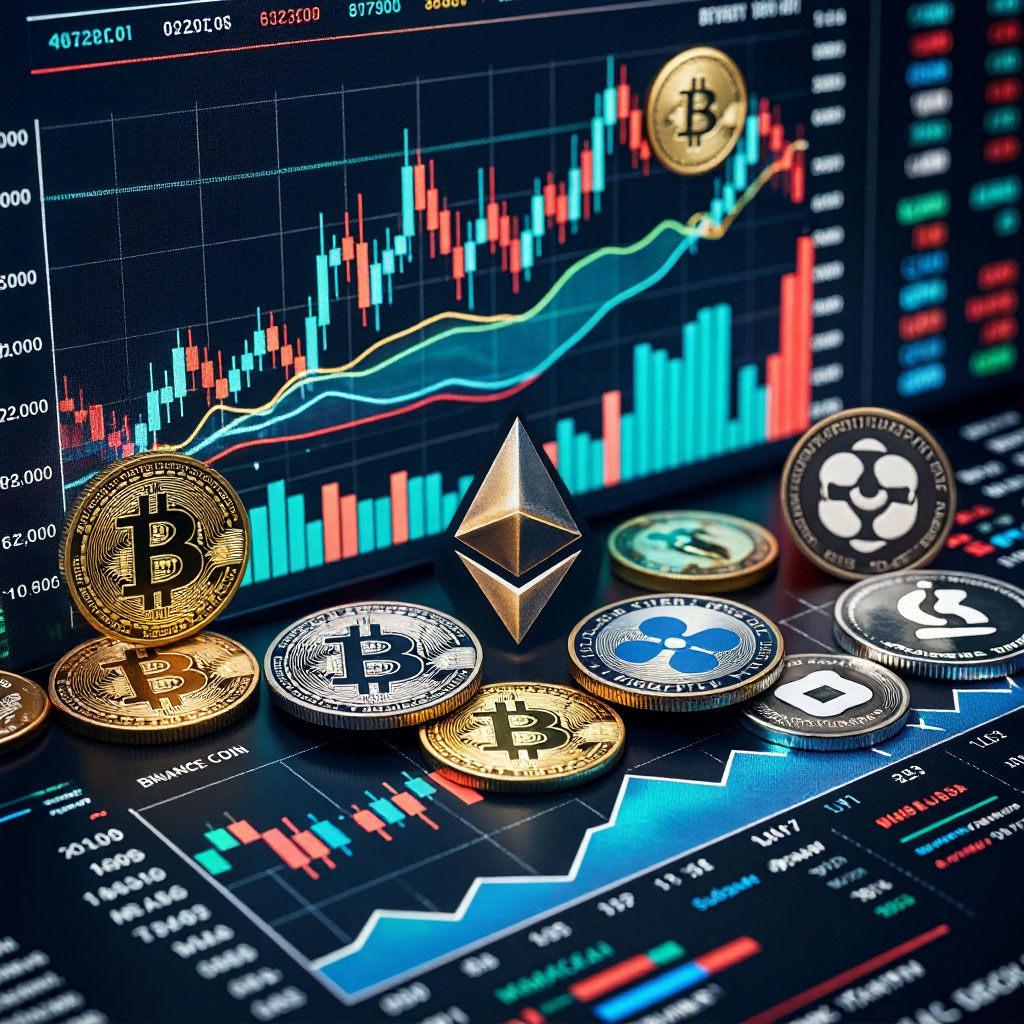
Bitcoin confidently holds the top spot due to institutional demand and its status as a digital gold equivalent. Ethereum retains the second position as the largest infrastructure platform in the blockchain industry.
The top ten also includes leading stablecoins, major ecosystem projects, and payment solutions. Investors pay particular attention to Solana, XRP, BNB, TRON, Toncoin, and Cardano.
Solana remains one of the fastest-growing blockchains thanks to high performance and active ecosystem development. XRP continues to benefit from expanding use in international payments. BNB retains a significant role due to the extensive infrastructure of crypto services.
Toncoin continues to attract attention due to integration with mass digital platforms and a growing user base. Cardano emphasizes an academic approach to network development and long-term technological improvement.
Investors are increasingly evaluating not only price dynamics but also actual network usage metrics: active users, transaction volumes, ecosystem development, and institutional adoption.
Macroeconomics Remains the Key External Factor
The crypto market is becoming increasingly integrated into the global financial system. As a result, central bank decisions and economic data have a growing impact on digital assets.
Investors closely monitor inflation, labor markets, economic growth dynamics, and expectations regarding interest rates. High rates make conservative instruments more attractive, reducing interest in riskier assets.
At the same time, there remains a possibility that if the global economy slows down, central banks may be forced to adopt looser policies. Such a scenario could create favorable conditions for a new growth cycle in both stock and digital asset markets.
In recent years, Bitcoin has increasingly shown correlation with the technology sector and growth indices. This means that global risk appetite remains one of the most important factors for the entire crypto industry.
What Lies Ahead for the Crypto Market
The beginning of June 2026 shows that the digital assets market is in a phase of reassessing expectations. ETF outflows are putting pressure on Bitcoin and Ethereum, but the fundamental factors driving the industry remain strong.
Institutional participation continues to grow, the regulated financial products market is expanding, stablecoin infrastructure is developing, and blockchain technology integration into traditional finance is intensifying.
In the short term, volatility may persist. However, long-term investors continue to view digital assets as an important element of the future financial system.
The key factors for the coming months will be the dynamics of ETF flows, the policies of major central banks, the state of the global economy, and the pace of adoption of new blockchain solutions in the real economy. These areas will determine whether the current correction is a temporary pause before a new growth phase or the beginning of a more prolonged period of consolidation for the crypto market.