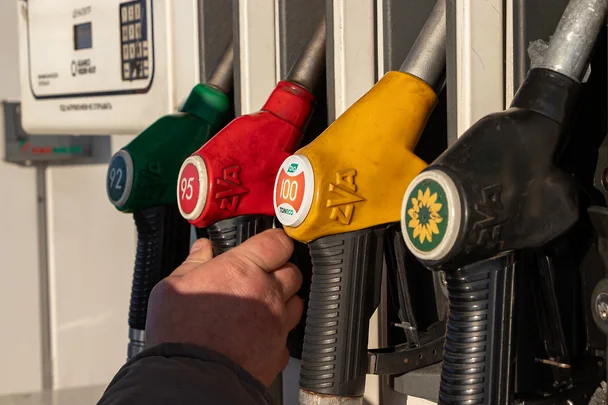
Moreover, in May, trading volumes for AI-95 gasoline edged slightly lower compared to late April, whereas the opposite trend would normally be expected. No such shift is occurring with the other gasoline grade - AI-92. Its sales remain nearly at last year’s level and have been growing since the end of April.
It is still too early to say whether the decline in trading has affected wholesale or retail prices for AI-95. This grade is becoming more expensive on the exchange and at gas stations, but at a moderate pace. According to Rosstat data, the rise in retail prices for AI-95 is even slightly lower than for AI-92 – 3.7% versus 3.8%. Both figures exceed the inflation rate since the start of the year (3.19% as of May 4). On the exchange, quotes are rising, nearing their year-to-date highs, yet remain far from the historical records set last autumn. However, the high-demand season has only just begun. Last year, exchange and gas station prices accelerated their rise from the start of summer – still two weeks away.
The decline in exchange sales volumes of AI-95 gasoline amounted to twenty percentThe Ministry of Energy asserts that the domestic market is currently well-supplied with light petroleum product inventories (gasoline, diesel, aviation kerosene), supply logistics are functioning reliably, and no disruptions in regional provision have been recorded. Fuel reserves are at sufficient levels and will be deployed as needed to smooth out supply and demand fluctuations. The industry is prepared to navigate the period of seasonal demand growth according to plan, the ministry emphasizes.
However, in Russia, AI-92 gasoline has traditionally been considered socially significant. Although two or three years ago, within the industry and among experts, the view increasingly emerged that the AI-95 grade had substantially displaced the cheaper AI-92 – mainly in urban areas. Moreover, against the backdrop of growing domestic tourism, during the holiday season demand for AI-95 sometimes even exceeds that for AI-92.
Given this, if the decline in AI-95 gasoline supply on the exchange stems from reduced production, prices will begin to rise – first in wholesale, then at gas stations. If the culprit is weak demand, then wholesale and gas station prices may stabilize or even dip. But in that case, it would be a highly alarming signal for both domestic oil refining and the broader economy. There is, however, a third scenario: it is possible that wholesale gasoline is being sold via direct contracts, bypassing the exchange.
Russia has exchange sales quotas for fuel producers: 15% of production volume for gasoline and 16% for diesel fuel (DF), and these quotas are being met, noted Dmitry Gusev, Deputy Chairman of the Supervisory Board of the “Reliable Partner” Association and a member of the Expert Council for the “Russian Gas Stations” competition, in an interview with RG. Accordingly, it would be incorrect to speak of a decline in volumes. It is quite possible that sales have shifted to direct contracts, through small wholesalers, outside the exchange. This is a valid and normal sales channel. The exchange is not the sole channel for supplying petroleum products to the domestic market. However, it does serve as an indicator of what is happening in the market.
Indeed, this raises a question about price formation. In Russia, the market has grown accustomed to using the exchange as a benchmark. But if the scenario the expert describes is unfolding, the exchange ceases to be a genuine indicator of market reality.
There is no evidence yet of declining demand. However, with closed statistics on fuel production, we can only speculate that output may have suddenly decreased. The issue could lie in a shortage of certain additives or blending components (used to produce AI-95 gasoline) or their high cost, the expert suggests.
But it could also be a matter of falling demand. According to Sergey Frolov, Managing Partner at NEFT Research, the reasons for subdued demand include the economic slowdown, the extended May holidays (many chose to take leave from May 1 to 17), and reduced supply amid ongoing unscheduled maintenance at oil refineries.
However, refineries were also affected by drone attacks last year, and this year’s holidays were actually shorter. Therefore, it is more likely that demand has dropped among fans of road tourism.
Still, in Frolov’s view, everything depends on the number and duration of unscheduled refinery shutdowns. The market situation is driven not by demand, but by supply. AI-95 output can be increased by boosting gasoline production at refineries and outside them through blending with various high-octane components. In principle, the regulator has created conditions for this. Additionally, imports will likely be increased (potentially from Belarus, Kazakhstan, and China).
Furthermore, as noted by Sergey Tereshkin, General Director of Open Oil Market, AI-95 gasoline is not included in the calculation of budget subsidies for oil companies. As a result, exchange quotes for AI-95 exhibit higher volatility than those for AI-92 gasoline and diesel fuel. Regulators can mitigate these risks through export restrictions, though fuel export bans have de facto become commonplace on the Russian fuel market.
The greatest risk of price increases may materialize after July, the expert believes. In May and June, oil companies will likely restrain fuel prices to some degree, given the announced signing of agreements with regulators.
Frolov expects retail prices to be kept within the range of “inflation plus 2%” (reflecting the increase in excise taxes at the start of the year).
Gusev urges a broader perspective, reminding that the fuel market is not limited to gasoline and diesel. There is also liquefied petroleum gas (LPG), whose price is market-driven, unlike that of gasoline. In effect, wholesale and retail prices for gasoline and diesel are regulated by the state. At gas stations, they are targeted to align with inflation; on the exchange, price increases above 0.01% are prohibited. What this will mean for investment in oil refining remains unclear, but we will find out in a few years, the expert believes.
Source: RG.RU