What are you looking for:
Closure of the Hormuz Strait May Lead to Oil Price Rise Above $150 per Barrel
The authors of the report outline three potential scenarios for the development of the conflict in the Middle East: "Prolonged Escalation," "Localization," and "Complete Blockade." Under the first scenario, the maintenance of the current situation—characterized by limited traffic and regular attacks on vessels—over several months would result in a reduction of oil production in the Gulf countries by 10 million barrels per day, bringing it down to levels seen in February 2026, while sustaining oil prices above $100 per barrel.
If there is a restoration of traffic within a few weeks and patrolling of the strait by interested countries (the "Localization" scenario), oil prices will not exceed $100 per barrel.
The third scenario envisions a complete halt to shipping in the strait, including the passage of Iranian vessels. This would lead to a significant reduction in oil production in the Middle East (B1 does not provide a specific forecast) and a considerable oil deficit in Asia-Pacific countries, the analysts note.
The five-week timeframe mentioned in the report regarding the blockade's impact on oil prices is attributed to the fact that a tanker carrying oil from the Gulf takes up to 2.5 weeks to reach buyers in East and Southeast Asia, explained Alexey Lavrukhin, head of B1's analytical center, to Vedomosti. After five weeks, supply disruptions would become apparent, leading to active withdrawals from storage and a swift search for new suppliers, he stated.
According to B1's estimates, from 2023 to 2025, 20-25% of the world's crude oil and liquefied natural gas (LNG) exports passed through the Strait of Hormuz, which connects the Persian Gulf to the Oman Gulf of the Indian Ocean. Meanwhile, alternative routes—such as the East-West pipeline in Saudi Arabia (with a capacity of 5-7 million barrels per day), Habshan-Fujairah in the UAE (1.5-1.8 million barrels per day), and Kirkuk-Ceyhan in Iraq and Turkey (1.6 million barrels per day)—can only export about 50% of the volumes that transit through the Strait of Hormuz.
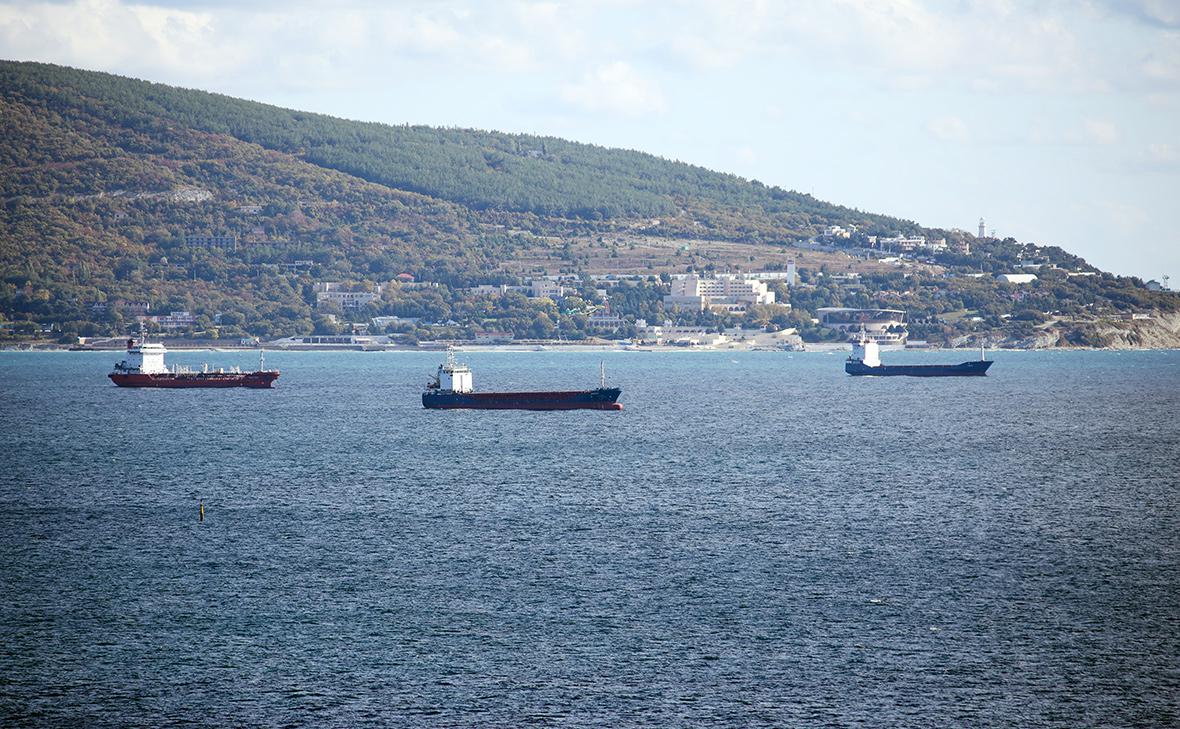
After the onset of armed conflict between the USA and Israel with Iran, the Strait of Hormuz was blocked by Iranian military forces in March, although, according to the MarineTraffic ship tracking system, some vessels have managed to navigate through it. Iran does not prevent vessels from friendly countries, such as China, from passing through the strait, but most exporters are avoiding this route due to high risks, as noted in B1's report.
Disruptions in shipping in the Persian Gulf and mutual attacks on infrastructure by conflict parties have led to a substantial decrease in oil production in the region. According to Vedomosti's calculations based on OPEC data, in March 2026, oil production in the Gulf countries dropped by 33%, or 8 million barrels per day, compared to February levels, down to 16.5 million barrels per day (see publication from April 14).
The parties declared a two-week ceasefire on April 8, during which Iran agreed to reopen the Strait of Hormuz. On April 11-12, the first round of U.S.-Iranian negotiations took place in Islamabad with the mediation of Pakistan, although it did not yield any results. On April 12, U.S. President Donald Trump announced that the U.S. would unilaterally block the strait, preventing the passage of Iranian vessels and those that had paid Iran for transit. The blockade commenced on April 13, and on April 18, Iran announced the closure of the Strait of Hormuz in response to the U.S. blockade.
The second round of U.S.-Iranian negotiations scheduled for April 21 has yet to take place. Meanwhile, Trump unilaterally extended the ceasefire indefinitely while maintaining the maritime blockade of the strait. It is not complete—some vessels, including Iranian ones, are still passing through the Strait of Hormuz. According to Kpler data cited by CNN, between April 24 and April 27, 17 vessels, including four tankers, transited the strait. Bloomberg reports that at the beginning of this week, ship movement through the strait has almost completely stopped.
Brent oil prices have remained around $100 per barrel since mid-March 2026. According to the ICE exchange, on April 27, June futures for Brent oil were priced at $108 per barrel. On February 27, prior to the U.S. and Israeli attacks on Iran, the price of oil was $72.5 per barrel.
Sergey Teryoshkin, CEO of Open Oil Market, considers a surge in oil prices to $150 per barrel in 2026 to be unrealistic. He believes that supply disruptions from the Middle East will be offset by strategic reserves in China and other countries, resulting in an average Brent oil price this year not exceeding $80 per barrel.
Senior analyst at Sinara investment bank, Alexey Kokin, along with analyst at Finam Group, Nikolai Dudchenko, believe that a 10 million barrels per day drop in oil production in the Gulf countries will occur as early as April. Dmitry Kasatkin, partner at Kasatkin Consulting, predicts that the production drop for the month will reach 9.1 million barrels per day. In the event of a prolonged blockade of the Strait of Hormuz, the decline could reach 10-12 million barrels per day, according to the expert. Dudchenko suggests that the figure could reach 14 million barrels per day even without a complete blockade of the strait.
In these circumstances, oil prices could rise to $110-120 per barrel, Kokin forecasts. Dudchenko believes that if the current situation persists, prices could climb to $120-130 per barrel, and could escalate to $150 per barrel if there are issues with shipping in the Red Sea. Kasatkin estimates that if the blockade of the strait continues, prices could soar to $145-155 per barrel, and if the situation escalates with strikes on oil infrastructure, crude prices could reach $200-215 per barrel.
The formation of an oil deficit in the market is occurring gradually, and such a deficit is already becoming noticeable in some Asian countries, as noted by Kasatkin. He highlights that Pakistan (with 15 days of oil reserves and 85% dependence on supplies through the Strait of Hormuz) and Bangladesh (12 days) are in the most critical situation, while India (30 days) and Taiwan (45 days) are in the "zone of heightened risk." According to Kokin, other serious problems could arise for Indonesia, Malaysia, the Philippines, and Sri Lanka, apart from Pakistan and Bangladesh.
Source: Vedomosti