The Global Venture Market Enters July 2026 with a Record Capital Volume, but Investors Are Increasingly Dividing Startups into Tech Leaders and Economically Undemonstrated Projects
As of July 8, 2026, news from the startup and venture capital sectors paints a picture of a new cycle: the global market is once again in a growth phase, but this growth has become significantly more concentrated. Venture funds, corporate investors, and sovereign capital are directing the largest checks towards artificial intelligence, computing infrastructure, data center energy solutions, defense technologies, quantum computing, legal tech, and industrial deep tech.
The main theme of the day is the shift of venture capital from the classic "growth at any cost" model to a strategic funding model for critically important technologies. Startups are increasingly evaluated not only by revenue growth but also by their ability to become part of a new technological infrastructure: energy, defense, computing, legal, or industrial.
For venture investors and funds, this means a shift in investment logic. The market has ample liquidity, but capital distribution is uneven: mega-funds and strategic investors are competing for a limited number of companies, while average startups face a more complex fundraising process, heightened requirements for unit economics, and longer due diligence periods.
Proxima Fusion Becomes the Highlight of the Day: Fusion Energy Takes Center Stage in Venture Discussions
The biggest news in the venture market is Proxima Fusion's €411 million funding round at a valuation of approximately €2.4 billion. The German startup, working on nuclear fusion technology, attracted capital from strategic and financial investors, including Google, RWE, XTX Ventures, and East X Ventures. This deal has become one of the most notable deep tech rounds in Europe in 2026 and has strengthened fusion energy's status as a distinct asset class.
For the startup market, this serves as an important signal: venture investments are increasingly directed towards technologies with long commercialization cycles but potentially systemic effects. Fusion energy interests not only energy companies but also Big Tech, as the development of artificial intelligence sharply increases the demand for stable, cheap, and low-carbon electricity.
- Key Sector: Fusion energy and clean energy for AI infrastructure.
- Investment Rationale: Betting on long-term energy independence for data centers and industries.
- Risk for Funds: High capital intensity, technological uncertainty, and a long exit horizon.
Artificial Intelligence Remains the Primary Capital Magnet
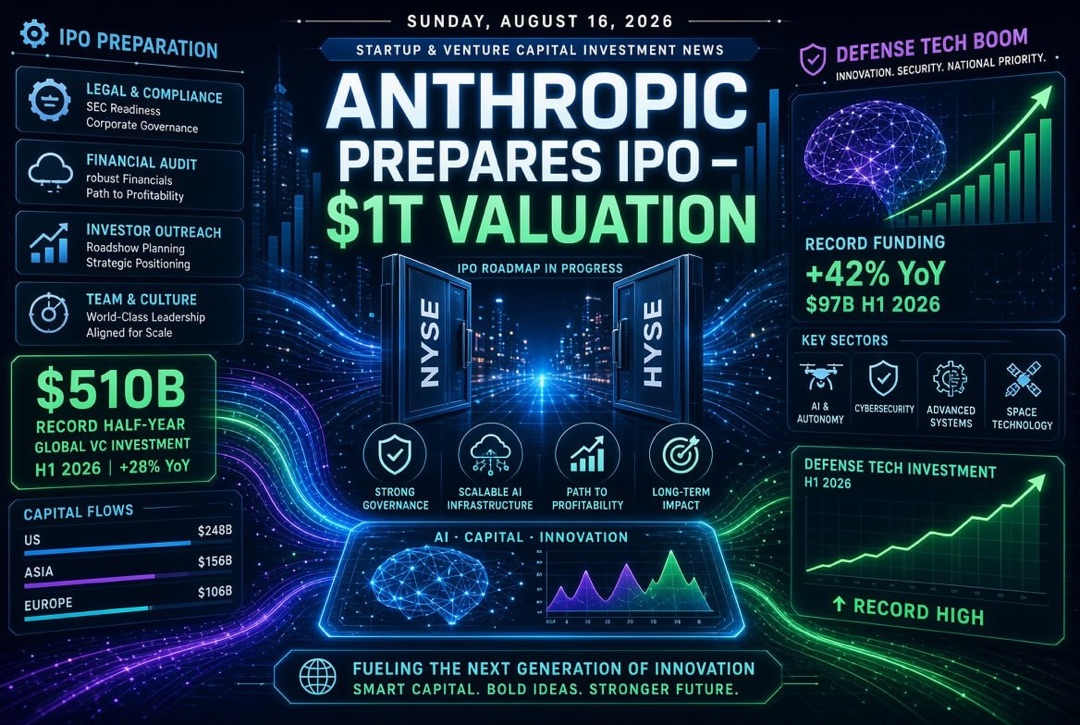
AI startups continue to dominate global venture investments. In the first half of 2026, the funding volume for startups reached record levels, with the largest share of capital directed towards companies related to artificial intelligence, AI infrastructure, computing platforms, robotics, defense tech, and healthcare AI.
However, the AI market no longer appears homogeneous. Investors are increasingly differentiating between three groups of companies:
- Frontier AI — Developers of fundamental models and large AI platforms.
- AI Infrastructure — Chips, data centers, cloud computing, security, agent management, and MLOps.
- Applied AI — Sector-specific solutions for law, medicine, industry, finance, e-commerce, and corporate processes.
Venture funds are becoming more cautious about companies that label themselves as AI startups without a technological barrier. Simple integration of an existing model is no longer seen as a sufficient basis for high valuation. What is prioritized now are proprietary data, secured infrastructure, high margins, and a repeatable sales model.
Norm Ai and Legal Tech: Corporate AI Becomes the Investment Standard
The legal AI segment received a boost after Norm Ai's $120 million funding round, valuing the company at approximately $1.2 billion. The company is developing a full-stack model for legal and regulatory artificial intelligence, reflecting a broader trend: venture capital is shifting away from experimental AI tools toward applied systems that help corporations reduce costs, accelerate compliance, and automate complex professional processes.
Legal tech is becoming especially attractive to funds, as this sector combines high average checks, complex regulatory barriers, and sustained demand from large corporations. Unlike consumer AI applications, corporate legal AI platforms can more quickly prove their value via savings in lawyers’ time, reduced operational risks, and increased decision-making speed.
Defense Tech and Autonomous Systems: Europe Accelerates Technological Mobilization
One of the most noticeable trends in July is the strengthening of defense tech. German company Quantum Systems raised $1.2 billion at a valuation of around $8 billion, signaling a major development for the European venture market. The company operates in the drones, autonomous systems, and software infrastructure segments for defense applications.
European funds are increasingly viewing defense technologies as a long-term investment market rather than a niche area. The growing demand from governments, NATO, industrial buyers, and energy infrastructure is making defense tech part of the broader deep tech ecosystem.
- Investors are focusing on autonomous drones, counter-drone systems, and robotic platforms.
- Corporations are searching for dual-use technologies for logistics, security, and industrial monitoring.
- Government programs create long-term demand but increase reliance of startups on politics and budget cycles.
China and DeepSeek: The AI Race Becomes a Matter of Technological Sovereignty
The Chinese AI startup market remains a critical area of focus for global investors. DeepSeek, one of the most notable players in the Chinese AI ecosystem, is working on its own inference chip and, reportedly, is preparing for a significant external funding round. This demonstrates that AI is no longer limited to models: control over computing has become a strategic asset.
Concurrently, Chinese authorities are considering restrictions on foreign access to the most advanced AI models. This intensifies the geopolitical component of venture investments. Funds increasingly need to consider not only the technological quality of a startup but also the regulatory framework, export restrictions, access to chips, and the structure of international investors.
New Venture Funds: Capital is Available but Becomes More Specialized
Against a backdrop of record startup funding, new funds and specialized strategies are emerging. The venture firm Chemistry is raising around $500 million for its second fund, focusing on seed and Series A in software. In Europe, Climentum Capital has launched its second climate tech fund, with first close at €60 million and a target volume of up to €100 million.
These examples signal an important shift: universal venture funds are giving way to specialized platforms. LPs increasingly want to understand the specific advantages that a fund possesses — in AI, climate tech, defense tech, fintech, enterprise software, biotech, or deep tech. For startups, this means the need to choose investors more carefully: not every fund with capital is a relevant partner.
Regional Landscape: The U.S. Leads, Europe Strengthens Deep Tech, India Returns to Growth
The geography of venture investments in 2026 is becoming more asymmetrical. The U.S. and North America maintain their leadership due to AI mega-rounds, IPOs, and significant M&A transactions. Europe is solidifying its position in deep tech, fusion energy, defense tech, fintech, and climate tech. The U.K. shows strong capital attraction dynamics amid the AI boom, while India is returning to growth after a period of more cautious funding.
For global investors, this means that capital allocation strategies must consider not only the country but also the regional industry specialization:
- U.S. — AI, cloud, chip infrastructure, frontier models, space tech.
- Europe — deep tech, defense tech, energy transition, fusion, fintech, industrial software.
- India — fintech, SaaS, consumer platforms, AI services, and B2B infrastructure.
- China — AI models, chips, robotics, industrial automation, but with high regulatory factors.
IPO and M&A: The Exit Market Again Influences Startup Valuations
The revival of IPOs and M&A has become an important factor for venture funds. After several years of weak liquidity, investors are again seeing exit scenarios from mature tech firms. This supports late-stage valuations but simultaneously makes the market more demanding: public investors evaluate not only growth but also margins, debt load, revenue quality, and cash flow predictability.
For late-stage startups, the IPO window represents an opportunity but not a guarantee. Companies with strong revenue, technological leadership, and clear unit economics can command premium valuations. Projects with inflated valuations, dependency on subsidies, or lack of transparency are likely to face discounts.
What Venture Investors and Funds Should Watch For
The key takeaway as of July 8, 2026, is that the venture market is growing but is less tolerant of weak business models. Money is returning to startups, but it is concentrating in companies that aspire to play a role as critical infrastructure in the new economy.
Venture investors should keep a close eye on several areas:
- AI infrastructure: computing, security, agent systems, MLOps, and data pipelines.
- Energy tech: fusion energy, grid infrastructure, storage, and energy supply for data centers.
- Defense tech: autonomous systems, drones, cybersecurity, and dual-use software.
- Legal AI and compliance automation: corporate solutions with high average checks.
- Quantum technologies and post-quantum security: a long horizon but strategic demand.
- Regional ecosystems: the U.S., U.K., Germany, India, and China as different venture growth models.
As of July 8, 2026, it is evident that news from startups and venture investments increasingly resembles not just a classic tech news feed but rather a roadmap for the future industrial, energy, and computational architecture of the world. For funds, the primary question is not just which startup is growing faster, but which company can become the infrastructure asset of the next decade.