Current News on Startups and Venture Investments as of April 19, 2026—AI Megarounds, IPO Growth, and Key Trends in the Global Market
The global startup and venture investment market enters mid-April 2026 in a state of stark contrast. On one hand, venture capital is showing historically high activity once again, driven by artificial intelligence, computing infrastructure, robotics, and applied enterprise solutions. On the other hand, the market is becoming increasingly concentrated: large funds and megaround financing are setting the agenda, while conditions remain harsh for early-stage companies and those without verified monetization. For venture investors and funds, this signifies a shift from a "growth at any cost" model to a more rigorous selection phase, where revenue quality, technological depth, and a clear path to liquidity become paramount.
AI Remains the Main Magnet for Capital
The primary theme in the global venture market is artificial intelligence. This now includes not only major developers of foundational models but also a broad ecosystem surrounding them: AI infrastructure, inference platforms, specialized chips, corporate AI agents, industrial software, autonomous transport, and robotics. These areas are shaping the largest deals and setting benchmarks for valuations.
For investors, this is an important signal. The new wave of funding is not directed at abstract AI narratives, but at companies solving specific narrow problems: accelerating computations, reducing inference costs, automating development, optimizing supply chains, increasing production efficiency, or creating a software framework around complex infrastructure.
- Focus is on AI infrastructure and computational capabilities.
- Interest is growing in B2B AI platforms with understandable economics.
- Capital is increasingly seeking a combination of technology and practical revenue.
The Venture Market is Growing, but Funds are Concentrating at the Top
Record volumes of venture investments in 2026 create an impression of broad market recovery, but the structure of deals tells a different story. A significant portion of capital is concentrated in a few large rounds and major funds. This means that the headline growth of the market does not equate to uniform improvements in conditions for all startups.
For the global startup market, this concentration indicates an increased gap between leaders and other participants. Companies with strong brands, well-known investors, strategic contracts, and demonstrated demand attract capital faster and under better terms. Meanwhile, many teams at the seed and Series A stages still face stringent scrutiny of unit economics, burn multiples, time to breakeven, and demand sustainability.
- Large deals shape overall market statistics.
- Late-stage companies feel more secure than early stages.
- Valuation without revenue is increasingly viewed as a risk rather than an advantage.
An IPO Window is Opening, Changing Fund Behavior
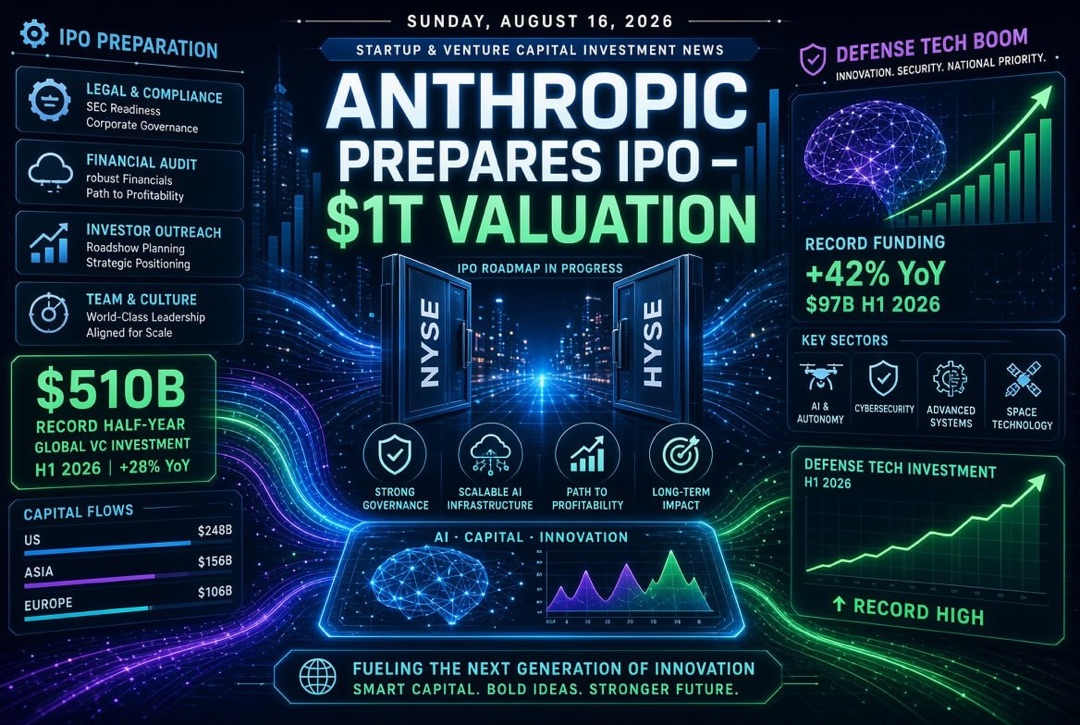
One of the most significant signals in April has been the revival of IPO discussions. For venture investors, this is not merely a backdrop; it is a direct indicator of whether the market can offer real exit mechanisms. If the IPO window does indeed begin to widen, late-stage valuations may receive additional support, and funds will become more active in companies nearing the public market.
This is why investor attention is drawn to companies at the intersection of AI, chips, infrastructure, and corporate platforms. The market is reevaluating not only growth but also the business's ability to be understandable to public investors: scalable revenue, predictable margins, large clients, and low dependence on speculative demand.
For funds, this means a return of interest in pre-IPO and late-stage strategies, particularly in segments where growth stories can be easily packaged within a public equity narrative.
Chips, Computing, and Inference Are Forming a Separate Supercycle
If the 2023-2025 market primarily focused on models and generative interfaces, then by spring 2026, the focus has shifted deeper—toward computational infrastructure. Startups working on accelerators, energy-efficient AI chips, edge AI, inference architecture, and specialized platforms for enterprise workloads are taking a more prominent position in the venture agenda.
This is a crucial structural shift. As the AI market matures, investors are looking not only for winners among applications but also for those who can profit from the foundational infrastructure of the new economy. In this context, particularly strong opportunities include:
- developers of specialized semiconductors;
- platforms that lower the cost of deploying models into production;
- companies working at the intersection of AI and industrial robotics;
- players creating infrastructure for autonomous systems and physical AI.
For global funds, this is one of the most investment-rich segments in the upcoming quarters.
Europe and Asia are Gaining Ground, but the Market Remains Selective
Outside the US, the market is also showing signs of revival. Europe maintains interest in AI, defense tech, energy technologies, and deep B2B software. Asia is recovering through selective megadeals, a more active role of corporate capital, government support, and infrastructure narratives. However, this does not mean a return to a mass warming of all segments.
Quite the opposite: investors have become stricter in distinguishing between "quality growth" and "stories without evidence." In Europe, capital gravitates towards companies with technological barriers to entry, while in Asia, the focus is on startups that can align with governmental and corporate priorities, including AI, manufacturing, robotics, energy efficiency, and semiconductors.
For international funds, this creates two strategies: either to bet on local champions or to seek cross-border companies capable of scaling across multiple jurisdictions.
Which Deals Set the Tone in Mid-April
The recent news flow indicates that investors are continuing to actively fund not only giants but also the next tier of rapidly growing companies. Rounds in enterprise AI, supply chain AI, fintech compliance, video generation, AI chips, and robotics are currently being discussed in the market. This expands the map of opportunities for funds that are not ready to enter overheated megaround deals but want to remain in the central investment theme of 2026.
The most noticeable categories in recent days include:
- Enterprise AI. Companies automating engineering teams, sales, customer analytics, and internal processes.
- Supply Chain and Industrial AI. Startups implementing forecasting, optimization, and AI solutions in the real sector.
- Fintech Infrastructure. Products for compliance, risk control, payments, and financial operations.
- AI Chips and Robotics. One of the most capital-intensive and strategically important market segments.
This structure shows that venture investments are becoming more application-oriented: funds want to see real operational value rather than just the promise of scaling.
What is Changing for Early and Mid-Stage Startups
For founders, the current market is neither completely closed nor truly easy. Money is available in the market, but quality demands have significantly increased. If not long ago it was possible to attract rounds with a general AI narrative, now investors require specificity: retention, ARR growth rate, gross margin, corporate client pipeline, customer acquisition cost, product depth, defensibility, and the possibility of international expansion.
The startups in the strongest positions now are those capable of demonstrating:
- a clear specialization in a specific vertical;
- real contracts, not pilot projects just for presentations;
- cost reductions or productivity growth for clients;
- a technological advantage that is difficult to replicate quickly;
- preparedness for the next round or strategic M&A.
This is especially important for the Series A and Series B segments, where the market no longer tolerates vague growth narratives.
What Venture Investors and Funds Should Consider
As of April 19, 2026, the venture capital market appears strong in volume but complex in structure. For investors, this necessitates a more precise approach to deal thesis. The focus is not merely on AI themes and startups, but on narrower segments where there is a mismatch between capital supply and demand.
Key indicators for the upcoming weeks include:
- monitoring the development of the IPO window and new public offerings;
- assessing whether high multiples in AI infrastructure will be sustained;
- seeking opportunities in Europe and Asia, where growth exists, but competition for quality assets is lower than in the largest US deals;
- distinguishing fundamental AI companies from rapidly heated stories lacking a sustainable moat;
- paying close attention to defense tech, robotics, energy tech, and applied enterprise software as adjacent sources for the next wave of growth.
Conclusion: The Startup Market is Active Again, but the Era of Easy Money has Not Returned
The global startup and venture investment market approaches April 19, 2026, in a state that can be described as strong but uneven. Venture capital is once again flowing into major stories, especially in AI, chips, infrastructure, autonomous systems, and corporate platforms. The IPO window is beginning to crack open, indicating that exit topics are returning to the funds’ agenda. However, discipline is also increasing: investors have become more demanding regarding asset quality, product economics, and scalability viability.
For venture funds, this is not a market of mass optimism, but rather a landscape for precise selection. For startups, the opportunity to attract capital remains, but only on the condition that the technology is market-validated, the business model is clear, and growth doesn’t appear artificial. This is the significant takeaway for April: the venture market is growing once again, but this time, it’s not the loudest companies that win, but the best-prepared ones.