Global Startup Market as of April 18, 2026: Where Venture Investments Are Heading, Why Funds Are Increasing Focus on Late-Stage Companies, and Which Segments Are Becoming the Main Beneficiaries of the New Cycle
By mid-April 2026, the startup and venture capital market is entering a phase where headline growth no longer signifies a uniform recovery across the entire ecosystem. Venture capital is returning swiftly but is being allocated increasingly selectively. Major funds and institutional investors are concentrating their efforts in areas such as AI, computing infrastructure, enterprise software, robotics, physical AI, fintech, and technology companies that are nearing scalability, IPOs, or strategic exits.
For venture investors and funds, this signifies a crucial shift. In previous years, the market was focused on a broad array of early-stage deals, whereas the current focus is on mature startups with strong revenues, corporate demand, and clear monetization strategies. Although early-stage opportunities have not disappeared, competition for capital has intensified, and the criteria for team quality, product, and unit economics have become significantly more stringent.
Key Takeaway: The Market Is Growing, But Money Is Flowing to a Narrow Circle of Winners
The central conclusion for the global startup market as of Saturday, April 18, 2026, is crystal clear: venture investments are accelerating, but this growth is driven not by widespread normalization but by capital concentration in a limited number of sectors. These primarily include:
- AI startups and infrastructure for artificial intelligence;
- late-stage and growth companies ready for scaling;
- enterprise AI and automation platforms for the corporate sector;
- semiconductors, on-device AI, robotics, and supply chain software;
- M&A targets for large corporations seeking not just a product but a technological edge.
This is why the startup market currently appears robust in terms of deal volume yet stringent concerning access to capital. For the top companies, this creates a favorable environment; for others, it signifies a period where venture capital has become significantly more selective.
Late-Stage Funds Are Regaining Initiative
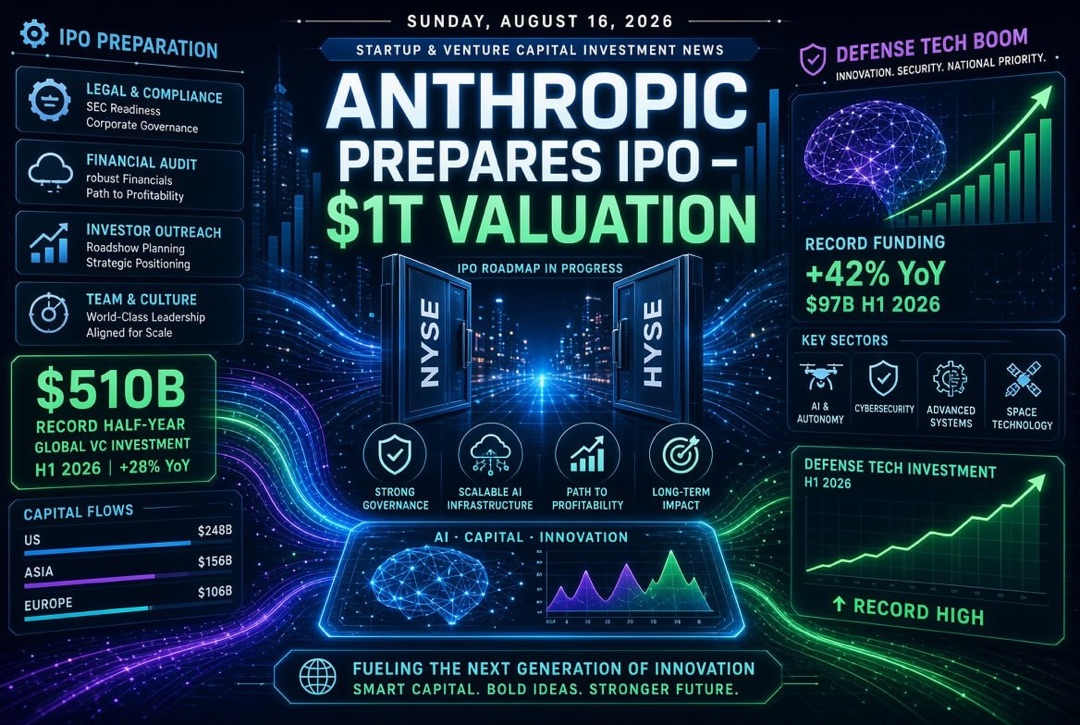
In 2026, large funds effectively endorse a new investment model: substantial capital prefers late-stage opportunities, where revenues, corporate clients, and exit scenarios have already been established. This alters the fundamental logic of the venture market. It is now not only about the potential of an idea but also about a startup's capacity to quickly evolve into an infrastructure asset or become an IPO target, secondary transaction, or strategic acquisition.
This scenario creates a new hierarchy for venture investors:
- Preference goes to companies with validated product-market fit;
- A valuation premium is awarded to those operating at the intersection of AI and corporate efficiency;
- Fund managers are increasingly boosting exposure to growth rounds rather than only to classic seed rounds;
- Market metrics are becoming less indicative, as a few gigantic transactions skew the overall picture.
This serves as an important signal for funds: headline records in venture investment volume do not imply that the entire startup landscape is equally liquid. On the contrary, the market is becoming two-speed.
Enterprise AI and Automation Are the Main Zones of Applied Demand
The most notable practical trend in April is the shift in interest from abstract AI promises to products seamlessly integrated into clients' business processes. Startups capable of automating expenses, engineering development, supply chains, internal analytics, and decision-making are receiving significantly more attention from investors and strategic buyers.
Why this matters for the venture market:
- Corporations are no longer satisfied with "AI for AI's sake"—they require measurable ROI;
- Enterprise software regains a stronger investment profile;
- Funds increasingly evaluate companies based on depth of integration into the client's workflow, rather than just user growth rates.
This logic is prompting the market to reassess not just generative models but also AI solutions capable of genuinely reducing costs, accelerating operations, and becoming part of corporate infrastructure.
New Rounds Affirm: Capital Is Flowing into Applied and Infrastructure Stories
The latest venture agenda shows that investments are being directed not only to frontier AI companies but also to applied startups with a clear business model. The focus is on enterprise engineering, supply chain AI, software for company growth, and automation of financial and operational solutions.
For investors, this means several things simultaneously:
- The market is still willing to finance growth stories with substantial checks;
In other words, 2026 strengthens not just the market for AI startups but also the market for companies capable of transforming artificial intelligence into a business operating system. For venture funds, this presents a more robust investment thesis than merely betting on consumer hype.
Asia Is Sending Strong Signals on IPOs and Technological Sovereignty
The Asian startup market remains a key growth area. China is ramping up support for AI, robotics, and semiconductors, while South Korea is carving its own path for chip startups and on-device AI. For global investors, this signifies that Asia is not an ancillary region but an independent source of technological leaders and future exit deals.
Crucially, the Asian agenda is now being shaped around three focal points:
- Growth of government and quasi-government capital in strategic technologies;
- Preparation of mature startups for IPO;
- Transition from local champions to companies aspiring to global scale.
This increases competition for capital while simultaneously expanding the list of potential leaders for international funds. For investors aiming at the global market, the Asian region in 2026 is no longer peripheral but one of the central avenues for venture capital allocation.
Europe Is Gaining Momentum but Remains a Market of High Selectivity
The European venture investment market also appears stronger than a year ago; however, there is particularly noticeable capital concentration around AI, deep tech, industrial software, chip-related solutions, and climate-linked infrastructure. Europe is becoming increasingly less of a mass venture market and more of a venue for a limited number of technologically strong companies well-positioned to prevail amid the region's drive toward digital and industrial autonomy.
This development makes Europe interesting for funds and LPs due to several reasons:
- Strong engineering base and quality technical teams;
- Robust corporate demand for AI and automation;
- Growing influence of governmental and quasi-market support tools;
- Emergence of new opportunities for scale-up companies, rather than just early stages.
As a result, Europe is solidifying its position as a venue for quality deals, although access to substantial rounds remains a privilege of a smaller number of startups.
M&A Is Once Again a Crucial Element of Venture Logic
Another key trend is the revival of strategic acquisitions. This is particularly significant for the startup ecosystem, as M&A restores a sense of liquidity to the ecosystem. When large corporations are willing to acquire AI assets, automation platforms, and corporate software, the entire venture investment cycle becomes more sustainable: founders gain additional exit options, while funds benefit from a clearer path to capital returns.
In 2026, the most attractive areas for M&A include:
- fintech and expense automation;
- enterprise AI with rapid ROI;
- infrastructure software solutions;
- products that can be rapidly integrated into a large buyer's ecosystem.
For venture investors, this indicates that the valuation of startups will increasingly depend not just on revenue growth but also on their strategic compatibility with large platforms, banks, enterprise vendors, and technology corporations.
What This Means for Venture Investors and Funds
On April 18, 2026, the strategy in the venture capital market appears increasingly pragmatic. Success is not merely about rapidly growing startups but about companies that fulfill multiple criteria:
- Operate in a sector with long-term structural demand;
- Possess technology that is difficult to replicate quickly;
- Can demonstrate practical economic effects for clients;
- Have a clear path to substantial revenues, IPO, or M&A;
- Can become part of the infrastructure in the next technological cycle.
For funds, this presents a market of opportunities, but not one characterized by relaxed risk. For founders, this marks a window where capital can be attracted under strong conditions if the startup can demonstrate not only technological novelty but also commercial significance.
This is why Saturday, April 18, 2026, marks a new reality for the venture market: startups are once again in the spotlight, venture investments are robust in volume, but the main asset is no longer growth itself but the quality of that growth. This indicates that the next round of capitalization will favor those who combine AI, infrastructure, corporate utility, and readiness for exit.