The Global Startup Market Approaches the End of Q1 2026 with Mixed Signals: Capital Remains Abundant, But Access Becomes Increasingly Uneven March 30, 2026
For venture investors and funds, Monday, March 30, 2026, begins with an exceedingly clear picture: the startup and venture investment market remains active, yet capital is increasingly concentrated in a few segments — artificial intelligence, AI infrastructure, defense tech, legal tech, robotics, and select mature fintech sectors. On the other end, projects lacking clear monetization pathways, weak unit economics, and vague product positioning find it increasingly difficult to close funding rounds under previous terms.
This dichotomy is currently shaping the agenda of the global venture market. Investors are not shying away from risk as an asset class, but they are conducting much stricter evaluations of revenue, efficiency, pathways to liquidity, and the genuine technological defensibility of businesses. For funds, this means a need to more accurately differentiate "trendy growth" from "capitalizable advantage."
Today's Main Theme: AI Remains the Core of the Venture Market, but Focus Shifts from Ideas to Infrastructure and Practical Value
By the end of March 2026, the market has definitively confirmed that artificial intelligence remains the primary magnet for global venture capital. However, an important shift has occurred within the AI vertical. Whereas capital used to flow into generic platform promises, the greatest interest now lies with companies that:
- control the infrastructure layer;
- integrate into critical corporate processes;
- can rapidly convert demand into large contracts;
- demonstrate not only user growth but also predictable monetization logic.
The startup market indicates that AI has ceased to be merely a technological narrative. It is now an investment category where success is not determined by the loudest pitches but by teams capable of transforming computations, models, and data into contract revenue, enterprise processes, and new standards of performance.
AI Infrastructure Emerges as a Distinct Asset Class
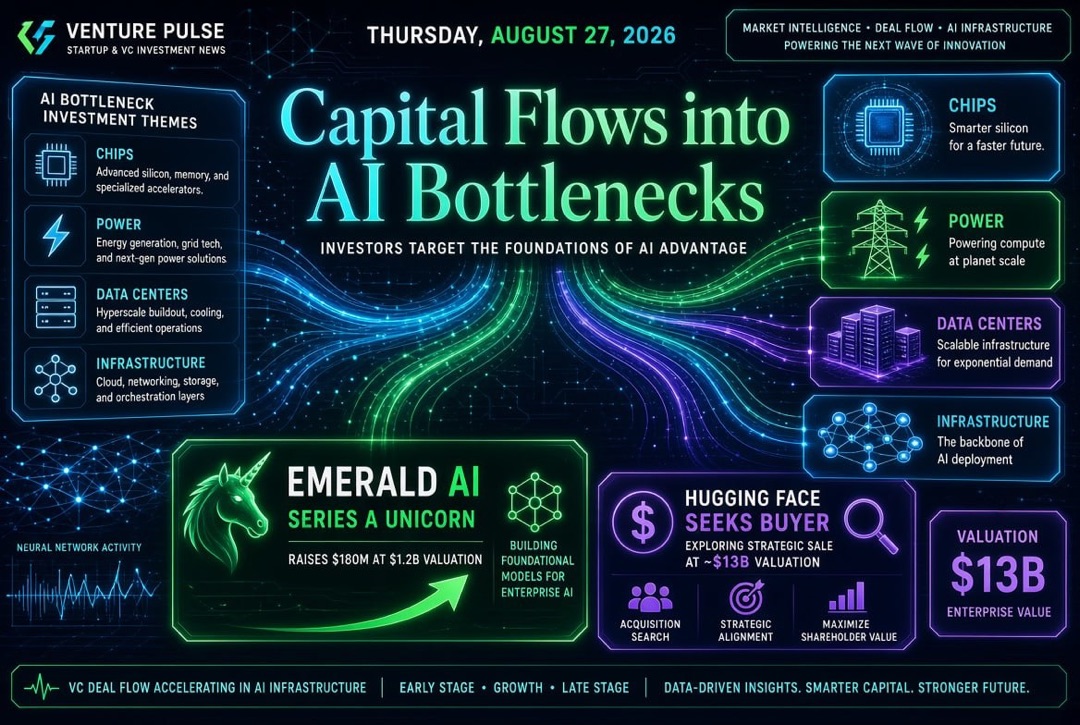
One of the most telling signals for the startup and venture investment market has been the dynamics surrounding AI infrastructure companies. Investors are increasingly financing not just applications, but also the foundational layer — data centers, computing power, infrastructure contracts, and hybrid funding models.
In this context, 2026 can be viewed as a moment of institutionalization for AI infrastructure. Capital is increasingly entering this segment not only through traditional venture rounds but also via:
- convertible debt;
- prepayments from major clients;
- strategic deals with tech giants;
- mixed equity/debt structures.
For funds, this is especially important. Where many venture investors previously sought asymmetry at the application level, an increasing number of players are returning to the thesis that a significant portion of AI market value will be created in the infrastructure layer. This elevates interest in capital-intensive companies but simultaneously makes selection criteria much stricter: merely having an ambitious roadmap is no longer sufficient; partnerships, contracts, and the capacity to handle scaling are now essential.
Defense Tech Solidifies Its Position as One of the Strongest Segments of 2026
Another major trend defining the startup and venture investment news as of March 30, 2026, is the steady growth of defense tech. This segment can no longer be considered niche; it is becoming an independent center of capital attraction due to the convergence of three factors:
- the growth of government and quasi-governmental demand;
- the real combat and practical demand for autonomous solutions;
- the potential for scaling through software, simulation, and platform models.
For venture funds, defense tech is becoming attractive not only as a theme for the "next cycle" but also as a domain where technological advantages can maintain margins for an extended period. Companies operating at the intersection of AI, autonomy, navigation, simulation, robotic systems, and dual-use software are particularly sought after.
This also alters investment logic. Unlike parts of classic enterprise SaaS, values here are evaluated not so much on the speed of customer base growth but on the strategic importance of the product, the depth of integration, and the potential for long-term software contracts.
Vertical AI: Investors Raise Stakes in Legal Tech and Specialized Services
If infrastructure forms the foundation of the new AI economy, vertical AI remains its main practical layer. This is particularly evident in legal tech, where the market observed a sharp increase in interest in platforms capable of automating complex professional processes in March.
The legal AI segment is significant for the venture market for several reasons:
- it operates within a high-cost professional environment;
- corporate clients are willing to pay for time savings and risk reductions;
- AI agents in this niche are moving from auxiliary functions to performing complete workflow chains.
For investors, this serves as one of the most straightforward examples of how generative AI is evolving from being an "overlay" to becoming the core product. This logic is beginning to spread to other verticals, including finance, security, development, compliance, knowledge management, and specialized B2B services.
Robotics and Autonomous Systems Regain Traction as Major Venture Story
There is a growing interest in robotics, autonomous systems, and industrial autonomy within the global startup market. In 2026, investors are viewing this segment differently than in previous waves of enthusiasm. Their interest is no longer based on futuristic presentations but rather on questions such as:
- where exactly productivity is generated;
- how quickly the solution can be implemented in real operational environments;
- whether models can be trained and re-trained on large sets of applied data;
- how much capital will be required to reach commercial maturity.
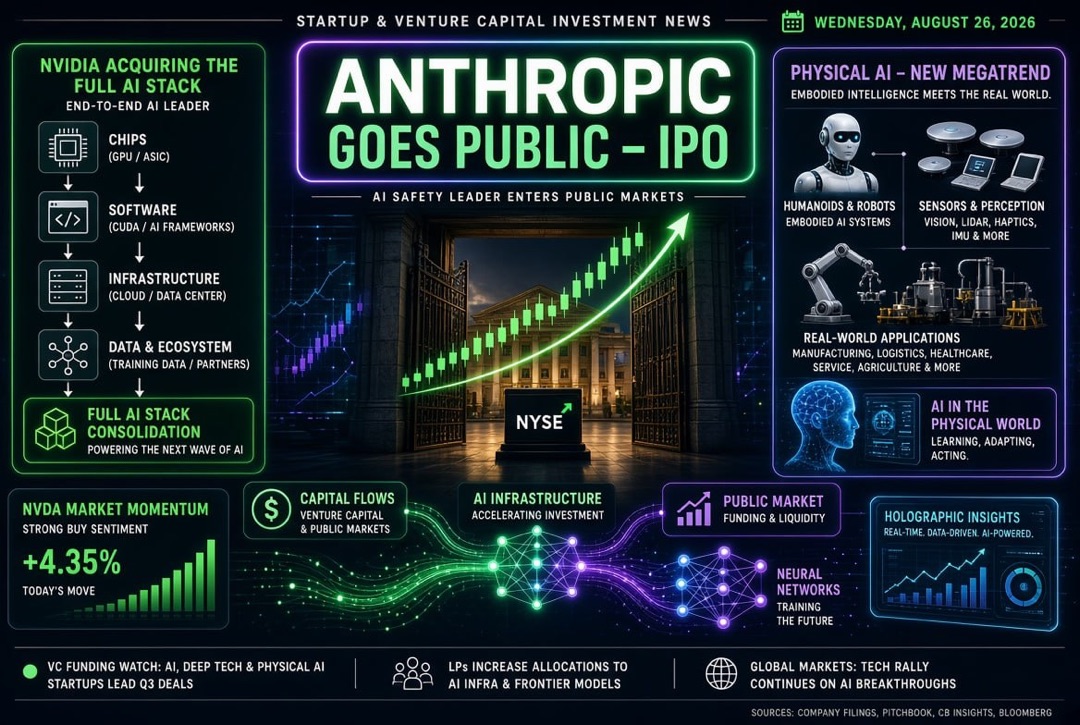
Companies operating in industrial applications, such as logistics, warehouses, ports, airports, autonomous transportation, defense integrations, and machine intelligence for physical systems, appear particularly strong. This signals to funds that physical AI is becoming not just a research topic but also a distinct capital distribution direction.
Fintech Remains Relevant, but the Focus Shifts to Europe and Mature Models
In fintech, the global picture appears more balanced. Unlike AI, where the market permits extreme valuations, investors act more cautiously and rely more heavily on model maturity. A notable signal in March was the strengthening of Europe's position, particularly London, as one of the key centers for global fintech development.
For venture investors, this leads to two conclusions:
- financial technologies remain attractive but no longer tolerate weak growth economics;
- the geography of capital is becoming more diversified, and Europe has a chance to reclaim some global attention.
There is particular interest in projects that operate at the intersection of fintech, AI, and corporate automation: payment infrastructure, B2B financial operations, risk intelligence, anti-fraud measures, and tools for enhancing operational efficiency.
Biotech and AI Drug Discovery Strengthen Positions Through Partnerships, Not Just Funding Rounds
An important feature of the current startup and venture investment market is the increasing significance of commercial partnerships as a form of value validation. This is particularly vivid in AI-biotech and drug discovery. Investors are increasingly looking not just at the volume of capital raised but also at a startup's capability to secure large partnership deals with pharmaceutical companies.
This approach alters the rules of the game:
- a strategic contract is becoming nearly equivalent to a large funding round;
- the corporate partner confirms the technology's demand;
- the startup's valuation is increasingly tied to its likelihood of future commercialization.
For funds, this represents one of the most mature ways to mitigate technological risk. Therefore, AI-biotech remains one of the sectors to watch closely in the upcoming quarters.
Liquidity Returns, but the Exit Window Remains Selective
One of the key questions for venture investors is when the market will again provide sufficient exit opportunities. At the beginning of 2026, the picture began to cautiously improve: the IPO market no longer appears completely closed, but there is still no broad window for all categories of tech companies.
Several liquidity channels can now be identified:
- M&A from major tech platforms;
- selective IPOs for truly strong companies;
- secondary transactions and partial liquidity in private markets;
- strategic partnerships with future buyout rights.
This indicates that funds will need to build exit strategies more flexibly in 2026. The market already shows signs of revival, but capital continues to reward size, business quality, and market leadership. For standard SaaS stories without clear differentiation, the liquidity window remains narrow.
What This Means for Funds and Startups at the Start of a New Week
On Monday, March 30, 2026, several practical takeaways can be highlighted for participants in the global venture market.
For Funds
- increase exposure to AI infrastructure, defense tech, and vertical AI;
- evaluate startups separately based on proven contract-driven revenue;
- filter more rigorously projects without clear pathways to liquidity;
- monitor Europe as a source of new fintech and AI stories.
For Startups
- focus on unit economics and commercial discipline;
- demonstrate measurable efficiency increases rather than abstract AI;
- prepare for inquiries not only about growth but also about capital structure;
- use partnerships and contracts as key arguments for valuation.
The news related to startups and venture investments as of March 30, 2026, illustrates a mature yet still aggressive market. Venture capital has not vanished — it has become more demanding. Major funds remain eager to invest in tech companies, but now the premium goes to those who can demonstrate strategic value, infrastructural significance, and genuine commercial power.
The central theme of the day is not merely the growth of AI but the redistribution of capital in favor of those startups that control critical elements of the new technological economy. For venture funds, this means a return to competition for the best deals. For founders, it heralds the end of the era of "capital on promises" and the beginning of a phase where value is created through revenue, integration, data, infrastructure, and execution quality.