Main Startup and Venture Investment News as of March 1, 2026: OpenAI's Mega Round, Growth of AI Funds, Investments in AI Infrastructure, Fintech, and Global Venture Market Trends Analysis for Investors and Funds
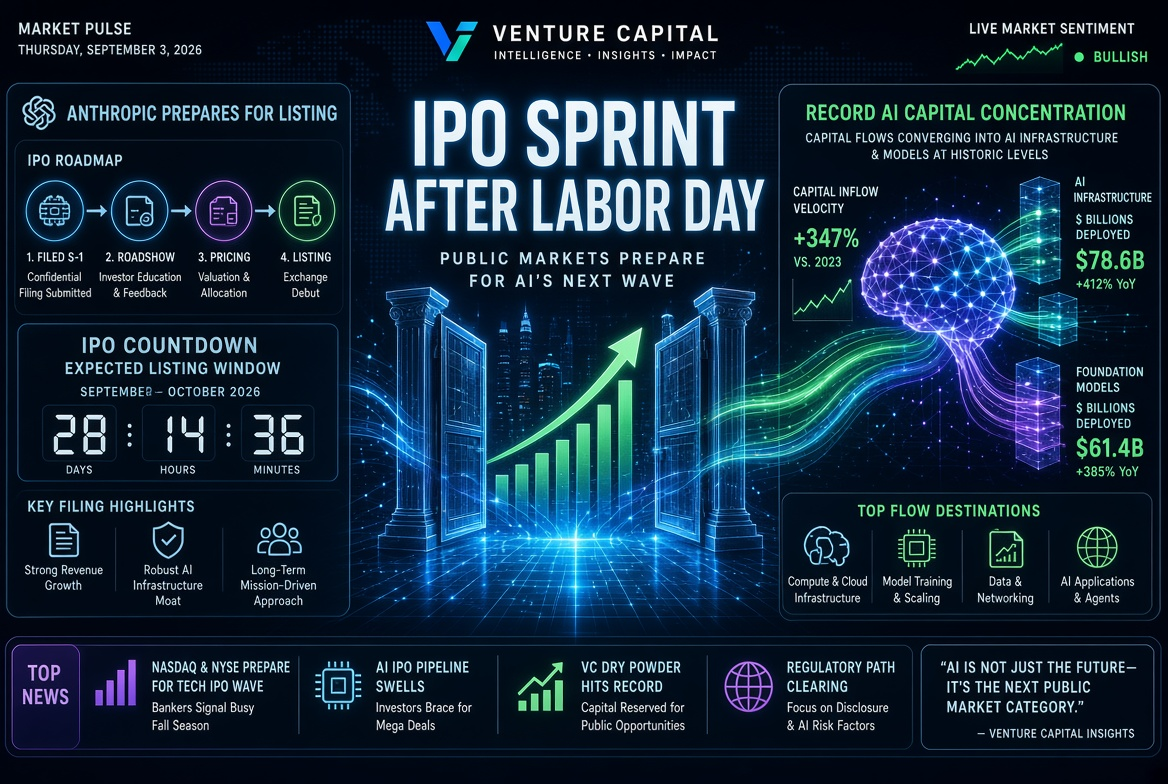
The end of February concludes the month on a high note for the venture investment market: investors are once again ready to write large checks for “frontier” technologies, and the competition for leaders in artificial intelligence is intensifying. The central theme of recent days is OpenAI's announced mega round, setting a new benchmark for the AI sector and enhancing the “gravity of capital” effect around infrastructure (cloud computing, chips, data center energy supply). Meanwhile, funds are restructuring their strategies: crypto-focused investors are broadening their mandates towards AI/robotics, while Asian markets are showing renewed vigor in startup financing.
Mega Deals: OpenAI Raises the Bar for the AI Market
The most significant news is OpenAI's announced mega round of approximately $110 billion, with a valuation reaching levels typically associated with the new generation of "super unicorns." This is an important signal for venture investors and growth funds: the market is ready to finance not only applied AI products but also capital-intensive infrastructure (computing, specialized chips, data centers), provided the company has a scalable platform, monetization potential, and a clear roadmap to leadership.
Why This Changes Market Dynamics:
- Redistribution of Liquidity: a portion of capital "sticks" to leaders, increasing the value of late rounds and making the market more polarized.
- Rising Costs of Scarce Resources: computational power and energy consumption are becoming strategic constraints — supporting startups in chips, inference optimization, cooling, and load management.
- Increased KPI Requirements: investors are increasingly expecting evidence of commercial traction (revenue, retention, corporate contracts), even within the AI segment.
Funds and “Mega Pools”: Crypto Venture Expands into AI and Robotics
A noticeable trend is the expansion of investment mandates among funds historically focused on the crypto market. At the intersection of AI and crypto, new investment theses are emerging: autonomous agents, agent payments, trust infrastructure, cybersecurity, and verification tools. The market interprets this as a continuation of capital flowing to where the next technological cycle is being formed.
What This Means for Deals in 2026:
- Increased Competition for Top Talent: the overlapping mandates increase the number of potential lead investors in early rounds.
- Accelerated Consolidation: funds will support "platform" companies capable of absorbing niche products for faster market entry.
- Shift Towards the Frontier: robotics, computing infrastructure, security, and "heavy" B2B cases are gaining increased priority.
Capital Geography: India Shows Acceleration in Startup Financing
A positive signal is emerging in Asia: the Indian ecosystem ends February with a growth in attracted financing compared to last year. For global venture investors, this means that the "second tier" of geographies is once again becoming a hunting ground — especially in fintech, SMB SaaS, logistics, and AI products for local markets and languages.
Practical Takeaway: it makes sense for funds to maintain a separate deal funnel for India and Southeast Asia, where the combination of market size, quality engineering teams, and rising domestic demand can yield asymmetric returns.
Fintech and AI: The Sector's "Second Wind" Amid Mega Deals
Fintech is gaining venture momentum again, with the key catalyst being the integration of AI in lending, risk management, compliance, and customer operations. More products are emerging that integrate voice and text AI agents into sales and service chains, reducing customer acquisition costs and increasing conversion rates. For investors, this sector offers easier proof of unit economics and a quicker path to revenue through corporate implementations.
Current "Hot" Niches in Fintech:
- Next-generation AI scoring and anti-fraud (behavioral models, graph relationships)
- Tools for creditors and debt collection operations (automation of communications, negotiation agents)
- RegTech/AML and transaction monitoring with a focus on model explainability
- B2B payments and liquidity management for international supply chains
Hardware and Infrastructure: Chip Startups Receive Premium for Computational Scarcity
Following a surge of interest in generative AI, demand for specialized "hardware" remains high. Startups in AI chips, inference accelerators, memory optimization, and energy consumption are attracting large rounds as they address the market's main pain point — the cost and accessibility of computing. In late-stage deals, the connection between "capital + manufacturing partners" is strengthening, while early rounds favor teams with backgrounds in semiconductors and system software.
Investors Should Verify: the existence of a production roadmap, factory partnerships, competitive total cost of ownership (TCO), as well as actual throughput and energy efficiency metrics under target loads.
Exits and Liquidity: The Secondary Market for Stakes Becomes a Standard Tool
With continued caution in the IPO market, liquidity is increasingly provided through secondary transactions: sales of stakes held by early investors, partial buyouts of packages, and structured "liquidity events" within late rounds. For funds, this is a way to manage portfolio lifetime and reduce pressure on distributed profitability index (DPI) without waiting for an "ideal window" in the public market.
How This Affects Venture Round Terms:
- Mixed rounds are becoming more common: primary (to the company) + secondary (to shareholders)
- Growing importance of "cleanliness" of the cap table and preemptive rights
- Increased attention to corporate governance and minority shareholder protection
M&A and Consolidation: The Race for Teams and Products Accelerates
Against the backdrop of a "winner-takes-most" dynamic in AI and adjacent sectors, consolidation is intensifying: large private tech companies and late-stage startups are acquiring niche players for their talent, data, intellectual property, and speed to market. For venture investors, this means a higher likelihood of exit through strategic sale—especially for products that complement the platforms of leaders (security tools, model observability, vertical AI assistants, robot components).
What Venture Investors Should Watch Next Week
In the coming days, the market will be digesting the implications of OpenAI's mega round and the ecosystem's response—from conditions in late-stage AI rounds to re-evaluations of infrastructure startups. The practical focus for venture funds and limited partners is on deal quality and evaluation discipline.
Checklist for the Next 7 Days:
- AI Funnel: separate “wrappers” around models from companies with defensible advantages (data, channels, integrations, infrastructure).
- Infrastructure: look for startups that reduce inference costs and enhance energy efficiency.
- Fintech: prioritize solutions with clear monetization and measurable impact on CAC/LTV.
- Secondaries: assess partial liquidity opportunities in mature portfolio assets.
The venture market is entering March 2026 with a pronounced tilt towards AI and infrastructure: mega deals are shaping “valuation anchors,” while funds are expanding mandates and increasing activity in adjacent areas—fintech, robotics, security, and chips. For venture investors and funds, the key strategy for the coming month is to avoid chasing noise and instead build portfolios around products with defensible economics, access to data/computing, and clear liquidity scenarios (M&A and secondary market) within a 12–24 month horizon.