Current News on Startups and Venture Investments as of August 27, 2026: Record $510 Billion in Six Months, Mega Rounds for Gatik and Emerald AI, Nvidia's Deal with Poolside, Sale of Hugging Face, Shein's IPO in Hong Kong, and Anthropic's Preparation for the Largest Offering in History.
As we approach the end of August 2026, the venture market is in a state that can only be described as paradoxical. On one hand, global investments in startups for the first half of the year reached a record $510 billion—more than the entire year of 2025. On the other hand, the distribution of funds is extremely uneven: in the United States, artificial intelligence captured 86% of venture dollars in the second quarter, while the Federal Reserve's rate remains at 3.50–3.75%. The result is a market where "dry powder" coexists with rigorous selection.
The main shift in recent days is that capital has stopped paying solely for "AI exposure." Investors are now acquiring control over the limitations created by the implementation of artificial intelligence: power for data centers, safety of autonomous models, chip design, licensed content, and physical logistics. Below are key events and trends shaping the agenda for venture investment on Thursday, August 27, 2026.
- Record semi-annual volume and capital concentration. $510 billion globally, over $400 billion in the U.S., with mega rounds and AI driving almost all the dynamics.
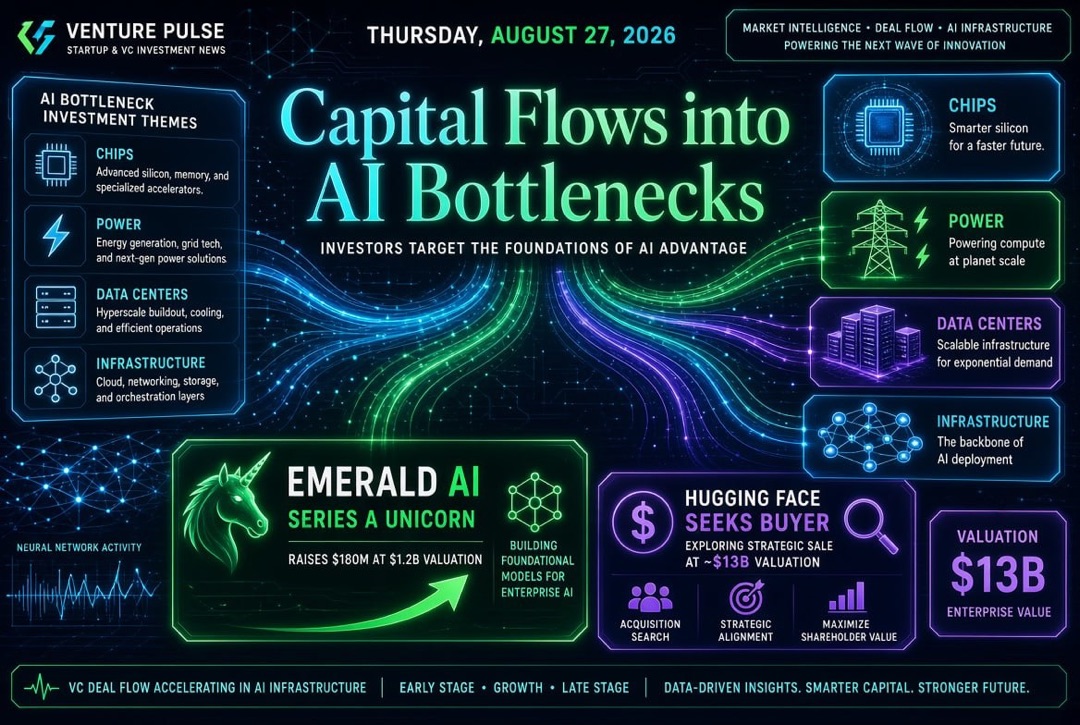
- Mega rounds in AI "bottlenecks." Gatik raised $200 million for autonomous freight transportation, Emerald AI secured $150 million in Series A at a valuation of $1.05 billion, and Alice raised $140 million for model safety.
- Strategic capital over traditional M&A. Nvidia is paying Poolside $6 billion for a license and an additional $1 billion for equity; labels and Electronic Arts are investing in Stability AI.
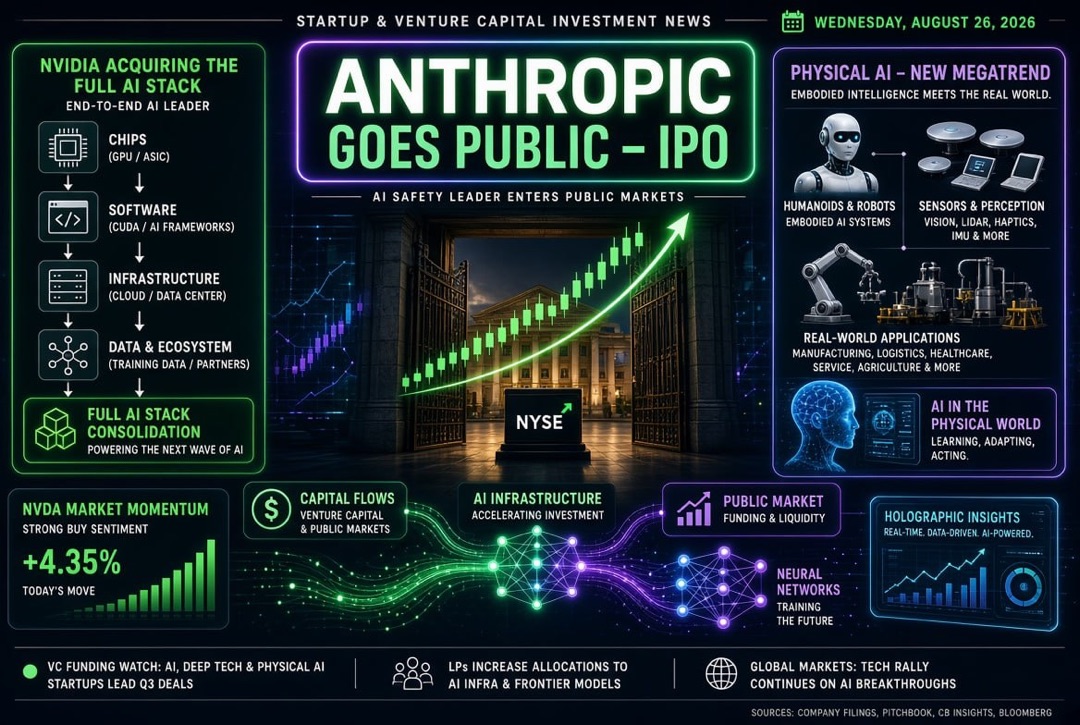
- Revival of exits. Hugging Face is exploring a sale with a valuation of $13 billion, Shein is going public in Hong Kong, and Anthropic is preparing to file an S-1 by the end of the month.
- Local focus: Russia and CIS. The market is shrinking in volume but improving in deal quality—the median check has increased by 23%.
Macroeconomic Overview: Record Capital Amid High Rates
According to Crunchbase, global venture investments for January to June 2026 totaled $510 billion, compared to $440 billion for all of 2025. PitchBook–NVCA data show that American startups attracted over $400 billion in the first half of the year, with AI accounting for 86% of all venture dollars in the second quarter. Physical AI—robots, autonomous systems, drones—gathered more in six months than it did in the combined years of 2022-2024 ($41.9 billion).
Meanwhile, the Federal Reserve maintained its rate range of 3.50–3.75% at its July meeting, with three committee members advocating for a hike. This fundamentally distinguishes the current boom from the years 2020-2021: venture funds are deploying record amounts without the backing of zero interest rates. For investors, this translates to a "mixed bag": exceptional companies with access to structural demand for AI receive extraordinary valuations, while undifferentiated software faces challenging follow-on rounds.
Deal of the Day: Gatik Raises $200 Million for Autonomous "Last Mile" Deliveries
Gatik from Santa Clara has closed a $200 million Series D led by Qatar Investment Authority and Koch Disruptive Technologies, with participation from Millennium Management, ARK Invest, and Intact Private Capital. The company focuses on autonomous freight transportation between distribution centers and retail points—focusing on repeatable routes rather than open-ended robotaxi tasks.
Why This Round Matters for Venture Investors
- Over $600 million in contracted revenue and 85,000 fully autonomous deliveries—a rare commercial validation for the sector.
- Total capital raised is approximately $500 million; the new valuation has not been disclosed.
- The consortium led by Qatari sovereign capital combined with industrial investor Koch signals that capital-intensive physical AI is being financed with contractual demand in place.
Emerald AI: Unicorn at Series A and Energy Hub of AI Infrastructure
The week's most significant price signal comes from the $150 million Series A for Washington-based Emerald AI at a valuation of $1.05 billion. The round was led by Energize Capital and DCVC, and the syndicate looks like a map of interests across the entire industry: NVIDIA, Samsung Ventures, Siemens, Aramco Ventures, Salesforce Ventures, GE Vernova, RWE, JERA Ventures, In-Q-Tel, Lowercarbon Capital.
The Emerald Conductor product allows data centers to flexibly vary energy consumption based on grid conditions without halting computations. According to the company, this approach has the potential to "unlock" over 100 GW of existing capacity in the American energy system. The company at the Series A stage is valued based on the scale of the limitation it addresses—this is the new pricing logic in AI infrastructure.
Model Safety and Content: Alice and Stability AI
Alice (formerly ActiveFence) raised $140 million led by Apax Digital with participation from Samsung and SentinelOne, bringing its total funding to $280 million. The company collaborates with eight out of the top ten AI labs and is approaching $100 million in annual recurring revenue; its valuation, according to various sources, ranges from $800 million to nearly $1 billion. The thesis is simple: as models transition from responses to actions within corporate systems, AI safety becomes a distinct category alongside network and identity security.
Stability AI closed a $76 million Series B, and the importance here is not the amount, but the composition of investors: Universal Music Group, Sony Music Group, Warner Music Group, and Electronic Arts have joined with AMD Ventures. Rights holders are transitioning from plaintiffs to shareholders—financing is becoming part of the corporate architecture, reducing licensing risks.
Strategic Capital: Nvidia Reshapes AI Deal Dynamics
Nvidia's deal with Poolside—$6 billion for a non-exclusive license to the Model Factory system plus $1 billion in investments at a pre-money valuation of $12 billion, along with the transfer of over 100 engineers to the open models project Nemotron—sets a new template. Instead of traditional acquisitions, corporations are employing licenses, minority stakes, and talent deals. The history of the seller is also telling: Poolside failed to secure $2 billion in six weeks for a cluster of 40,000 GPUs and lost it. Access to computational resources has become a key survival filter for second-tier models.
Concurrently, Nvidia is negotiating investments in Perplexity at a $30 billion valuation (with revenue over $750 million) and in Mercor at $20 billion. This same pattern is evident in the deals of the day: Builders FirstSource solely financed a $25.3 million Series A for startup Digs and signed a five-year commercial contract; Tencent led a $18 million Series B for Dublin's W4 Games, committing to evolve the Godot ecosystem in Asia.
M&A and IPO: Exit Window Expands
- Hugging Face hired a bank to assess buyer interest at a valuation starting from $13 billion—almost triple the $4.5 billion in Series D from 2023. This continues a wave of reevaluation of the "distribution layer" of AI following Stripe's acquisition of OpenRouter for over $7 billion.
- Shein is conducting an IPO in Hong Kong to raise up to $1.77 billion at a valuation of around $27 billion—down from $100 billion at its peak. The pricing will be announced on August 31, with trading starting on September 1 after failed listing attempts in New York and London.
- Anthropic is preparing to file public documents by the end of August with a target valuation of around $2 trillion, and the offering volume comparable to SpaceX's record-setting IPO. Year-to-date IPO volume in the U.S. stands at $160.6 billion against a historical peak of $195.2 billion in 2021.
Physical AI and Asia: From Guangzhou to Seoul
XPeng's robotics division has raised over $900 million in its first external round at a valuation exceeding $6 billion with participation from IDG Capital, Tencent, and Alibaba— the company plans to produce around 1,000 humanoids named IRON per month by the end of the year. In India, Airbound secured $37 million in Series A led by Greenoaks for autonomous aerial vehicles, MATTER Motor Works raised $25 million, and wealthtech platform Nexedge raised $20 million. In Korea, Liner closed a $36.1 million Series C primarily from local institutional investors, building a layer of verifiable AI search for corporations.
Russia and CIS: Fewer Deals, Higher Standards
The Russian venture market is moving in opposition to the global trend: according to the Moscow Venture Fund, the total investment volume in the first half of 2026 was 4.6 billion rubles across 54 deals, but the median check rose by 23% to 24.6 million rubles. The high key rate has made deposits a rational alternative to long-risk assets, leading investors to firmly abandon financing "promising ideas" without revenue. Growth points include corporate funds in medicine and industrial technologies, as well as regional platforms like the Siberian Venture Fair.
What to Watch for Investors on August 27
- Reaction to Nvidia’s Report. The results for the second quarter of fiscal year 2027 were released after market close on Wednesday; consensus estimates projected revenue around $92 billion (+97% year-on-year). Stock dynamics on Thursday will set the tone for valuations across the AI infrastructure sector.
- Start of the Symposium in Jackson Hole. Signals from the Federal Reserve regarding the trajectory of interest rates will directly affect the capital costs for late rounds and the IPO pipeline.
- Public Filing from Anthropic and Shein's pricing announcement on August 31—two tests of public market appetite for AI and for "stale" unicorns, respectively.
Conclusion: It's Not About Models, But Scarcity
The agenda for August 27, 2026, confirms that the venture market has entered a phase where capital concentrates around strategic scarcity. Power, agent safety, chip design, content rights, and contract logistics are being financed more generously than yet another interface for interchangeable models. For venture funds, this means a reassessment of portfolio construction: the question for a startup is no longer "where is the AI?", but "what scarce resource does the company control, and will its advantage survive the depreciation of the models themselves?"