Oil Market: Brent at $88 — A Week of Decline After Two-Week Rally
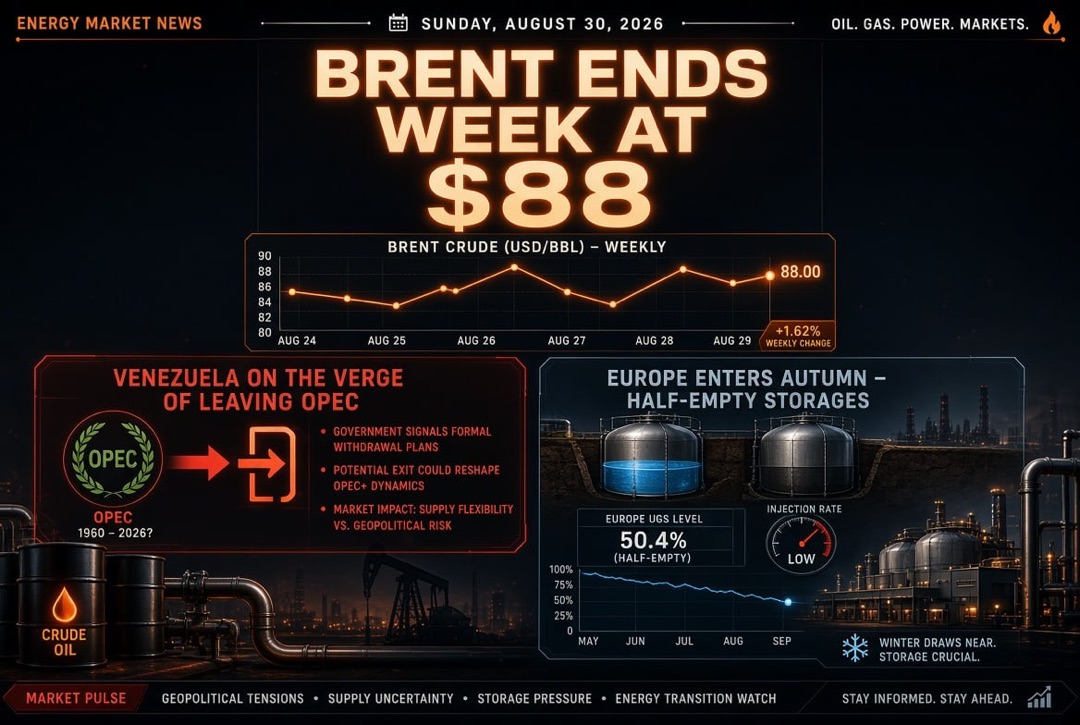
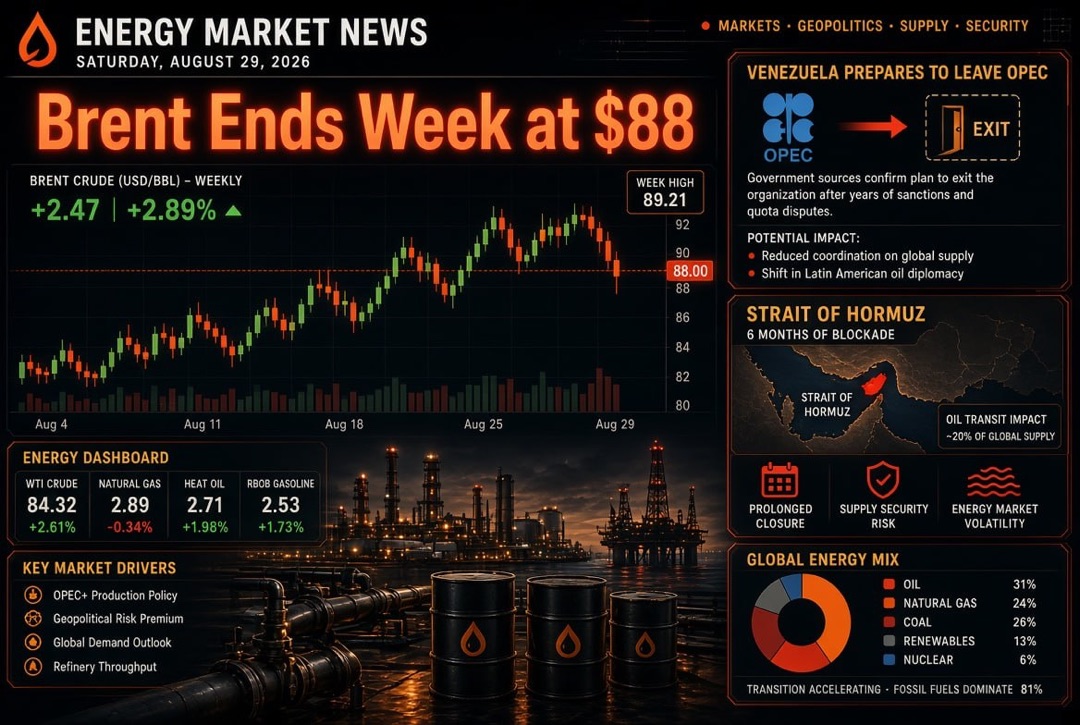
Oil prices experienced a wide range during the week. On Monday, Brent lost about 2.5%, dipping towards $92 amid the announcement of new US sanctions against Iran. By Thursday, the price retreated to $88, and on Friday the market closed the week with moderate declines. The result was a drop of over 5% for Brent and around 4% for WTI over five sessions. Nevertheless, since the beginning of the year, the benchmark remains approximately 25-40% higher than pre-crisis levels: the premium for geopolitical risk following the closure of the Strait of Hormuz in February has not dissipated. Key drivers of oil prices include:
- Diplomacy Over Hormuz: The agreement between Iran and Oman on a temporary corridor and joint demining serves as a major bearish factor.
- The Venezuelan Factor: Reports of negotiations between Caracas and Washington regarding access for American companies to oil fields have heightened expectations for increased supply.
- Harsh Rhetoric: The White House's refusal to revert to the terms of the June memorandum with Tehran briefly reversed the market upwards (+2.1% for Brent during that session).
- Russian Risk: Strikes on Russian refineries and ports limit exports of oil and oil products, providing support for prices from below.
The EIA forecast average Brent prices around $85 in the third quarter and does not expect a return to pre-war production levels in the Middle East before early 2027. Global oil inventories continue to decline: according to the IEA, observed reserves have fallen by 410 million barrels since the beginning of the war.
Venezuela and OPEC: A Blow to the Cartel's Unity
The main corporate-political news at the end of the week is that Venezuela, one of the five founding countries of OPEC, is exploring plans to exit the organization. The topic is being discussed in contacts with American officials alongside negotiations regarding access for US companies to Venezuelan fields; no final decision has been made. The country's output in July was approximately 1.16 million barrels per day — half of what it was a decade ago, thus, the direct impact on the oil market balance is limited. However, the symbolic significance is immense: following the recent departure of the UAE, another maneuver raises questions about the cartel's cohesion ahead of the OPEC+ meeting on September 6, where the base scenario remains a pause in quota increases until the end of the year.
The Strait of Hormuz: Six Months of Crisis and the Iran-Oman Corridor
Friday marked six months since the onset of the war, which shut down a key artery of the global energy system, through which around 20 million barrels per day of oil and oil products used to pass. The current framework for resolution is as follows:
- Iran and Oman have agreed on a temporary shipping route: the entry and part of the exit will pass through Iranian territorial waters.
- The parties have agreed on joint demining of the waters and the division of transit revenues.
- Technical negotiations regarding a permanent corridor and future management of the Strait will continue.
Tehran emphasizes that full reopening of the Strait is impossible without the US fulfilling its commitments, while the IRGC directly accuses Washington of delaying the deal. President Trump states that he is "in no hurry," while the US Treasury prepares to demand that G20 partners reduce ties with Iran under the threat of severing access to the dollar system. For the energy sector, this means continued high volatility: physical flows are recovering slowly, and insurance rates remain prohibitive.
Gas and LNG: Europe Between €65 and €100 per Megawatt-Hour
The gas market remains the most vulnerable segment of the global energy sector. TTF futures have retreated from a 3.5-year high of €68.46 and ended the week around €65 per MWh following news of de-escalation. The fundamental picture is concerning:
- Storage: EU gas storage facilities are only about 61-63% full — a historic low for end of August compared to nearly 74% a year earlier; the target level for November 1 has been lowered to 80%.
- Forecasts: In the case of a cold winter and slow recovery of Qatari exports, analysts anticipate December TTF prices above €100/MWh.
- Asia: Spot LNG JKM is holding around $21-22/MMBtu, and competition for Atlantic cargoes will intensify in the autumn.
- USA: Henry Hub remains below $3/MMBtu with record output — American LNG is becoming the main resource for closing the European deficit.
Oil Products: Record Diesel Shortage in the Atlantic Basin
American refineries are operating at around 97% capacity, but diesel fuel stocks in the US have dropped to seasonal lows that are unprecedented in history. Europe, having lost Middle Eastern and some Russian volumes, has for the first time in seven years purchased diesel from Mexico. Crack spreads for medium distillates remain at record levels — for refineries and fuel companies, this represents the primary source of margin, while for consumers, it is an inflation factor on the brink of the heating season.
Russia: Falling Refining and the Fate of Diesel Exports
The domestic fuel market in Russia remains under manual control. The ban on gasoline exports is effective until January 31, 2027, and jet fuel until the end of November. The embargo on diesel fuel exports expires on September 1, and according to industry sources, officials plan to extend it for at least the end of September; a discussion is underway for an extension until the end of the year. The reasons include the aftermath of drone strikes on refineries, a local deficit that returned in August in several regions, and refining at two-decade lows. For the global oil product market, this means a loss of Russian diesel volumes at a peak of European shortfall; for the domestic market, it leads to imports of fuel from Belarus and Asia as a backup.
Electricity, Renewable Energy, and Coal: Crisis Extends the Era of Coal
The energy crisis has rewritten the trajectory of the energy transition. Expensive LNG has made coal more competitive in Europe and Asia: it is estimated that coal generation will account for nearly a third of global electricity output in 2026. At the same time, renewable energy is accelerating where there are local resources: in the US, solar generation has grown by over 20% in the first half of the year, while wind and solar have for the first time surpassed coal and nuclear combined. Counteracting factors include tariffs on solar modules and a pause in the approval of new data centers in Texas, dampening forecasts for electricity demand growth.
Week Ahead: What to Watch for Energy Market Participants
- OPEC+ meeting on September 6: decision on quotas for October and response to the Venezuelan maneuver.
- Decision by the Russian government on diesel fuel exports post-September 1.
- Progress in technical negotiations between Iran and Oman and the dynamics of transit through the Strait of Hormuz.
- Rates of gas injection into European storage and TTF quotations at the end of summer.
- Signals from Washington regarding Venezuelan fields and sanction pressure on Iran through the G20.
Conclusion
The oil market is drifting towards a scenario of gradual de-escalation in the Middle East but remains a hostage to physical flows through Hormuz and the integrity of OPEC, which may be tested by Venezuela's possible exit. Gas and diesel have transformed into the key points of scarcity in the global energy landscape for autumn 2026, while coal has received an unexpected reprieve in the energy transition. For investors and energy companies, the upcoming week — with the OPEC+ meeting and Moscow's decision on diesel — will be crucial for positioning for the fourth quarter.