Oil Market: Brent Above $95 Amid Military Premium
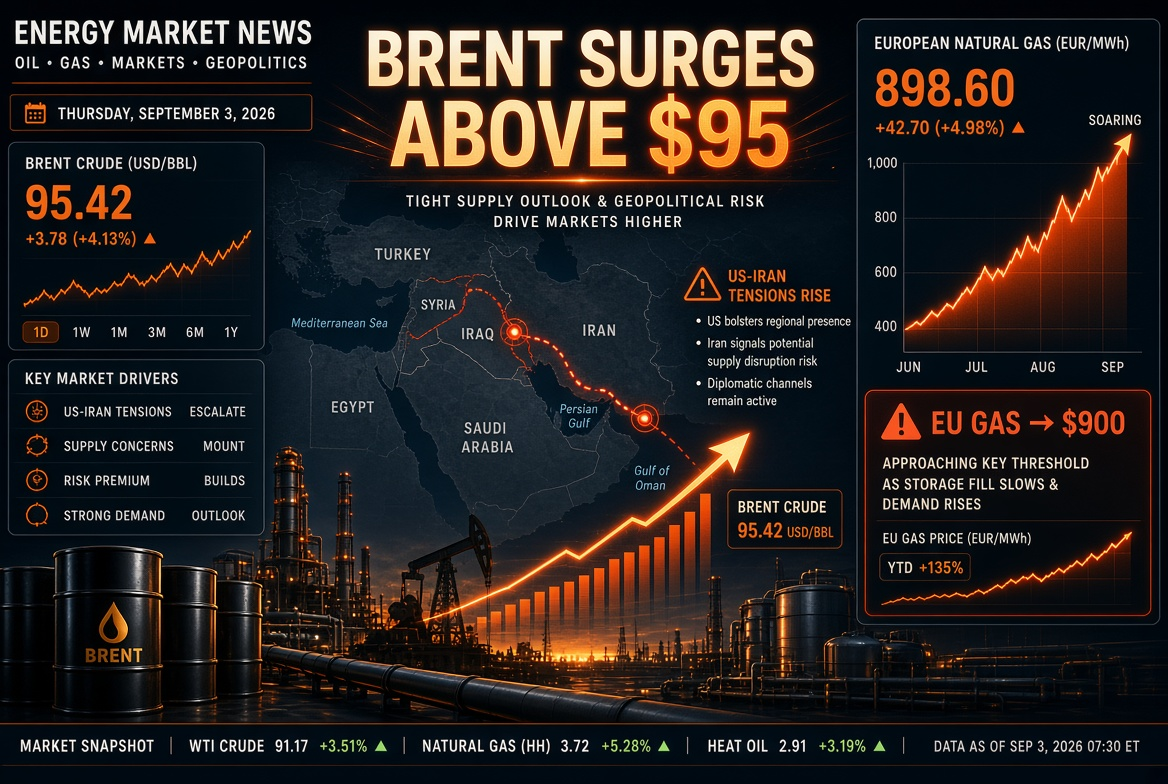
Oil prices are showing a swift increase. Brent futures ended Tuesday with a rise of over 4.5% and continued to climb on Wednesday, trading between $95–97 per barrel, while American WTI settled above $90. The market is pricing in a rising risk of supply disruptions from a region responsible for about one-fifth of global marine oil trade. Key price drivers include:
- Military Escalation: The USA launched a series of strikes on targets in Iran, including attacks on two Iranian tankers; Tehran retaliated with missile strikes on a US base in Jordan and launches toward the UAE.
- Threat to Kharg Island: Washington openly considers striking Iran's main oil export hub, which would have a direct impact on crude supply.
- Paralyzed Shipping: Transit through the Strait of Hormuz has reportedly declined to about 6 million barrels per day, down from earlier volumes that covered up to 20% of global supply.
- Insurance Premium: Attacks on commercial tankers, including Saudi and South Korean vessels, have sharply increased freight and insurance costs in the Persian Gulf.
Analysts note that as long as support around $90 per barrel holds, the market remains buyer-driven; however, with each wave of price increases, the risk of a sharp correction grows in the event of de-escalation.
Geopolitics: The Strait of Hormuz as the Epicenter of Global Energy Risk
The conflict between the USA and Iran has been ongoing for about six months, but the current phase appears most perilous for the global FEC. Iran has declared the Strait of Hormuz closed to commercial shipping, while Washington insists it controls the waters. Simultaneously, the USA is consulting with Russia and China regarding sanction pressure on Tehran. It is crucial for the global market that the strait not only facilitates oil from Saudi Arabia, Iraq, Kuwait, and the UAE, but also Qatari LNG — the temporary loss of nearly 20% of global LNG supply has already triggered a price shock across gas markets in Europe and Asia. Any scenario, from a blockade to strikes on Iran's export infrastructure, could add several dollars to the risk premium on prices.
OPEC+: Conclusion of the Production Increase Cycle and Pause Until Year-End
Amid geopolitical turmoil, the alliance of exporters adheres to its previously approved plan. As of September, seven key OPEC+ countries — Saudi Arabia, Russia, Iraq, Kuwait, Kazakhstan, Algeria, and Oman — have increased quotas by 188,000 barrels per day, fully concluding the exit from voluntary cuts of 1.65 million b/d. The total allowable production level has reached 36.2 million barrels per day. Further increases have been paused until the end of 2026; however, the basic restrictions of around 2 million b/d, in place since 2022, remain. The next ministerial meeting is scheduled for September 6, with the market closely monitoring whether the alliance will react to the Middle Eastern premium and the declining volumes of Iranian exports. An intriguing factor remains the redistribution of quotas following the UAE's exit from OPEC and OPEC+ in May 2026.
Gas Market: Europe Delayed in Stockpiling, TTF Approaches $1000
The European gas market is experiencing the most strained start to autumn in years. October futures at the TTF hub are trading around $880–895 per thousand cubic meters, adding about 2% since the beginning of the week — at the end of August, quotes surpassed $800 for the first time in five months, and now the market is seriously discussing a move towards $1000. The reasons for the price rally include:
- Significant volumes of LNG from Qatar and the UAE are absent due to shipping restrictions through the Strait of Hormuz.
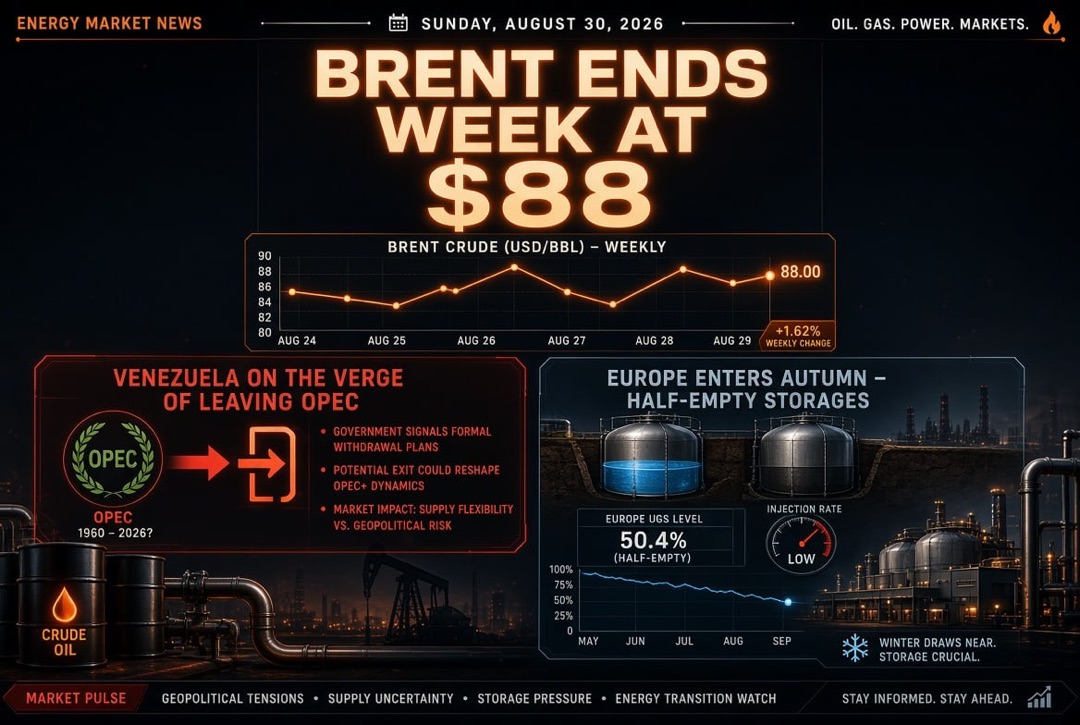
- The historically low levels of reserves in European gas storage facilities ahead of the heating season.
- Increased gas consumption by power plants during the summer amid heat and rising energy demand.
- Competition for spot LNG cargoes, only partially alleviated by reduced purchases from China and rejections from price-sensitive buyers like Pakistan.
LNG: US Exports as a Market Hedge
Balancing the market are new liquefaction capacities in North America: the Golden Pass and Plaquemines projects are ramping up production, and US LNG exports are holding near record levels. However, there is little available volume to promptly compensate for Middle Eastern losses, which maintains high price volatility in Europe and Asia.
Electricity and Renewables: Renewable Generation Mitigates Shock
The global electricity sector is adapting to gas shortages. According to industry analysts, the continued introduction of solar and wind capacities has been a key factor in diversifying energy supply and mitigating the effects of the gas shock: in regions with a higher share of renewables, dependence on expensive imported fuel is felt less. Concurrently, rising gas prices are provoking a switch back to coal in several countries in Asia and Europe. A distinct structural trend is the rapid increase in electricity demand from data centers and artificial intelligence infrastructure: in the USA, energy systems are revising load forecasts, and access to grid capacity is becoming a scarce asset, enhancing the investment attractiveness of generation and network companies.
Coal: Demand Supported by Expensive Gas
The coal market has once again become a beneficiary of the gas crisis. The switch of power plants from expensive gas to coal is being observed in both Asia and some European countries, supporting prices for thermal coal and the operational capacity of exporters — Indonesia, Australia, Russia, and South Africa. China and India continue to maintain high volumes of coal generation to cover peak loads, and in the short term, coal remains a backup resource for the global energy sector, despite long-term decarbonization goals.
Russian Oil Products Market: Export Restrictions and Targeted Easing
Within the domestic framework of the Russian FEC, a strict regulatory regime remains in effect. The complete ban on gasoline exports has been extended until January 31, 2027, applying to both producers and traders. However, from September 1, restrictions on diesel fuel, marine fuel, and gas oil have been eased — their export is once again permitted for direct producers, which reduces the risk of oversupply at refineries and falling processing volumes. These measures are complemented by:
- Increased regulations for fuel sales on exchanges to ensure the domestic market;
- Monitoring by the Federal Antimonopoly Service over speculative resale of oil products;
- A damping mechanism to compensate oil producers for some of the lost export revenues.
Fuel stocks in the country are comparable to last year's levels, and the situation in regions that experienced disruptions in the spring is gradually normalizing — however, the autumn maintenance season for refineries calls for regulators to remain vigilant.
What This Means for Investors: Key Indicators as of September 3
The FEC market enters Thursday with the highest geopolitical premium seen in months. Investors and market participants should monitor the following:
- Dynamics of the US-Iran Conflict: Any signals regarding a strike on Kharg Island or, conversely, negotiations could shift Brent prices by a few dollars in either direction.
- Shipping Through the Strait of Hormuz: The restoration of transit will be the main deflationary factor for oil and LNG.
- OPEC+ Meeting on September 6: The alliance's response to the declining volumes and price rally.
- Pacing of European Gas Storage Replenishment: This will determine whether gas holds above $900 per thousand cubic meters.
- Russian Fuel Market: The effect of partial diesel export openings and exchange quotes for gasoline.
The base scenario for the coming days is the maintenance of high volatility amid elevated oil and gas prices: the energy market is once again trading on geopolitics rather than the balance of supply and demand.