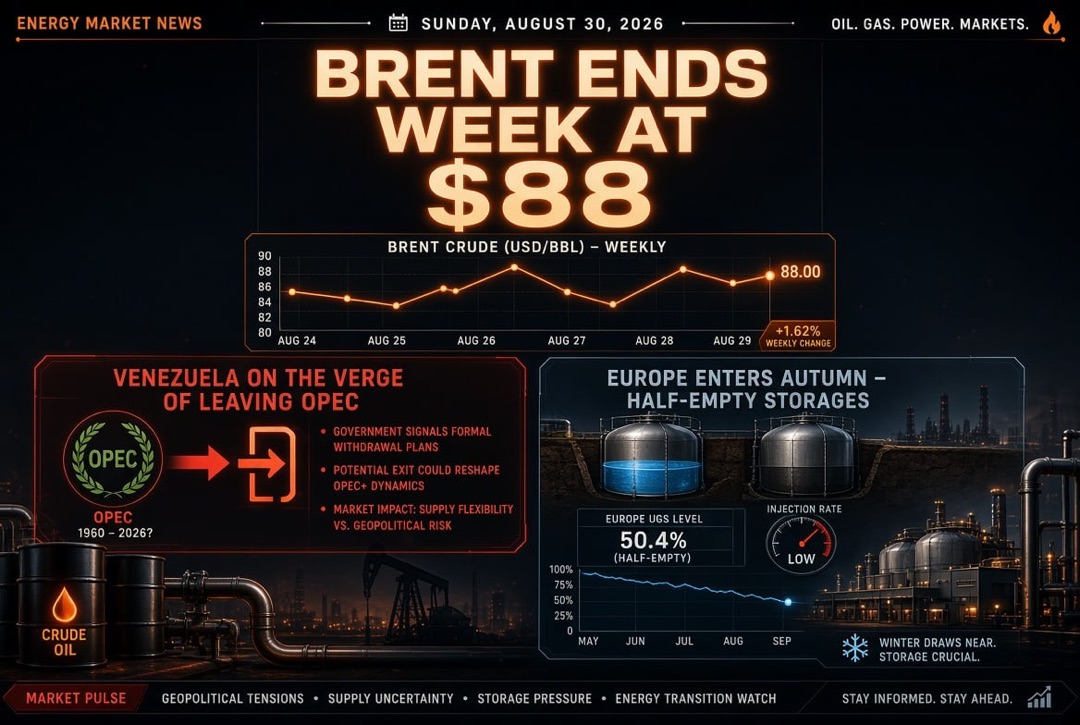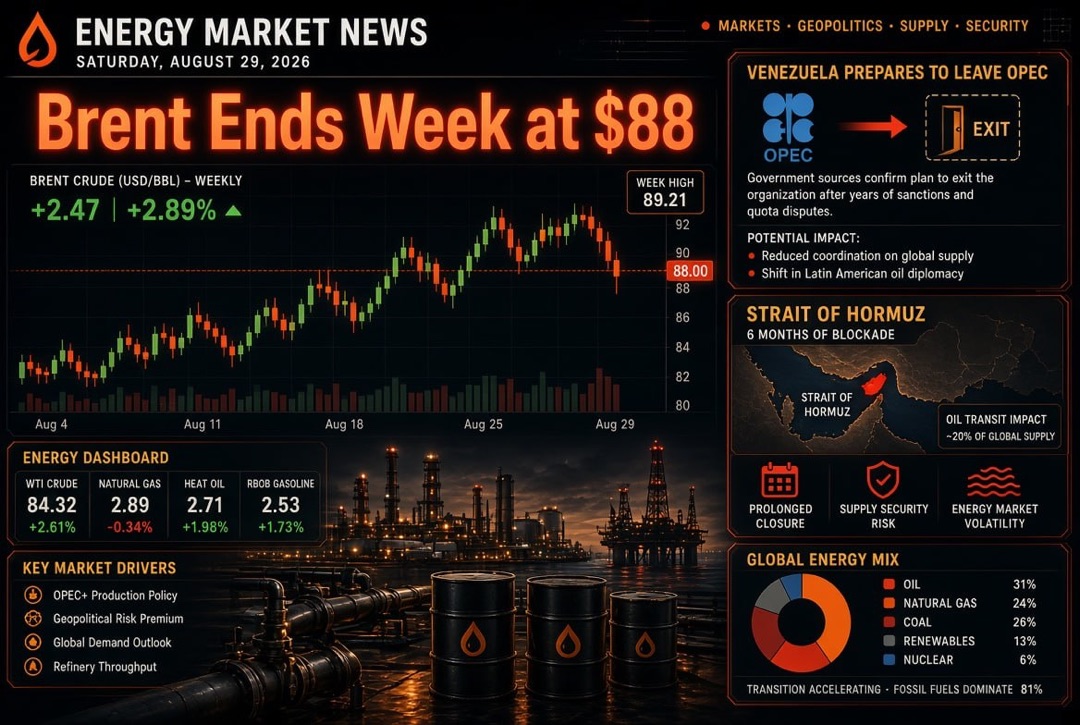
Global Oil and Gas and Energy News as of March 15, 2026. Brent Oil Prices Rise Above $100, Tensions in the Global Gas Market, LNG, Oil Products, and Electricity Market Situations, Analysis of Key Trends in the Global Fuel and Energy Sector for Investors and Energy Companies.
The global fuel and energy complex enters mid-March in a state of heightened volatility. For investors, oil companies, gas traders, electricity market participants, refineries, and oil product manufacturers, the sharp rise in the geopolitical premium for oil and gas remains a key topic. The oil market has stabilized above the psychologically significant $100 per barrel mark, the European gas market is facing low inventory levels ahead of the injection season, and refinery and electricity sectors are forced to quickly adapt to a new risk structure. Against this backdrop, the energy sector is increasingly splitting into two contours: traditional hydrocarbons are once again becoming the basis for short-term stability, while renewables, grids, and storage systems retain strategic investment attractiveness.
For the global market, this signifies a shift in focus. Whereas at the beginning of the year the primary concern was the pace of demand growth and OPEC+'s strategy, attention has now shifted towards the physical availability of raw materials, logistic resilience, the status of export corridors, refinery profitability, and the ability of energy systems to meet peak loads without price shocks for consumers.
Oil Market: Risk Premium Once Again Determines Barrel Prices
The major news in the global oil and gas market is the sharp increase in the role of geopolitics in pricing. The oil market in March is driven less by demand expectations and more by questions regarding the physical availability of raw materials and oil products. For market participants, this signifies a return to a state where even mild supply disruptions can rapidly translate into spikes in prices.
- Brent oil remains above $100 per barrel, significantly raising inflation risks for the global economy.
- Export flows from the Middle East and the resilience of maritime logistics are in focus.
- For oil companies, rising prices bolster cash flow, but intensify political pressure on producers.
Moreover, the oil market remains highly sensitive to news. Even potential increases in supply from certain countries do not alleviate tensions, as market participants factor not only the current deficit but also the risk of prolonged supply disruptions into pricing. For investors in oil, oil products, and oil and gas sector stocks, this presents an environment of high returns yet also high price turbulence.
OPEC+, IEA, and Strategic Reserves: The Market Shifts from Forecasting to Crisis Management
A significant development in March is that market stabilization mechanisms are already engaged. The coordinated release of oil from strategic reserves demonstrates that major energy consumers acknowledge that tensions in the fuel and energy sector have exceeded the bounds of ordinary market correction. This alleviates some panic but does not eliminate the underlying issue—risks to physical supplies remain higher than the volume of immediate compensation.
- OPEC+ retains its significance as a supply management tool, but its influence is temporarily overshadowed by logistical and geopolitical constraints.
- Strategic reserves help cushion price shocks but do not replace stable exports from key producing regions.
- For the global fuel and energy sector, this sends a signal: in 2026, the oil balance will be determined not just by production but also by transportation infrastructure.
In this configuration, the oil market remains tight for consumers and favorable for producers. However, for governments and central banks, this worsens the macroeconomic backdrop, as expensive oil raises costs in transport, industry, electricity generation, and petrochemicals.
European Gas Market: Low Stocks Become the Key Risk of Q2
The European gas market enters a new cycle with a significantly weakened position. Following winter fuel withdrawals, gas storage facilities in the EU are filled notably below the average levels of previous years. For the gas market, this means that the injection season starts from a tighter point, and any volatility in the LNG market immediately reflects on prices.
This is particularly critical for Europe for several reasons:
- The low inventory base increases sensitivity to the costs of summer supplies;
- Competition with Asia for LNG may intensify as early as the second quarter;
- Gas again becomes not only a fuel source for heating but also a pricing factor in electricity and industry.
The gas market is currently establishing a new price corridor for the entire European economy. For electricity producers, energy-intensive industries, and gas traders, this denotes increased hedging activity and a more cautious approach to sales over longer periods. For investors in the fuel and energy sector, gas remains one of the most sensitive segments of the global energy market.
LNG: Global Logistics Becomes a Key Variable
The LNG segment in March once again proved to be the central channel for redistributing gas risk between Europe and Asia. When pipeline flexibility is restricted, the market promptly shifts to competing for LNG cargoes. In this situation, suppliers with reliable logistics, available volumes, and flexible contracts emerge victorious.
Three major trends are currently forming in the global LNG market:
- Europe aims to ensure summer inventory replenishment at any cost, while regulators attempt to prevent purchases "at any price."
- The United States is reinforcing its role as a systemic supplier, with its export infrastructure gaining strategic significance for the Western energy balance.
- Any disruptions from major exporters immediately transform into increased premiums on gas, electricity, and coal.
This elevates the value of LNG projects, tanker fleets, regasification terminals, and gas infrastructure for the global fuel and energy sector. For funds and strategic investors, interest is shifting from purely raw materials stories to infrastructure assets with long cash flows.
Refineries and Oil Products: Refining Margins Improve, but Operational Risks Rise
The oil products market in March experienced a significant strengthening in refining activity. Refineries worldwide are gaining support from rising cracks, especially in diesel and aviation fuel. For refiners, this is a positive signal: even with expensive oil, margins can remain strong if the market is experiencing a deficit of finished products.
However, the refining sector is still facing constraints:
- Unstable raw material supply complicates plant loading planning;
- Expensive logistics increases the production costs of oil products;
- The diesel market remains particularly sensitive for Europe, where a structural deficit of distillates persists.
For fuel companies and traders, this denotes a favorable environment in oil products but also heightened demands for inventory management. For investors, stocks of refiners and companies with a high share of marketing and sales appear more resilient in the current market phase than businesses solely reliant on upstream activities.
Electricity: Rising Demand Increases the Value of Gas, Nuclear, and Backup Generation
The global electricity sector is simultaneously experiencing two trends: long-term demand growth and short-term fuel price increases. This is particularly evident in the U.S. and Asia, where the expansion of data centers, industrial loads, and digital infrastructure is pushing consumption upwards. For generation, this means that reliability is once again a key factor in asset evaluation.
Current trends in the electricity sector include:
- Gas remains a fundamental stabilizer of the energy system, despite price volatility;
- Coal temporarily strengthens its position in several countries as a hedge against gas shortages;
- Nuclear generation is re-entering the agenda as a source of predictable and non-carbon power;
- Grids, storage systems, and demand flexibility are becoming as important as generation itself.
For the electricity market, this signifies growing importance for capacity assets, networking projects, and companies capable of providing stable power supply during price stress periods.
Coal and Renewables: Temporary Rise in Coal's Role Does Not Cancel Long-Term Energy Transition
Rising gas prices and disruptions in the LNG market have already bolstered certain segments of the coal market. For some Asian countries and parts of emerging markets, coal remains the fastest method to keep electricity prices from surging. However, this does not signal a reversal of the global energy transition. Rather, the world’s energy profile is entering a phase where short-term supply security temporarily takes precedence over climate optimization.
Renewables, meanwhile, maintain strategic attractiveness:
- Solar and wind generation reduce dependence on imported fuel;
- Storage projects and grid modernization are receiving additional justification;
- Energy security is increasingly being interpreted as diversification rather than solely as an increase in oil and gas production.
Therefore, over the next few years, balanced energy portfolios that combine traditional fuel and energy sectors with electricity, infrastructure, and low-carbon capacities may benefit the most, rather than extreme bets on “only oil” or “only renewables.”
What This Means for Investors and Players in the Global Fuel and Energy Sector
As of March 15, 2026, several fundamental conclusions can be drawn for the global energy market. Firstly, oil, gas, and oil products have again become the main transmission mechanism for geopolitics into inflation. Secondly, the European gas market enters the injection season from a vulnerable starting position. Thirdly, refineries, LNG infrastructure, the electricity sector, and flexible generating capacities are gaining a new investment premium.
Key reference points for investors, oil companies, refineries, gas traders, and electricity market participants in the coming weeks include:
- The dynamics of Brent oil and stability of prices above $100 per barrel;
- The speed of recovery in global flows of oil, LNG, and oil products;
- The pace of gas injections in the EU and TTF’s reaction to competition for LNG;
- Refining margins in diesel, gasoline, and aviation fuel;
- Political measures by countries to curb tariffs and fuel prices;
- New signals regarding demand for electricity, coal, gas, and renewables.
The conclusion for the global fuel and energy sector is straightforward: the market has entered a phase where not only the reserves of oil and gas matter, but also the ability to quickly deliver energy, refine raw materials, balance the energy system, and safeguard consumers against price shocks. This logic will define the behavior of oil and gas, energy, refineries, oil product markets, coal, and renewables in the coming weeks.