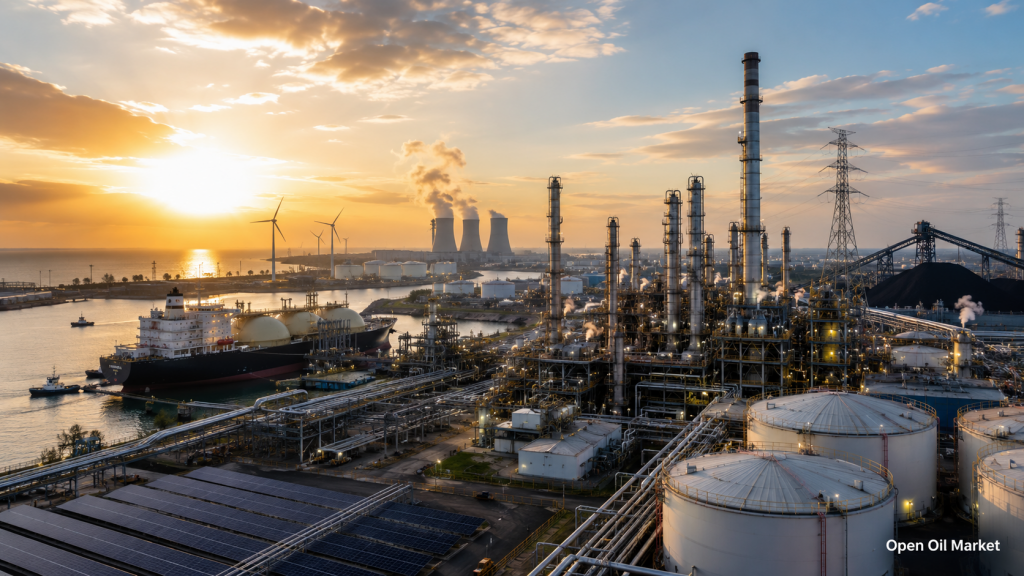
The Global Fuel and Energy Complex: July 6, 2026 - Oil Refineries, LNG Terminals, Oil Storage, Renewable Energy Sources, Coal, and Power Grids
The global fuel and energy complex enters Monday, July 6, 2026, with a new risk balance. The key theme of the day is the decision by major OPEC+ countries to increase oil production in August by an additional 188,000 barrels per day. For investors, oil companies, traders, refineries, and stakeholders in the energy market, this signals that the market is gradually moving away from acute geopolitical premiums, but is not returning to full normalization.
Brent oil remains around the levels of 70–72 dollars per barrel, the European gas market continues to be sensitive to LNG supply, diesel and aviation fuel maintain high margins, and the electricity sector increasingly relies on a combination of gas, renewables, coal, and grid infrastructure. A new investment logic is forming in the raw materials and energy sector: there is more raw material available in the market, but reliable processing, logistics, and access to the end consumer are becoming more expensive.
OPEC+ Opens the Tap: Oil Gets a Signal for Supply Growth
A key news item for the oil market was the decision by seven OPEC+ countries—Saudi Arabia, Russia, Iraq, Kuwait, Kazakhstan, Algeria, and Oman—to increase production by 188,000 barrels per day starting in August. This continues the strategy of gradually returning a portion of the voluntary cuts that had been in place following a previous period of weak demand and high volatility.
For the oil market, this signifies several consequences:
- The supply of crude oil will grow faster than the most cautious market participants had anticipated;
- The geopolitical premium in Brent and WTI quotes is decreasing;
- Gulf oil companies are striving to restore export flows after disruptions;
- Investors are re-evaluating the scenario of oil shortages in the second half of 2026.
However, a formal increase in quotas does not always equate to a similar increase in actual production. Some OPEC+ countries are already facing infrastructure, logistics, and internal consumption constraints. Therefore, the market will closely monitor not only the announced quotas but also real export volumes, port loading, tanker movements, and trends in commercial oil inventories.
Brent and WTI: The Oil Market Loses Strategic Premiums but Does Not Achieve Sustainable Surplus
Oil prices at the beginning of July appear more stable than during heightened tensions in the Middle East. The gradual recovery of shipping through the Strait of Hormuz has alleviated fears of a physical shortage of crude. For Brent, the range of around 70–72 dollars per barrel becomes a critical equilibrium zone between expectations of rising supply and still limited inventories.
Three opposing factors simultaneously influence oil quotes:
- Increased supply. OPEC+ is returning part of its production, and non-aligned producers are also utilizing high margins to boost exports.
- Weaker-than-expected demand. China and parts of Asia are demonstrating more cautious consumption of raw materials, particularly in the industrial sector.
- Ongoing logistics risks. Even after the reduction of tensions in the Persian Gulf, insurance rates, freight, and tanker routing remain above normal levels.
For oil and gas investors, this means the market is no longer trading exclusively on geopolitical risks. Classic parameters are back in focus: production, inventories, demand for oil products, refinery utilization, and the policies of the largest importers.
Gas and LNG: Europe’s Dependence on Global Competition for Molecules
The gas market remains one of the most sensitive segments of the global energy landscape. European gas prices at the TTF hub are holding above pre-crisis comfortable levels, reflecting the region's dependence on LNG and competition with Asia. Although the current situation appears more stable than during peak periods of the energy crisis, Europe's structural vulnerability has not vanished.
A key feature of the gas market in 2026 is the high interconnectivity of regions. Any disruption in LNG supplies from Qatar, the U.S., Australia, or Nigeria can quickly impact prices in Europe, Asia, and Latin America. For energy companies and industrial consumers, this raises the importance of long-term contracts, flexible logistics, and supplier diversification.
Key factors for the gas market in the coming weeks include:
- The pace of gas injections into European underground storage;
- The volume of LNG supplies from the U.S. and Qatar;
- Summer electricity demand due to heat in Europe and Asia;
- Competition between industrial consumers and the energy sector;
- The condition of gas infrastructure and regasification terminals.
Refineries and Oil Products: Diesel Becomes the Main Risk for the Energy Market
While pressure in crude oil is gradually shifting towards growing supply, the oil products market remains significantly more strained. Refineries around the world are operating under conditions of unstable utilization, limited access to certain grades of crude, and high margins for middle distillates. Diesel, aviation fuel, and marine fuel remain strategically important products for logistics, industry, agriculture, and defense supply chains.
Importantly, the reduction in crude processing in certain regions exacerbates the imbalance between crude prices and the prices of finished fuels. For oil refineries, this creates an opportunity window, but simultaneously increases operational risks: maintenance challenges, accidents, sanction restrictions, and shortages of individual components can quickly lead to local deficits.
For fuel companies and traders, key focus areas include:
- Monitoring diesel fuel inventories ahead of the autumn-winter season;
- Monitoring export restrictions on oil products;
- Assessing refinery margins on diesel, gasoline, and aviation kerosene;
- Diversifying oil product supplies between Europe, the Middle East, Asia, and Latin America.
Electricity: Demand Grows Faster than Infrastructure
The global electricity sector enters the second half of 2026 amidst accelerated demand growth. Data centers, artificial intelligence, transport electrification, industrial production, and air conditioning during hot seasons are increasing the load on energy systems. While generation develops faster than networks, storage, and balancing capacities.
For the energy sector, this creates a paradox: renewables (RE) are becoming cheaper and more expansive, but system reliability increasingly relies on gas, coal, hydropower, nuclear generation, and grid reserves. Countries with developed infrastructure benefit from an increase in the share of solar and wind generation, while regions with network deficits encounter limitations in connecting new capacities.
For investors in electricity, it is important to assess not only installed capacity but also the quality of the energy system: access to networks, reserving, storage, tariff regulations, and payment demand from industry.
Renewables: The Energy Transition Accelerates but Faces Network and Permit Limitations
The renewable energy sector remains one of the key areas for global investments. Major infrastructure funds, industrial groups, and technology companies continue to invest in solar and wind generation, energy storage systems, and corporate energy platforms. Demand from data centers, semiconductor manufacturers, and companies aiming to secure long-term prices for electricity is particularly strong.
However, renewables not only face investment opportunities but also limitations:
- Long permit acquisition times;
- Deficits in network connections;
- Rising costs of equipment and construction in certain regions;
- The need for investments in energy storage;
- Political uncertainty surrounding subsidies and tax incentives.
For investors, this means that the most attractive projects will not just be solar or wind generation but comprehensive platforms: generation plus network, storage, long-term corporate contract, and a clear regulatory environment.
Coal: Energy Security Supports Demand in Asia
Despite the rise of renewables and the climate agenda, coal remains an important part of the global energy mix. In Asia, demand is supported by China, India, Indonesia, Vietnam, and other developing markets, where electricity is needed for industry, urbanization, and population growth. For these countries, coal generation remains a tool for energy security, especially during peak demand periods.
Energy coal quotes at the beginning of July remain significantly below the crisis peaks of 2022 but above levels that could be considered fully comfortable for consumers. This reflects steady demand from Asia and supplier caution after several years of high volatility.
For investors, the coal sector remains complex: on one hand, it generates cash flow and is in demand in energy systems; on the other hand, it carries regulatory, environmental, and reputational risks. Therefore, the market is gradually dividing into two segments: short-term trading and production for energy security, alongside long-term reductions in coal dependency in countries with strict climate policies.
Raw Markets and Supply Geography: The World Restructures Energy Routes
The global energy complex increasingly depends not only on production but also on supply routes. Following tensions around the Strait of Hormuz, oil and gas importers are ramping up diversification efforts. Japan, South Korea, India, and European consumers are striving to reduce dependence on any one region, route, or type of raw material.
In practice, this means increased importance for:
- American oil and LNG;
- Atlantic supplies to Europe and Asia;
- Flexible shipping routes;
- Insurance for maritime transport;
- Backup oil product suppliers;
- Investments in ports, terminals, and storage facilities.
For oil and gas companies, this creates a new competitive environment: success relies not only on who can produce cheaply but also on who can guarantee the delivery of oil, gas, LNG, coal, or oil products to the end consumer.
What Investors and Energy Market Participants Should Pay Attention To
Monday, July 6, 2026, shows that the global energy market is moving from a phase of panic risk assessment to a more pragmatic evaluation of balance. But this does not mean a decrease in the significance of the energy sector for investors. On the contrary, oil, gas, electricity, renewables, coal, oil products, and refineries are becoming even more interconnected.
In the coming days, investors should watch five key indicators:
- Actual OPEC+ production. Not only quotas matter but also actual export volumes.
- Brent and WTI prices. Maintaining Brent around 70 dollars will indicate how much the market believes in the recovery of supply.
- Diesel margins and refinery utilization. Oil products could become the main source of volatility.
- European gas and LNG. The pace of storage filling will define the region's resilience as winter approaches.
- Electricity and renewables. Increasing demand from data centers and industry will support investments in generation, networks, and storage.
The key takeaway for the global energy complex: the oil market is gradually stabilizing, but the overall energy system remains fragile. For investors, oil companies, fuel traders, refineries, and electricity producers, 2026 will be a year in which profitability is determined not only by the price of a barrel but also by logistics quality, access to processing, inventory management, and the ability to navigate the new geography of global energy flows.




