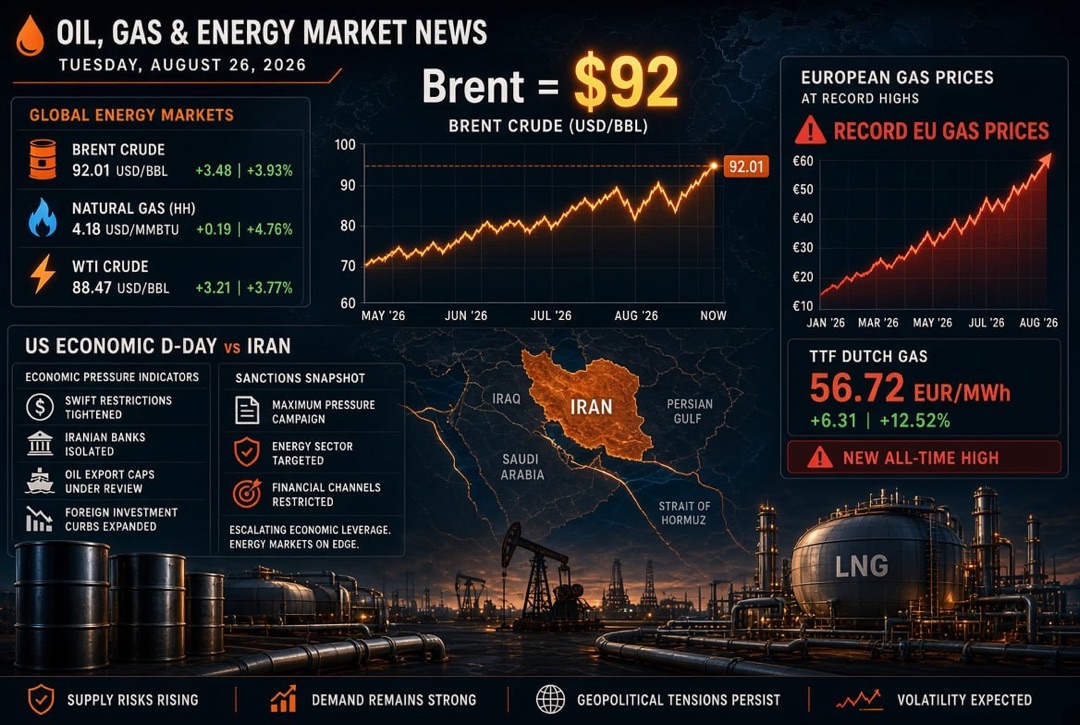
Key Highlights for Wednesday Morning, July 29, 2026
- Oil. Nearby Brent futures are trading around $86–87 per barrel, and WTI is around $81. On Monday, both benchmarks lost about 8% — the largest single-day decline in months.
- Geopolitics. The U.S. has suspended a series of nighttime strikes on Iran; Washington cites a "pause for negotiations", while Tehran has yet to confirm any concessions.
- Logistics. Net exports of oil and oil products through the Strait of Hormuz averaged approximately 2.9 million barrels per day for the week ending July 24, down from 5.9 million bpd the previous week.
- Gas. Spot TTF prices rose to approximately $744 per thousand cubic meters, up from an average of $532 in June — the highest since December 2022.
- Electricity and Renewables. Solar generation accounted for about 25% of electricity production in the EU for the first time, surpassing nuclear, gas, and wind power.
- Russia. The ban on gasoline exports has been extended until the end of 2026, and the import damper has been expanded to diesel fuel.
Oil: The Market is Unwinding the Geopolitical Premium
The central theme in the oil market is the speed at which the geopolitical premium is disappearing. As of July 23, Brent had reached a six-week high amid the twelfth consecutive nighttime strike by the U.S. on Iranian assets and escalating tensions in the Red Sea. Following reports of the suspension of these strikes, prices opened the week with a sharp decline: first to $86.80, then below $85 — the first time since July 17. By Monday evening, the market had recovered part of its losses, but declines continued into Tuesday, with oil stabilizing near three-week lows from Tuesday to Wednesday.
The market is fundamentally being pulled by three forces:
- Diplomatic Hope. The pause in strikes is interpreted by traders as an opportunity for a deal and a precursor to a reopening of shipping.
- Physical Shortage. Supply through Hormuz remains half of the norm, and insurance rates for vessels in risk zones are significantly higher than pre-war levels.
- Return of Supply. The partial return of Iranian barrels to the market intensifies competition for Asian buyers and exerts downward pressure on differentials.
Investment bank analysts previously raised their Brent price forecast for 2026 to $85, incorporating prolonged disruptions in the Strait. The current de-escalation suggests this forecast is more likely to be an upper limit rather than a lower one.
Strait of Hormuz and the Red Sea: A Bottleneck in the Global Energy Sector
Before the conflict, approximately a quarter of the world's maritime oil trade and around 20% of global LNG passed through the Strait of Hormuz. Currently, movement has only partially resumed: tankers are primarily navigating a northern corridor along the Iranian coast, and pumping rates are unstable from week to week.
Simultaneously, the second route has also seen an escalation. Yemeni Houthis reported attacks on the Eastern-Western pipeline, which connects Saudi Arabian oil fields to the port of Yanbu on the Red Sea, as well as on infrastructure near Jazan. This pipeline serves as a critical bypass in the event of Hormuz blockage, so any prolonged interruptions in its operation will immediately reinstate the risk premium in oil and freight prices.
OPEC+: Quotas Are Increasing, Actual Production Is Lagging
Formally, the alliance is continuing its trend towards easing restrictions. The collective ceiling for the "seven" key participants was raised in July to 30.633 million bpd, up from 29.548 million bpd in June. However, actual volumes are far below permitted levels:
- Saudi Arabia produced approximately 3.44 million bpd below its quota;
- Iraq — 2.38 million bpd below;
- Kuwait — 1.18 million bpd below;
- Russia produced 8.928 million bpd in June, falling short of its plan by 834,000 bpd;
- Kazakhstan, on the contrary, exceeded its quota by more than 1.15 million bpd.
The lag among Middle Eastern participants is attributed not to discipline but to the physical inability to export crude. The UAE's exit from OPEC and OPEC+ as of May 1 has further limited the manageability of the deal. The practical takeaway for the market is that the alliance has significant "sleeping" export potential that could flood the market immediately after the normalization of shipping — this is the main medium-term bearish factor for oil.
Gas and LNG: Europe is Paying for Insufficient Injection
The European gas market is moving in opposition to oil. As of July 19, EU underground storage facilities were filled to about 54% (approximately 57.7 billion cubic meters) — nearly 16 percentage points lower than the five-year average. Injection rates are slowing: daily replenishment was about 308 million cubic meters in June, approximately 270 million cubic meters in July compared to 338 million cubic meters last year.
Why Gas Prices Are Rising
- July LNG imports may drop to about 6.5 million tons — the lowest in two years and around a quarter lower year on year;
- Asia is buying up free cargoes: for the Asia-Pacific region, this is a current consumption issue, whereas for the EU, it concerns stockpiles;
- Qatar is gradually restoring shipments from Ras Laffan and promises to return the majority of its capacity within two months following the full reopening of the strait;
- As of January 1, 2027, the EU's ban on importing Russian LNG under long-term contracts will come into effect, and pipeline gas will be banned by September 30, 2027.
Conservatively, by early November, EU UGS facilities may only be about 75% full — near a historic minimum. This keeps the premium in winter contracts high and renders the European industry structurally vulnerable for another heating season.
Coal: Correction After Escalation
The coal market reacts to oil and gas volatility with a lag. In mid-July, European thermal coal indices rose above $118 per ton, following oil and gas, but last week prices corrected downwards in Europe, China, and Australia. Stocks in the nine largest ports in China remain around 29 million tons, which limits growth potential.
For Russian exporters, the picture is mixed. Transshipment through Black and Azov Sea ports increased by 21.5% in the first half of the year, reaching 13.9 million tons, supporting total exports. However, sanctions, high rail tariffs, and ruble strengthening compress margins, while competition for Turkish and Asian markets intensifies. The long-term benchmark is set by China’s five-year energy development plan for 2026–2030: demand for coal and oil is expected to peak within the next five years, after which they will transition to the status of reserve sources.
Electric Power and Renewables: Record Solar Output and Expensive Evenings
In June, solar power plants provided about 25% of electricity generation in the European Union for the first time, surpassing nuclear, gas, and wind generation; monthly records were set in 18 EU countries. On specific days, the share of renewables in Germany approached 74%, while solar generation reached 37.5%.
The downside of these records is the growing volatility of electricity prices. A shortage of storage systems leads to daytime surpluses being wasted, while evening peaks are met with expensive gas and coal generation. An additional factor is restrictions on French nuclear plants due to river water temperatures during heatwaves. For investors, this shifts the focus from introducing new renewable capacities to networks, battery storage, and flexible demand.
Russia: Fuel Market, Refineries, and Dampers
The domestic refined products market remains under manual control. The current measures package includes:
- A complete ban on gasoline exports, extended until the end of 2026;
- A ban on the export of diesel fuel, marine fuel, aviation kerosene, and gas oils;
- A reduction in the norm for mandatory exchange sales of gasoline from 15% to 10% for the period from July 1 to September 30;
- Maximum refinery loading, reducing current maintenance durations, and postponing scheduled repairs;
- An import damper, expanded from July to gasoline, and, after amendments to the Tax Code, to diesel fuel and middle distillates (for a period until July 2027);
- A zero import duty and an increase in supplies from EAEU countries.
A mechanism is also being prepared to account for direct contracts when calculating exchange norms — authorities hope to reduce the risk of local shortages in regions.
Russian Oil Exports: Discounts Against the Budget
The physical volumes of Russian oil exports are near the year's highs, but the price component is deteriorating. The Urals discount increased by approximately $3 per barrel in the first half of July compared to June; under FOB conditions at Baltic ports, the spread to Dated Brent was assessed in the range of $25–28 per barrel against a five-year average of around $19.8. The average price used for calculating MET in July was about $50.4 per barrel compared to $63.5 in June.
Considering that the budget is based on Urals at around $59 per barrel and that the deficit already significantly exceeds the annual target, the July price decline will affect treasury revenues in August. The return of Iranian barrels to the Indian market intensifies competition and increases the likelihood of further discounts.
What Market Participants in the Energy Sector Should Monitor in Upcoming Sessions
- The Format of U.S. – Iran Negotiations: Confirmation of direct contacts could push Brent into the $75–80 range.
- Dynamics of Pumping through Hormuz: Returning to 5–6 million bpd will signal the end of the supply crisis.
- Houthi Attacks on Saudi Infrastructure: Strikes on Yanbu and the Eastern-Western pipeline could instantly reinstate the risk premium.
- Gas Injection Rates in EU Storage: Lagging behind schedule in August means an expensive winter and high TTF.
- Restoration of LNG Shipments from Qatar: A key factor for the balance between Europe and Asia.
- OPEC+ Decisions on Quotas for September and the actual ability of participants to meet them.
- Russian Exchange Prices for Gasoline and Diesel amidst prolonged export bans and import dampers.
The conclusion for investors and participants in the energy market is that oil is entering a phase of price normalization amid ongoing logistical abnormalities, gas remains the most strained segment of the global energy sector, coal is trading sideways, and the electricity sector is increasingly reliant on network flexibility rather than installed capacity. Any of the mentioned points can change the entire configuration of the commodity and energy market in a single session.