Current News in Oil, Gas, and Energy as of February 24, 2026: Oil and OPEC+ Decisions, LNG Imports in Europe, Refinery Margins, Oil Product Markets, Electricity, Renewables, and Coal. Analysis for Investors and Participants in the Global Energy Market.
As the week begins, the global energy sector enters a phase of "managed volatility": oil is trading within ranges as traders simultaneously assess OPEC+ discipline, supply risks, and stock trajectories, while the gas market shifts focus to Europe — record LNG supplies help close stock shortages and smooth price spikes. In electricity, there is a heightened focus on grid constraints and generation reliability, while in coal and oil products, attention is drawn to seasonal demand and refinery maintenance schedules.
For investors and market participants, the key question for the coming weeks is how quickly stocks (oil, diesel, gas) will normalize and how carefully the industry will navigate the end of winter in the Northern Hemisphere without new logistics or geopolitical shocks.
Oil: Expectations regarding OPEC+ and the Role of Stocks
The oil market at the end of February is trading with the logic of "first stocks, then production policy." On one hand, seasonally weaker demand encourages caution among producers; on the other hand, declining commercial stocks in developed economies heighten price sensitivity to any signals regarding production and exports. In this environment, market participants are closely monitoring whether the pause in increasing production will persist and what the pace of potential return of additional barrels will be in the second quarter.
- Drivers Upwards: low stocks in certain regions, risk premiums, local disruptions, and infrastructure constraints.
- Drivers Downwards: expectations of an oversupply in 2026, increased production outside OPEC+, and the prospect of gradually increasing quotas amid stable demand.
- What to Monitor: weekly data on oil and oil product stocks, differentials among grades, freight rates, and insurance on shipments.
Gas and LNG: Europe "Pulls" the Market Towards It
The main intrigue in the gas market is the speed of stock recovery in Europe and the impact of record LNG imports on price dynamics. Weaker demand in Asia (partly due to cautious spot purchases) allows for a larger volume of LNG to flow to the Atlantic. This is critical for Europe: high import rates help compensate for seasonal consumption and reduce the risk of sharp price spikes due to weather factors.
However, competition for molecules has not disappeared: any change in weather, an increase in Asian demand, or disruptions in export infrastructure can quickly reinstate a risk premium. An important nuance for fuel companies and the electricity sector is that gas availability not only affects price quotes but also influences production structure, gas generation margins, and the capacity market balance.
- Short-term: the key factor is the injection rates and stock levels before transitioning to the spring season.
- Medium-term: the growth of U.S. exports and the flexibility of the global LNG pool enhance system resilience but maintain dependence on logistics.
- Risk Factors: bottlenecks in regasification, shipping restrictions, competition for tankers, and maintenance campaigns at LNG plants.
Oil Products and Refineries: Margins under Pressure from Diesel and Seasonal Shifts
The oil products segment often undergoes restructuring at the end of winter: demand for specific fractions changes, and the market anticipates planned refinery repairs. Diesel and gasoil remain in focus, as middle distillates dictate refining margins in many regions. When diesel prices weaken, refinery margins may decrease, especially for players with less flexible configurations.
- Refineries and Repairs: the increasing share of offline capacities raises the risk of local shortages of specific products even amidst an overall surplus of raw materials.
- Logistics: delivery costs and storage accessibility enhance price discrepancies between regions.
- Market Practice: traders assess crack spreads, diesel stock levels, and demand dynamics from industry and transport.
Electricity: Grid Constraints, Generation Balance, and Price of Reliability
The topic of grid infrastructure is becoming more prominent in global electricity markets: the expansion of renewables and distributed generation is constrained by grid capacity, thereby increasing the value of investments in networks, storage, and flexible generation. For energy companies, this signals a shift in priorities from "building megawatts" to "ensuring delivery and flexibility."
In several regions, changes to connection rules and prioritization for new projects are being discussed, impacting the viability of renewables and the pace of deployment. Simultaneously, interest in upgrading gas generation remains strong as a source of flexibility, especially where the share of solar and wind is rapidly increasing.
Renewables and Hydrogen: Investment Dependent on Regulations and Demand Quality
The renewable energy sector continues to expand, but the market is increasingly differentiating between "installed capacity" and "effective energy delivery to the grid." As the share of renewables increases, balancing rules and energy origin requirements become crucial — especially in green hydrogen, where regulatory clarity affects financing closure timelines and offtaker contracting.
- Focus Areas: projects integrating renewables into the grid, storage, hybrid stations, and digitizing dispatching.
- Hydrogen: demand is shifting towards industrial clusters with stable consumption and infrastructure.
- Methane and ESG: controlling methane leaks is becoming a key factor for access to capital and market sales.
Coal: Asian Demand and the Role of Coal in the Energy Balance
Coal remains a "safety net" fuel for part of the energy systems, particularly during gas shortages or grid constraints. On a global level, key variables include demand in Asia, pricing competition with gas, and environmental restrictions. For companies dealing with coal, it is critical to manage logistics and contract bases, as spot volatility intensifies with any supply disruption.
Geopolitics and Sanctions: Risk Premium Remains
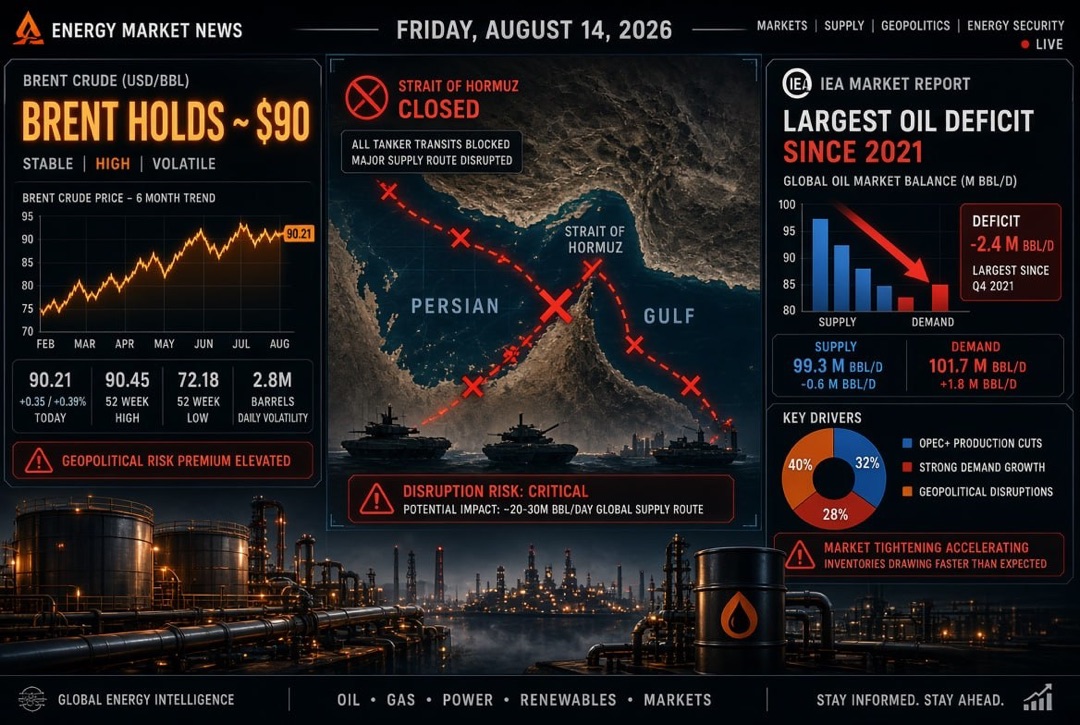
Even with relatively calm price dynamics, the market retains an inherent risk premium: trade restrictions, uncertainty surrounding routes and insurance, as well as the likelihood of local disruptions. Practically, this expresses itself in heightened sensitivity of grade differentials, discounts/premiums in certain directions, and an increased emphasis on "reliable" supply chains.
- For Oil: critical are flows through key export corridors and the stability of transport infrastructure.
- For Gas and LNG: the schedules for loading export terminals and the availability of fleet are significant.
- For Oil Products: restrictions on specific product categories and regional regulations have an impact.
What This Means for Investors and Energy Companies
In the coming weeks, three axes dominate the outlook: (1) the balance of oil and oil product stocks, (2) Europe's ability to close the gas deficit through LNG, and (3) the resilience of the electricity sector in the face of grid constraints and the growing share of renewables. From a strategic standpoint, it is prudent to prepare for scenarios where the market remains volatile but without sharp trending movements, unless a significant external shock occurs.
- Oil and Gas: increased focus on stocks, signs from OPEC+, and demand dynamics in Asia.
- Refineries and Oil Products: monitoring margins, schedules for maintenance, and regional diesel/gasoline imbalances.
- Electricity and Renewables: emphasis on networks, storage, and flexibility as new value sources.