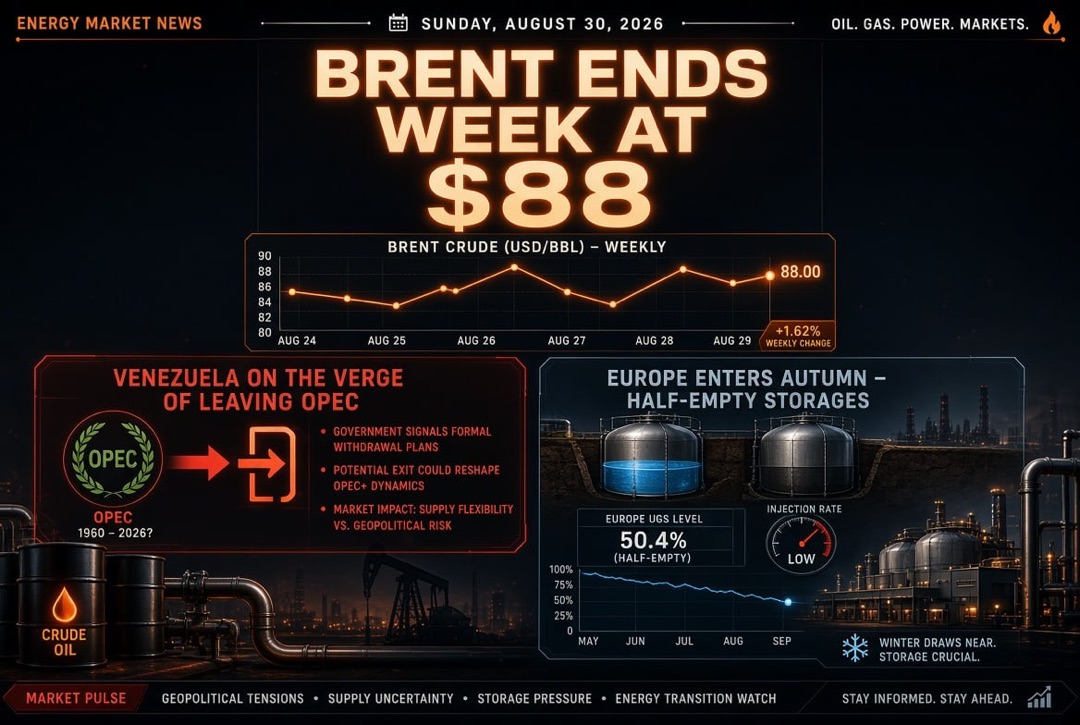
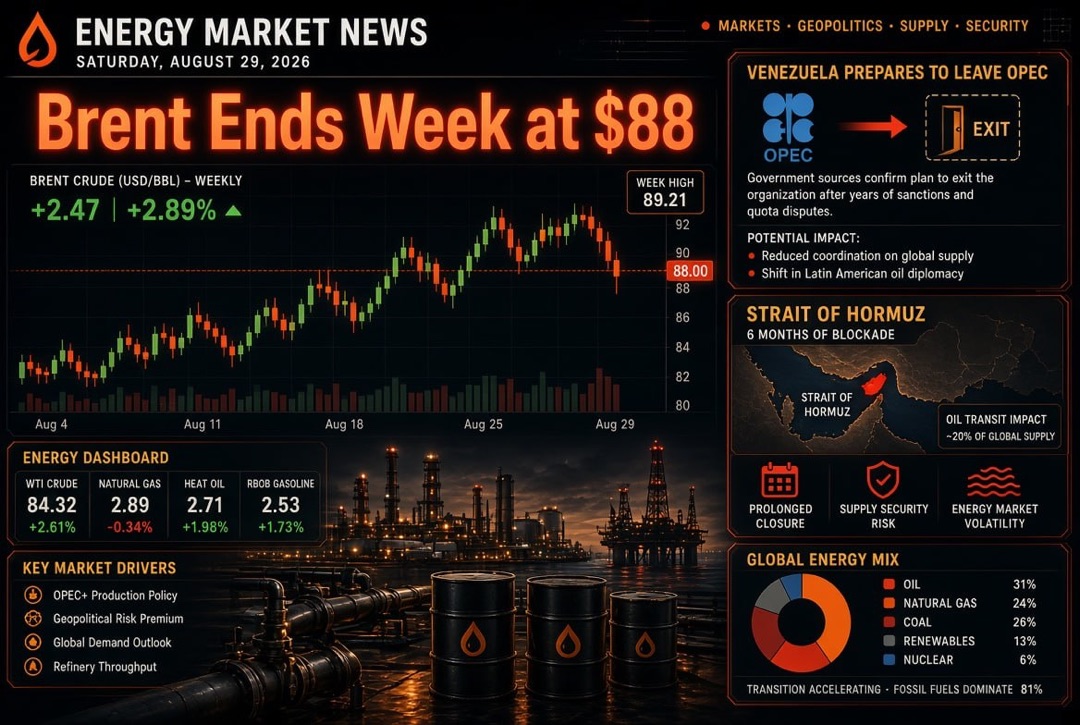
Oil Market: Brent at $88 — Week Ends with Over 5% Decline
Oil prices are adjusting after a two-week rally. Brent traded close to $88 a barrel on Friday, while WTI hovered around $82–83. The weekly decline for Brent exceeded 5%, with WTI losing over 4%. However, since the beginning of the year, the North Sea benchmark remains roughly 30% higher year-on-year: the premium for geopolitical risk following the closure of the Strait of Hormuz in February persists. The key price drivers for oil heading into the weekend include:
- Diplomacy over Hormuz: The Iran-Oman agreement on sharing control and revenue from transit through the strait remains the main bearish factor this week, although Tehran emphasizes that immediate shipping resumption will not occur.
- Firm Stance from Washington: On Friday, prices briefly turned upwards following reports that the U.S. is excluding a return to the terms of the June peace memorandum with Iran, leading the market to understand that a final deal will be delayed.
- Russian Risk: Statements from Vladimir Putin regarding the futility of negotiations with Ukraine and preparation for an intensification of hostilities, coupled with ongoing strikes on Russian refineries and ports, restrict Russia’s export potential and support prices from below.
- Logistics in the Persian Gulf: Saudi Arabia is ramping up shipments from terminals within the Gulf, restructuring export routes due to Houthi threats to shipping in the Red Sea.
Venezuela and OPEC: Founder Country on the Brink of Historic Exit
The main corporate-political news of the week centers around reports that Caracas is seriously exploring an exit from OPEC. The topic is under discussion in negotiations with U.S. officials, but no final decision has been made. The context renders this narrative strategic for the entire global oil market:
- Venezuela is one of the five countries that founded OPEC in 1960 and possesses the largest proven oil reserves globally, currently producing only around 1–1.2 million barrels per day.
- The U.S. is discussing long-term agreements for American companies to access Venezuelan fields; some officials view the Washington-Caracas alliance as a counterbalance to OPEC's influence.
- This marks the second potential exit this year: the UAE left OPEC and OPEC+ on May 1, 2026, while Iraq publicly expressed dissatisfaction with quotas over the summer.
- Increasing Venezuelan production through American investments could provide a new source of supply in the coming years — a factor that may pressure long-term prices.
For investors, the "Vexit" scenario primarily poses the question of the cartel's manageability: further fragmentation of OPEC+ raises the risk of market share competition reminiscent of 2020. A key reference point will be the alliance meeting on September 6, where the baseline scenario remains a pause in quota increases until the end of the year.
Strait of Hormuz: Six Months of Crisis and a Fragile Diplomatic Window
Friday, August 28, marked a symbolic date — exactly six months since the beginning of the U.S. and Israeli military operation against Iran and the subsequent closure of the Strait of Hormuz, through which around 20% of the world's oil trade and nearly one-fifth of LNG passed before the war. The current status of this key artery in the global energy landscape:
- Iran and Oman have agreed on the coordinates for shipping routes: incoming traffic via the northern corridor in Iranian waters, outgoing via the southern corridor in Omani waters, as well as revenue sharing from transit and joint demining of the waters.
- Tehran insists that the agreement with Muscat does not automatically imply the reopening of the strait until the U.S. fulfills its commitments; traffic remains significantly lower than pre-war levels of approximately 130 vessels per day.
- Shipping safety has not been restored: an attack on a tanker off the coast of Oman on August 25 keeps insurance rates at prohibitive levels.
- U.S. Treasury Secretary Scott Bessent is preparing to demand that G20 partners reduce ties with Iran under the threat of restricting access to the dollar system — the sanctions pressure is shifting into the financial realm.
Gas and LNG: Europe Enters Autumn with Lowest Storage Levels Since 2009
The gas market remains the most vulnerable segment of the global energy sector. TTF futures rose above €68/MWh at the beginning of the week — a peak since the start of 2023 — before retreating to around €65–67 by Friday as news of diplomatic progress emerged. The fundamental outlook is concerning:
- Storage Levels: EU underground gas storage is only about 63% full — the lowest for the end of August since 2009 — with a target level of 80% by November 1, reduced from previous targets of 90%.
- Qatar: Over the six months of blockade, the world's second-largest LNG exporter has lost around $24 billion in revenue, with shipments during certain periods down by 96% — an unprecedented supply shock.
- Price Predictions: If Middle Eastern exports gradually normalize, the December TTF could exceed €100/MWh — double previous base estimates from the beginning of the year.
- Regulatory Factors: The EU's ban on Russian pipeline gas and LNG has been in effect since March 2026 with transitional periods, constricting maneuvering space amid shortages.
- Market Divergence: The Asian JKM holds at $21–22/MMBtu, while the U.S. Henry Hub is below $3/MMBtu amidst record production: this spread fuels interest in new U.S. LNG export projects.
Refined Products: Record Low Diesel in the U.S. and Record Refinery Utilization
The latest EIA report recorded U.S. refinery utilization at 97.4% capacity—processing reached 17.4 million barrels per day, while commercial crude oil inventories saw almost no change (428.9 million barrels). The key signal for the refined products market: diesel fuel inventories in the U.S. have fallen to the lowest seasonal level on record. Europe, facing a shortage of middle distillates following the withdrawal of Russian and Middle Eastern volumes, first purchased diesel from Mexico in seven years. For fuel companies and traders, this indicates that record crack spreads for diesel will likely persist at least until the end of autumn—heightening market sensitivity to any news regarding refinery conditions on both sides of the Atlantic.
Russia: Fate of Diesel Exports to Be Determined Over the Weekend
The domestic fuel market in Russia remains manually controlled, and the coming days are thus critical. The current ban on diesel fuel exports for producers expires on September 1; industry sources indicate that the government is leaning toward an extension at least until the end of September, with discussions also considering a scenario extending until the end of 2026. A complete ban on gasoline exports remains in effect until January 31, 2027, and restrictions also apply to aviation fuel. Deputy Prime Minister Alexander Novak states that there is no diesel shortage, and several refineries are returning from maintenance; however, drone strikes on refining infrastructure continue to restrict output: processing in the summer fell to levels not seen in over two decades, and July production—around 8.9 million barrels per day—was the lowest in six years. For the global market, this means a drop in Russian diesel volumes at the peak of Europe's middle distillate shortage.
Electricity, Renewables, and Coal: Energy Crisis Extends Coal's Era, But Energy Transition Accelerates
High LNG prices have rewritten the balance of global electricity generation: coal has received an unplanned extension and remains the largest single source of generation, providing about one-third of global output. Meanwhile, the combined total of renewable sources—solar, wind, hydro, and bioenergy—is projected by the IEA to surpass coal for the first time in 2026. The regional picture is contrasting:
- In the U.S., solar generation increased by 21% in the first half of the year, with wind and solar contributing around 20% of output, while coal generation fell by approximately 11% due to cheap gas.
- Texas has suspended approvals for new data centers, prompting the EIA to lower its forecast for the state's energy consumption growth in 2027 from 14% to 6%—the first noticeable sign of cooling in AI loads on the grid.
- In Europe and Asia, high LNG prices are making coal more competitive than gas in electricity generation, supporting demand for thermal coal from exporters—Indonesia, Australia, and South Africa.
Macroeconomics: Jackson Hole and Rates as a Factor in Demand for Energy Resources
An additional reference point for raw material markets will be Fed Chair Kevin Warsh's speech at the Jackson Hole symposium on Friday. Signals regarding the trajectory of interest rates directly impact the dollar's exchange rate, the cost of financing energy projects, and projections for oil and gas demand. A dovish tone would support commodity prices, while a hawkish stance could intensify pressure on oil, which is already declining on diplomatic news.
What to Watch Over the Weekend and Next Week: Calendar of Energy Sector Participants
- Official reaction from Caracas and OPEC to reports of Venezuela's potential exit from the cartel.
- Decision from the Russian government regarding diesel fuel exports prior to the expiration of the ban on September 1.
- Data on actual transit through the Strait of Hormuz and the fate of the Iran-Oman corridor.
- Injection rates of gas into European underground storage and TTF dynamics following the retreat from three-year highs.
- OPEC+ meeting on September 6: pause in quota increases and discussions on parameters for 2027.
- Escalation risks along the Russia-Ukraine line and the state of Russian oil refining.
- The implications of the Fed chair's speech in Jackson Hole for the dollar and commodity markets.
Summary of the week: The oil market drifts towards a de-escalation scenario in the Middle East but remains a hostage to physical flows through the Strait of Hormuz and growing uncertainty within OPEC itself, where following the UAE's exit, Venezuela now contemplates leaving. Gas and diesel remain the primary points of shortage in global energy for autumn 2026: Europe enters the heating season with the lowest reserves in 17 years, while coal receives an extension to its era despite the accelerating energy transition. Daily analytics on oil, gas, renewables, and the energy market can be found in the Open Oil Market Telegram channel.