Current News in Oil, Gas, and Energy as of April 5, 2026, Including Oil, Gas, LNG, Electricity, Renewables, Coal, and Refineries
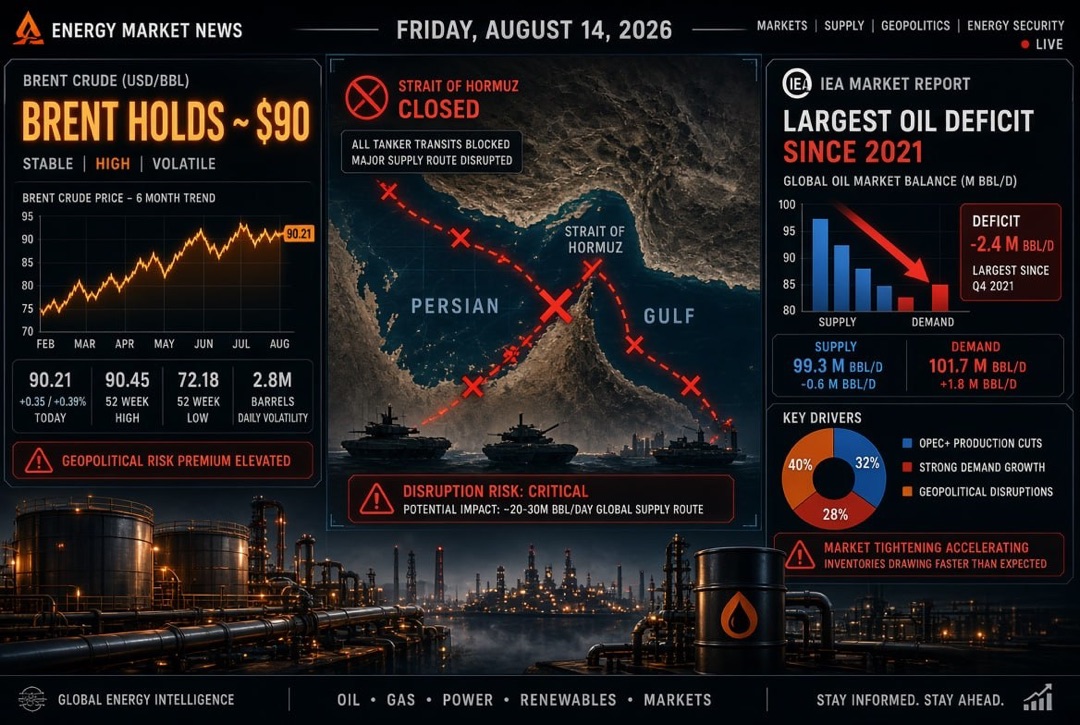
The global energy market concludes the first week of April with a state of heightened nervousness. For investors, oil companies, fuel firms, and participants in the oil, gas, electricity, renewables, coal, petroleum products, and refinery markets, the key theme remains not only the rise in geopolitical premiums but also the rapid reconfiguration of global raw material and fuel flows. Central to this focus is the response of OPEC+, the resilience of supply through strategic routes, LNG dynamics, refinery status, and the energy system's capacity to offset the shortfall of more expensive gas with coal, backup generation, and the accelerated introduction of capacity in the renewables segment.
Whereas at the beginning of the year the market anticipated a softer scenario for oil and gas, the primary driver of prices and investment decisions has now become supply security. For the global energy sector, this means that the premium for reliability is once again more critical than the premium for efficiency. Consequently, news in oil, gas, and energy as of April 5, 2026, is shaped around several interconnected blocks — production, exports, refining, electricity, LNG, coal, and the energy transition.
Oil: The market is pricing in not only shortages but also the duration of the crisis
The oil market is entering a new trading cycle with the sentiment that the current shock may not be short-lived. For global oil market participants, it is no longer just the increase in prices that matters, but rather the duration of supply constraints and how much volume will fall out of the global physical balance system.
- Traders and oil companies are increasingly incorporating the risk of prolonged disruptions into their quotes.
- Importing countries are intensifying their focus on strategic reserves and alternative routes.
- For investors in oil and petroleum products, the emphasis is once again on the physical availability of barrels rather than merely financial volatility.
Against this backdrop, the market becomes more sensitive to any signals from producers. Even moderate changes in production or export policies are now capable of influencing expectations more significantly than standard inventory statistics. For oil companies, this creates a window for increased margins, but simultaneously heightens political and logistical risks.
OPEC+ and Production: The Key Question - Can the Alliance Stabilize the Market Without Losing Price Control?
For the oil market, the main event of the day remains the anticipation of decisions and comments from OPEC+. The position of the alliance will determine whether the market perceives the current situation as a managed shock or the beginning of a deeper phase of imbalance. Should OPEC+ confirm a willingness to gradually restore volumes as restrictions ease, it could provide the market with psychological support; however, if the signal is stringent, oil will maintain a heightened risk premium.
For investors and industry participants, three key points are crucial:
- The ability of OPEC+ countries to quickly compensate for the falling volumes.
- The willingness of key exporters to increase production without disrupting price discipline.
- The impact of OPEC+ decisions on the downstream segment, including refineries and the petroleum products market.
Even if the alliance formally maintains a cautious approach to increasing production, the market will assess not just statements but the actual availability of export flows. Under current conditions, oil production and its physical delivery have become two separate stories, which is critical for the global oil and gas sector.
Petroleum Products and Refineries: Refining Gains Strategic Significance
In the petroleum products segment, the situation appears even more sensitive than in the crude oil market. When global logistics are disrupted and supplies of specific fuel types decrease, refineries find themselves at the center of a new wave of demand. This is especially pertinent for diesel, gasoline, aviation fuel, and liquefied gases.
Characteristic trends for the petroleum products and refining market currently include:
- increased importance of export-oriented refineries that can swiftly redirect supplies between regions;
- the growing role of American and Asian hubs in balancing global fuel shortages;
- increased focus on refining margins, especially for middle distillates;
- increased interest in storage, transshipment, and blending infrastructure.
For oil and fuel companies, this means the market is temporarily shifting the profit center from upstream to a broader value creation chain. Those players with strong positions in refineries, logistics, and petroleum products are likely to navigate this phase more successfully than companies narrowly focused solely on extraction.
Gas and LNG: The Flexibility Premium Becomes the New Currency of the Market
The gas market remains one of the most vulnerable segments of global energy. LNG once again plays the role of a safety net for entire regions, but therein lies the problem: when demand for flexible cargoes rises simultaneously in Asia, Europe, and developing countries, the premium for quick delivery skyrockets.
Several critical processes are currently evident in the global gas and LNG markets:
- Importers are intensifying competition for available LNG cargoes;
- Countries with strong domestic supply are increasingly reselling cargoes to external markets;
- The value of long-term contracts and diversified supply portfolios is rising again;
- Investments in terminals, regasification, and gas infrastructure now have additional justification.
For gas companies and LNG investors, this indicates a return to a model where portfolio flexibility commands a premium. At the same time, interest in the upcoming wave of new LNG capacity is growing; however, the current market logic is focused on the upcoming months, not the five-year horizon. Consequently, short-term tightness continues to dominate over long-term narratives about supply growth.
Electricity: Expensive Gas Again Alters the Generation Structure
The electricity segment responds to developments faster than most other parts of the energy sector. As gas prices rise and become less predictable, energy systems increasingly lean on whatever can ensure load reliability: coal generation, backup capacities, oil blocks, nuclear generation, and energy storage.
For the global electricity market, this creates several repercussions:
- Pressure on retail and industrial tariffs is increasing;
- Governments are reverting to crisis support measures for consumers;
- Energy companies are reassessing dispatch models and fuel priorities;
- Grid reliability has become as important as decarbonization.
The energy sector is increasingly demonstrating that, in times of crisis, the market rewards not the ideal generation structure, but a resilient one. For investors, this heightens interest in companies capable of operating across electricity, gas, energy storage, and systemic services.
Renewables and Energy Storage: The Energy Transition is Not Reversed; It Gains New Justification
Despite the rising role of traditional energy sources, renewables are not taking a backseat. On the contrary, the current crisis strengthens the arguments for accelerating the development of solar and wind generation, as well as energy storage. For the global energy market, this has become not only an environmental agenda but also a question of import independence.
Reasons why the renewables sector retains strategic appeal include:
- Solar and wind generation reduce dependence on imported fuel;
- Energy storage enhances grid resilience and the value of flexible generation;
- Hybrid projects are becoming especially sought after in regions with high volatility in gas and electricity prices;
- Energy companies are incentivized to accelerate capital investments in low-carbon assets.
For global energy investors, this means that the topic of renewables and batteries does not contradict the rising prices of oil and gas. On the contrary, expensive traditional energy accelerates the payback on certain new projects, particularly where there is support from network infrastructure and access to financing.
Coal: A Temporary Beneficiary of Gas Instability
Coal is re-establishing itself as a last-resort fuel for energy systems that are unwilling to risk supply stability. This does not signify a long-term reversal of global energy towards the past, but in the short term, coal remains an important element of the balance, especially in Asia.
Key observations for the coal market include:
- High-calorific grades are receiving additional demand as a substitute for expensive gas;
- Importing countries are temporarily softening regulatory approaches for the sake of energy security;
- Demand for coal is supported not only by electricity but also by the overall logic of fuel diversification.
For energy market participants, this serves as yet another reminder that the energy transition in the real economy does not progress in a straight line. When markets face physical gas shortages, coal and backup thermal generation quickly regain significance.
What This Means for Investors and Players in the Global Energy Sector
The news in oil, gas, and energy as of April 5, 2026, indicates that the global energy sector is entering a phase where the key asset is not just resources but the management of the entire chain—from extraction and refining to the delivery of final energy. For investors, this means the necessity to adopt a broader perspective on the sector.
Currently, the most significant factors are:
- Companies with stable oil and gas exports;
- Players with strong positions in refineries and petroleum products;
- Energy companies with diversified generation;
- LNG and gas infrastructure operators;
- Projects in renewables and storage that enhance the flexibility of energy systems.
The main takeaway for the global market is straightforward: energy is once again trading as a security sector rather than merely a cyclic demand sector. As long as supply tensions persist, oil, gas, electricity, renewables, coal, petroleum products, and refineries will remain in the spotlight for investors worldwide. For the global energy sector, this is a period not only of risk but also of significant re-evaluation of the value of reliability, infrastructure, and the ability to adapt swiftly to the new energy order.