Current News in the Oil, Gas, and Energy Market as of April 11, 2026: Oil, Gas, and Electricity Prices, Renewable Energy Development, and Key Trends in the Energy Sector
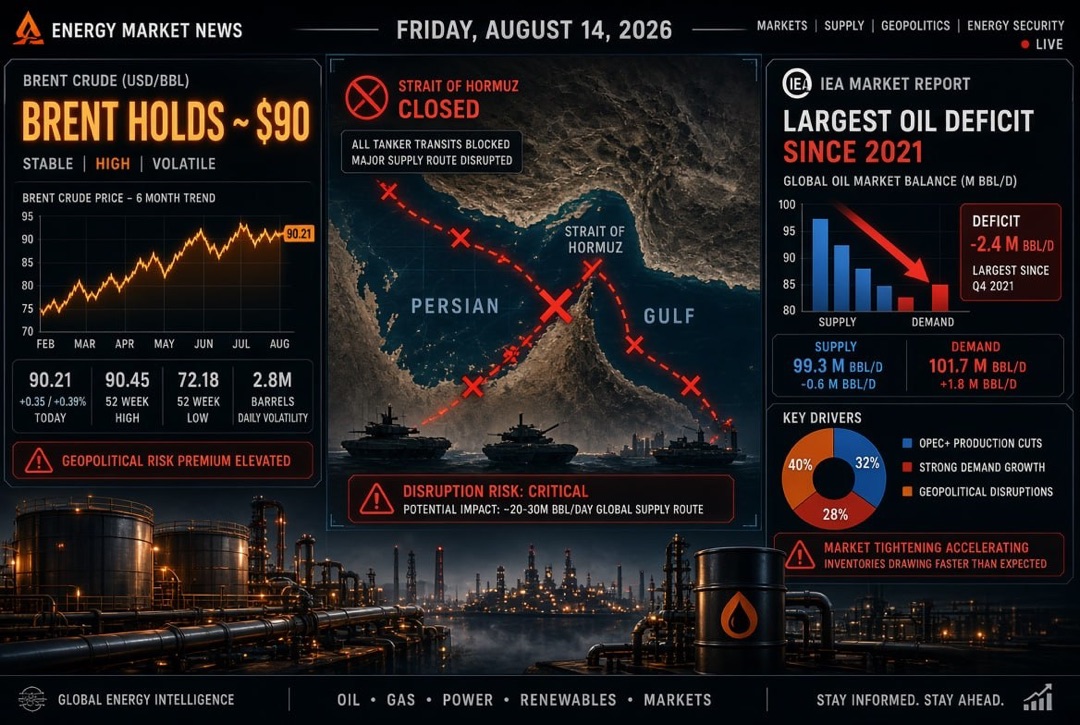
The global oil, gas, and energy sector concludes the week with heightened sensitivity to geopolitics, logistics, and the status of physical deliveries. The main drivers for investors, oil companies, refineries, energy market participants, and renewable energy sectors are a combination of limited navigation through the Strait of Hormuz, risks to Saudi infrastructure, and ongoing pressure on the global gas balance. Simultaneously, the market is gradually starting to look beyond the immediate phase of the crisis: attention is shifting from the mere fact of the shock to which segments of the energy sector will be the main beneficiaries in the coming months.
For the global market, this means one thing: oil prices remain high, the risk premium stays intact, refining margins and the export economy of petroleum products appear stronger than at the beginning of the year, and the electricity and renewable energy sectors receive additional impetus for accelerated investments. Against this backdrop, April 11 will be a day when investors will evaluate not only the price of a barrel but also the resilience of the entire energy chain—from oil and gas extraction to fuel, generation, and infrastructure.
Oil: The Market Maintains a Risk Premium Despite Stabilization Attempts
The key theme in the oil sector is not just the rise in volatility but a shift in the balance of expectations. The oil market no longer assesses the situation as a short-term spike. It begins to factor in the likelihood that even with partial de-escalation, transportation and infrastructure constraints will be resolved slowly.
- Brent remains near the psychologically significant zone of approximately $100 per barrel.
- WTI holds up even better due to the characteristics of the U.S. domestic market and supply structure.
- The risk premium persists due to limited capacity along key export routes.
For oil companies, this means improved pricing conditions but simultaneously increases operational and insurance costs. For oil and gas investors, this creates a classic duality in the market: upstream benefits from high oil prices, while downstream gains advantages only where there is access to raw materials and export logistics. This is why large producers with robust export capabilities and diversified infrastructure appear more favorable compared to companies reliant on a single route or region.
OPEC+ and Supply: Formal Readiness to Balance the Market Does Not Lift Real Constraints
The signal from OPEC+ remains cautiously stabilizing. The alliance continues to demonstrate readiness to manage supply, yet the market understands that theoretical quotas and actual ability to quickly increase production do not align at present. Amid logistical bottlenecks and infrastructure risks, even the existence of spare capacity does not guarantee its swift monetization.
This is a significant point for the energy market. Formally, oil-producing countries may declare willingness to increase supplies, but the physical market in 2026 increasingly trades not on nominal production but on the real availability of barrels for buyers. This amplifies the role of:
- alternative export routes;
- strategic reserves;
- the state of tanker logistics;
- the speed of oil infrastructure recovery.
Consequently, participants in the oil market and fuel companies should monitor not only OPEC+'s decisions but also actual shipment dynamics, tanker insurance, and terminal accessibility.
Refineries and Petroleum Products: Refining Remains One of the Main Beneficiaries of the Week
The petroleum products sector maintains a constructive outlook. Even after a local pullback in prices for diesel, gasoline, and jet fuel, the market continues to show signs of supply tightness. This is especially crucial for refineries, as refining is currently becoming one of the most attractive segments of the energy sector.
The diesel sector appears strongest. For fuel companies and oil firms with access to modern refineries, this entails:
- support for export margins;
- a more stable cash flow in the petroleum products sector;
- increased importance of a flexible product basket;
- heightened focus on operational reliability of facilities.
While the oil market remains a hostage to geopolitics, the petroleum products market increasingly reacts to the real shortage of refining capacity and delivery challenges. For investors, this suggests that shares of refiners and integrated oil and gas groups may perform better than the market overall, especially if the company benefits from exporting fuel to deficit regions.
Gas and LNG: Europe Maintains a Calm Publicly But Prepares for a Challenging Injection Season
The gas market appears less dramatic than oil, yet strategically this is where the next major risk is forming. European regulators state that there is no immediate threat to supplies; however, the focus shifts to preparing for winter and the need for early storage filling. This means that the gas market remains vulnerable to any deterioration in the LNG situation.
The main characteristics of the current moment include:
- Europe is striving to accelerate gas injection into underground storage.
- Spain maintains a significant role for U.S. LNG, although the import structure is changing.
- Disruptions in Middle Eastern flows continue to impact the global gas balance.
- The market increasingly prices in a premium for supply flexibility rather than just volume.
For gas companies and LNG market participants, this enhances the value of long-term contracts, available regasification capacity, and diversified supply geography. For Europe and Asia, gas remains not just a transitional fuel but a critically important element of energy security.
Electricity: High Hydrocarbon Prices Accelerate the Shift to Electrification
The electricity sector is receiving a new wave of political and investment support. The rising cost of oil and gas transforms electrification into not only a climate strategy but also an economic imperative. This is especially evident in Europe, where governments and energy companies are enhancing programs to transition consumers and industries to an electric consumption model.
On a global level, this creates several trends:
- increased interest in grid infrastructure and distribution capacities;
- growing demand for stable low-carbon generation;
- support for projects related to heat pumps, electric transport, and industrial electrification;
- an enhanced role for nuclear energy and large utility companies.
For investors, the electricity market becomes not defensive but strategic. Companies capable of providing stable generation and connecting new loads stand to benefit just as much as traditional oil and gas sectors.
Renewable Energy: Offshore Wind and Solar Generation Return to the Spotlight
The renewable energy sector is experiencing a rare combination of fundamental and political support. Amid expensive hydrocarbons, offshore wind energy, solar generation, and storage are once again perceived not as niches but as part of the response to the energy security crisis. It is especially important that this argument now resonates not only in climate discussions but also in national resilience agendas.
In the short term, renewable energy will not fully replace oil and gas. However, for the global energy sector, it is already clear that:
- solar generation is growing faster than most other electricity segments;
- wind energy receives a new boost through energy independence programs;
- hybrid models combining renewables, grids, and storage are becoming more investment attractive;
- capital increasingly seeks a balance between the returns of oil and gas and the long-term growth of clean energy.
For the global market, this indicates that renewable energy in 2026 is strengthening its positions not in opposition to the crisis, but largely thanks to it.
Coal: The Segment Maintains its Role as a Backup Fuel for Energy Systems
Despite the long-term structural shift towards clean energy, coal remains an important element of the energy balance. In Asia and several developing markets, it continues to serve as a backup resource when gas becomes too expensive or insufficiently available. India is already emphasizing the adequacy of coal reserves to meet electricity demand, while coal remains a tool for rapid response to fuel stress in Asia.
For investors, this indicates that the coal segment cannot be overlooked in the tactical landscape of 2026. It retains its significance where energy security takes precedence over the speed of the climate transition.
What This Means for Investors and Participants in the Energy Sector
As of April 11, the global commodity and energy sector is forming several clear signals.
Key Takeaways of the Day
- Oil remains expensive, and the risk premium has not disappeared.
- The oil and gas sector benefits from prices but suffers from logistical risks.
- Refineries and petroleum products appear stronger than crude oil in terms of short-term economics.
- The gas market is externally stable but remains strategically tense.
- Electricity and renewable energy receive acceleration due to electrification and energy security policies.
- Coal retains its role as a reserve resource in global generation.
For oil companies, fuel companies, refineries, electricity market participants, and investors, this suggests the need to operate not solely based on a singular bet on oil or gas but rather with a broader matrix: extraction, refining, logistics, generation, and energy infrastructure. Such diversification has become the main response to the instability of the global energy market.