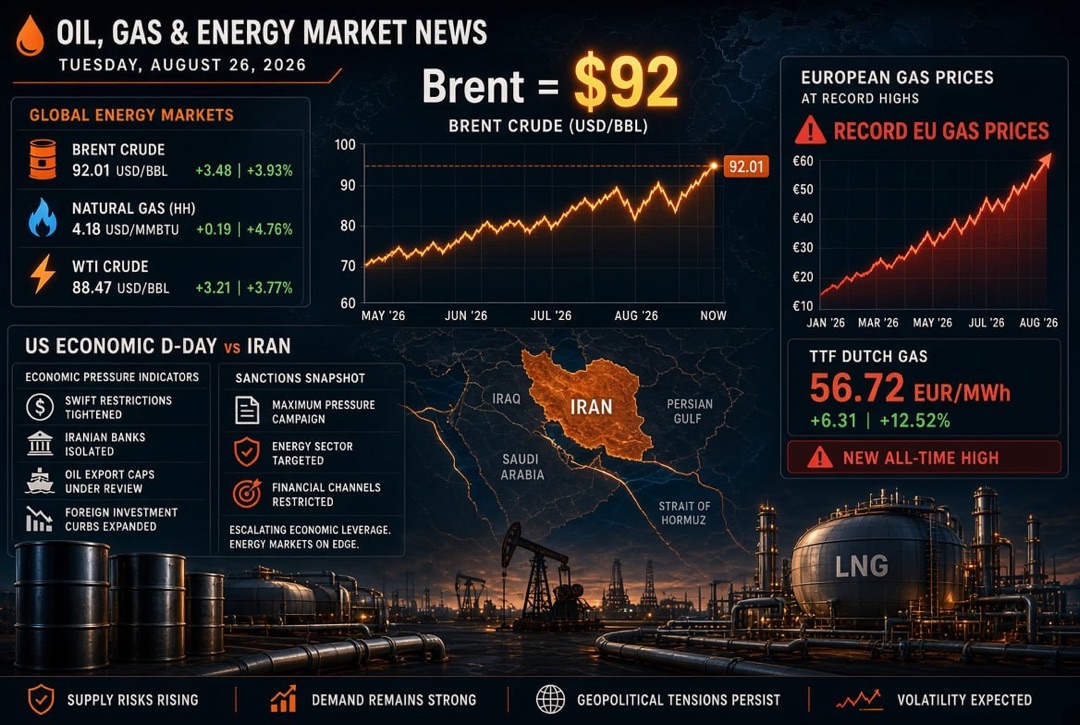
Current News in the Oil, Gas, and Energy Sector as of January 1, 2026: Oil, Gas, Electricity, Renewable Energy, Coal, and Oil Products. A Global Overview for Investors and Market Participants in the Energy Sector.
Global Oil Market
At the end of December 2025, the price of Brent crude oil hovered around $60 to $64 per barrel, experiencing slight fluctuations after a brief surge leading up to the New Year. Experts indicate that global oil supply significantly outpaces demand, with new volumes from the US, Brazil, Canada, and other countries growing faster than consumption, putting downward pressure on prices. OPEC+ is expected to maintain current quotas without increasing production at its meeting on January 4, in an effort to mitigate the oversupply.
- Supplies: Major producers are ramping up output, leading to a surplus of oil in the market.
- Geopolitical Risks: US actions regarding Venezuelan oil and attacks on tankers are elevating risk premiums in pricing.
- OPEC+: At the January meeting, OPEC+ countries are likely to hold off on increasing production, restraining further export growth.
- Demand: Global demand remains moderate amid economic uncertainty. Increased consumption in petrochemicals and aviation partially offsets declines in other sectors.
Thus, despite fundamental oversupply of oil, current prices are bolstered by unfavorable geopolitical conditions. As global oil inventories remain close to record-high levels and supply conditions fluctuate, significant price drops are not anticipated.
Global Gas Market
The natural gas market displays mixed dynamics: European prices continue to decline due to record LNG imports from the US, while Asian demand remains restrained by high fuel costs. Gas reserves in underground storage in Europe exceed 85%, providing a safety net ahead of the winter season. In the US, wholesale gas prices (Henry Hub) fluctuate around $4 per MMBtu, demonstrating modest seasonal increases during the colder months.
- Europe: Generating companies are actively purchasing LNG, with more than half of European imports being supplied by the US, partially offsetting reduced Russian gas supplies. The surplus influx of fuel leads to price declines and narrows the gap between European and Asian prices.
- Asia: LNG imports are declining due to high prices and moderate economic demand. China, the largest consumer, is increasing its gas production and pipeline imports from Russia and Central Asia, reducing reliance on expensive LNG.
- Local Trends: Compared to the start of the year, European gas prices have fallen approximately 45%, despite cold weather conditions. Gas markets are becoming increasingly integrated due to the constant flow of LNG from the US.
The growth of LNG export supplies from the US remains a key factor: record supply is pushing out more expensive imports and stabilizing gas prices in Europe and Asia, making gas markets interconnected and less susceptible to seasonal shocks.
Fuel Markets and Oil Products
The situation in oil product markets is characterized by a cautiously bullish sentiment. Global refinery maintenance campaigns and drone strikes on Russian refineries are limiting the supply of diesel and gasoline, supporting high margins. Global refineries are operating at near-maximum capacity; many companies plan to increase processing to take advantage of favorable price differentials between raw hydrocarbons and products.
- Market Demand: Daily consumption of gasoline and diesel remains stable, though there are fuel shortages at gas stations in some regions.
- Refining: The fall and winter maintenance season has affected key refineries in Europe, the US, and China, maintaining high prices for oil products despite an excess of crude.
- Refinery Margins: The diesel spread has surged to a four-year high due to intense competition for limited supplies and strong demand for transport and industrial fuel.
- Russia: The Russian government has extended the temporary ban on gasoline and diesel exports until the end of February 2026 to curb rising prices in the domestic market and eliminate local fuel shortages.
Thus, fuel markets remain volatile: increasing refining activity may soften price spikes, but export restrictions and local logistics disruptions will maintain tension. Investors and market participants are closely monitoring news from refineries and fuel inventory reports, as these factors determine near-term trends in the oil product sector.
Energy and Renewable Sources
The global electricity sector continues its transition to low-carbon technologies. By the end of 2025, the share of generation from renewable sources (RES) has set new records: in many countries, solar panels and wind turbines generated maximum energy output for the year. Analysts note that global capacity for new RES installations has increased significantly compared to the previous five-year period, and energy storage systems (ESS) are being implemented for grid stability. The results of the COP30 climate summit reinforce the global community’s commitments to increase "clean" generation.
- Growth of Solar Energy: Asian and Middle Eastern countries have built dozens of gigawatts of new solar parks, while Europe has streamlined approval processes for such projects.
- Wind Generation: Average annual wind generation has increased in Europe and China: in some regions (e.g., Northern Europe), wind farms have provided a record amount of electricity.
- Energy Storage: Investments in large battery systems are rapidly increasing, allowing for the smoothing of fluctuations in wind and solar generation and reducing reliance on fossil reserves during peak hours.
- Hybrid Energy: To maintain balance in renewable generation, countries are building new nuclear power plants and modernizing existing reactors, viewing nuclear energy as a key element of a sustainable transition.
Energy companies are expanding their portfolios in the RES sector: many traditional oil and gas giants are announcing significant investments in wind and solar plants as well as hydrogen projects, reflecting a long-term shift in industry priorities. Experts emphasize that successful transition requires active upgrades of electrical grids and infrastructure development; otherwise, rapid growth in "clean" generation may be constrained by technical barriers.
Coal Sector
Coal markets are displaying mixed dynamics. In developed countries, demand for coal continues to decline due to accelerated decarbonization and the replacement of coal-fired power plants with gas and renewable sources. However, in Asia, especially in India and some Southeast Asian countries, coal consumption remains high due to the need to ensure baseload power. Analysts expect that global coal consumption will stabilize or slightly decline after record growth in 2025.
- Developed Markets: In Europe and the US, many coal power plants have been decommissioned or converted to gas, and US coal exports are decreasing.
- Asia and the Middle East: Rapid industrial growth in China, India, and other countries keeps demand for coal high despite efforts to transition to alternative sources.
- Prices and Trading: After rising in the first half of 2025, coal prices have stabilized at moderate levels. Chinese coal imports from abroad remain a significant factor for Australia and Indonesia.
Thus, the coal sector is undergoing a phase of redistribution. While coal retains its role as a backup source during peak demand periods, investment trends are gradually shifting towards "clean" technologies, reflecting prospects for long-term energy transformation.
Market Outlook and Forecasts
Most analysts expect that in the first quarter of 2026, oil prices will remain at moderately low levels. Experts estimate that the average price of Brent at the beginning of the year will be around $55 per barrel, despite possible brief fluctuations. The price of US gas (Henry Hub) may rise to ~$4.30 per MMBtu in the winter of 2025/26 but is anticipated to return to around $4 as demand stabilizes. Electricity consumption is expected to continue growing by 1-2% annually in developed countries, supported by an increasing share of RES. Global coal consumption is projected to be lower in 2026 compared to the previous year.
- Oil: A supply surplus is expected to persist at least until the summer of 2026, which will continue to keep prices in check unless OPEC+ resumes quota reductions.
- Gas: Further growth in LNG exports from the US will keep prices low in Asia and Europe, although the winter demand peak may temporarily drive up quotes.
- Electricity: Increased RES generation will gradually reduce dependence on fossil sources. Energy companies are continuing to invest in expanding "clean" generation and modernizing grids.
- Investments: Energy companies plan to diversify their assets: an increase in investments in renewable projects, hydrogen initiatives, and the development of new fields is anticipated.
Overall, energy markets are entering 2026 with moderate optimism: the balance of supply and demand is currently supporting relative price stability. However, any significant changes in geopolitical situations or economic activity could quickly alter trend directions. Investors continue to closely monitor industry news and global energy supplies reports, which will be pivotal guiding factors in the coming months.
The Open Oil Market team wishes all readers a Happy New Year 2026 and success in their pursuits in the fuel and energy markets!