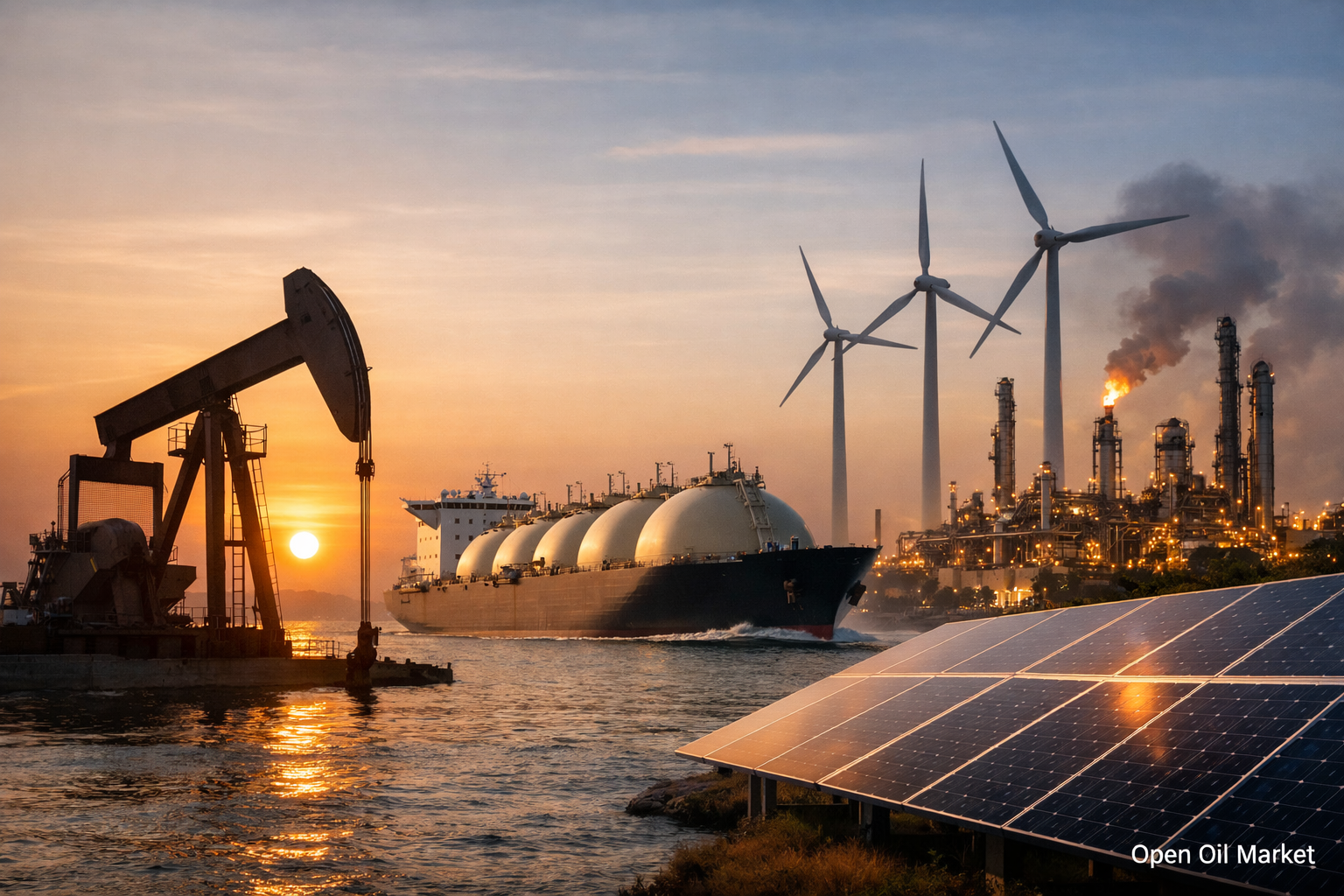
Global News of the Oil, Gas, and Energy Sector as of February 1, 2026: Oil, Gas, Electricity, Renewable Energy, Coal, and Refineries. Key Events in the Global Energy Market for Investors and Industry Participants.
The latest developments in the fuel and energy complex (FEC) as of February 1, 2026, are drawing the attention of investors and market participants due to their scale and mixed signals. Geopolitical tensions are escalating once again: the United States is tightening sanctions in the energy sector, and risks of conflict in the Middle East are increasing, creating uncertainty and driving oil prices to multi-month highs. At the same time, global oil and gas markets are demonstrating relative stability. Oil prices, having experienced a significant decline in 2025, have partially regained lost ground but remain moderate by historical standards—there is still an oversupply in the market amid subdued demand, and the OPEC+ alliance is keeping production under control. The European gas market is confidently navigating the winter season: record gas reserves in storage facilities and mild weather in January are keeping prices at low levels, ensuring comfort for consumers.
Meanwhile, the global energy transition continues to gain momentum: renewable energy sources are setting new generation records, although countries still rely on traditional hydrocarbons for the reliability of their energy systems. In Russia, following a spike in fuel prices last autumn, authorities are maintaining strict measures to stabilize the domestic oil product market. Below is a detailed overview of key news and trends in the oil, gas, electricity, and commodity sectors as of this date.
Oil Market: Geopolitical Risks Trigger Price Increase
Global oil prices surged significantly over the past week, reaching the highest levels in the last six months. Nevertheless, overall oil prices remain relatively restrained due to underlying market fundamentals. The North Sea Brent crude stabilized around $70–72 per barrel, while the American WTI ranged from $64–66. Current levels are still 10–15% lower than a year ago and significantly below peak values observed during the energy crisis of 2022-2023.
- OPEC+ Supply: Major oil exporters are maintaining discipline in supply. In 2025, the OPEC+ alliance gradually increased production by nearly 3 million barrels per day (from April to December) as previous restrictions were eased, leading to a surplus. However, at the start of 2026, considering the seasonally low winter demand, OPEC+ countries paused further increases. At their meeting in January, members unanimously decided to maintain current production limits at least until the end of the first quarter of 2026 to prevent renewed market oversaturation. If necessary, the alliance indicates readiness to cut production again. This proactive approach keeps oil prices in a narrow range and reduces volatility.
- Demand Slowdown: Global oil consumption growth has significantly weakened. According to updated estimates from the International Energy Agency (IEA), global oil demand increased in 2025 by only ~0.7 million barrels per day (compared to +2.5 million b/d in 2023). OPEC estimates demand growth for 2025 at about +1.2 million b/d. Reasons include a slowdown in the global economy and the effect of the previous period of high prices, which spurred energy conservation. An additional contribution to curbing demand has come from China: in the second half of 2025, growth in industrial production and fuel consumption in China was lower than expected (industrial production growth fell to its lowest pace in 15 months).
- Geopolitical Factors: The oil market is affected by opposing political forces. On one hand, the escalation of sanctions has intensified restrictions on trade in energy resources. In the fourth quarter of 2025, the U.S. imposed the harshest sanctions in years against the Russian oil and gas sector (including a ban on transactions with several major companies), forcing some Asian buyers to reduce oil imports from Russia. Additionally, Washington effectively announced the possibility of imposing high tariffs (up to 500%) on imports into the U.S. from countries that continue to purchase Russian oil and gas—this initiative aims to deprive Moscow of export revenues that finance the conflict in Ukraine. Simultaneously, the risks of disruptions in the Middle East have increased: in January, reports surfaced that the U.S. was considering a military strike against Iran regarding Tehran's nuclear program. Against this backdrop of tension, investors are pricing in increased risk premiums in oil prices. On the other hand, periodic signals about a potential ceasefire in Eastern Europe (still without tangible results) create expectations that sanctions against Russian exports may eventually be eased and the full volume of Russian oil could return to the market—this factor weighs on bearish sentiments. For now, the combined influence of all factors maintains a moderate oversupply in the market, keeping the oil market in a state of slight surplus.
As a result, oil prices remain within a relatively narrow range, lacking sustainable momentum for either further increases or sharp declines. Market participants are closely monitoring upcoming events—from OPEC+ decisions (the next ministerial meeting is scheduled for February 1, where an extension of the current production policy is expected) to developments in the geopolitical situation—which could alter the risk balance for oil prices.
Gas Market: Europe Navigates Winter Confidently, Prices Remain Low
In the gas market, attention is focused on the successful passage of winter by European countries. So far, the season is unfolding in favor of Europe: January has been relatively mild, leading to moderate gas withdrawals from storage. By early February, underground gas storage facilities (UGS) in the EU are about 60% full, significantly above the average level for this time of year and providing a high safety margin in the supply system.
As a result, along with stable liquefied natural gas (LNG) supplies and pipeline gas from alternative sources, prices in the European market remain low. The benchmark TTF index fluctuates around €25–30 per MWh—significantly lower than peak values seen during the energy crisis two years ago. For industries and consumers, such price levels have provided significant relief: many energy-intensive enterprises have resumed production, and heating bills for households have notably decreased compared to last winter.
The market is prepared for possible weather surprises: short-term periods of cold may temporarily increase demand and prices, but currently, systemic risks of fuel shortages do not appear. Moreover, Europe’s strategy of diversifying gas sources and energy conservation measures has proven effective, allowing for a flexible response to challenges. At the global level, the IEA forecasts that world natural gas consumption in 2026 may reach a new record, primarily due to growing demand in Asia. However, currently, the supply of LNG and pipeline gas is sufficient to meet needs, and the European market is entering the final phase of winter without turmoil.
International Politics: Sanction Pressure, Middle East Tensions, and Changes in Venezuela
Geopolitical factors continue to exert a serious influence on energy markets. In early 2026, the United States intensified efforts to limit Russian energy exports. President Donald Trump is promoting a bill through Congress that proposes imposing extremely high tariffs—up to 500%—on imports into the U.S. from countries that "knowingly trade" with Russia in oil and gas. The goal is to reduce Moscow's revenues from energy exports, which Washington believes finance the military conflict in Ukraine. These measures are causing tensions in foreign trade: China has strongly protested against external pressure on its energy policy, stating that its trade with Russia is legitimate and should not be politicized. India, for its part, is trying to maneuver—Delhi indeed reduced the share of Russian oil in its imports over the past year while simultaneously negotiating with Washington over the easing of U.S. tariffs on Indian goods.
Another high-profile event at the beginning of the year is unexpected changes in Venezuela that could affect the balance of power in the oil market. In early January, the U.S. conducted a military operation that resulted in the ousting and arrest of Venezuelan leader Nicolás Maduro. President Trump stated Washington's readiness to support a temporary administration in the country until a new government is formed. This unprecedented move has resonated on the international stage: several countries (for example, China) condemned the violation of Venezuela's sovereignty and principles of international law. However, for the oil and gas sector, the crucial question is whether the regime change will lead to the return of Venezuelan oil to the global market. Venezuela possesses the largest proven oil reserves in the world, but due to sanctions and an economic crisis, its production has plummeted over the past decade. Experts note that even with political changes, there will not be an immediate increase in exports: the country’s oil infrastructure requires significant investment and modernization. Nevertheless, the anticipated gradual easing of sanctions could eventually increase the supply of heavy Venezuelan oil to the global market, which will become a new factor for the balance of power within OPEC+.
Tensions in the Middle East have also intensified. In January, the U.S. introduced new sanctions against Iran, accusing Tehran of advancing its missile-nuclear program and destabilizing the region. Reports emerged that Washington is considering a targeted strike against Iranian nuclear facilities if diplomatic pressure yields no results. Iran has categorically rejected demands to limit its defensive capabilities, stating it will not tolerate external interference. The escalation of rhetoric between the U.S. and Iran has added to the nervousness in the oil market: traders fear supply disruptions from the Persian Gulf in the event of a military conflict. While a direct confrontation has been avoided so far, the mere threat of destabilization in this key oil-producing region is driving up prices and remains one of the main sources of uncertainty for FEC market participants.
Asia: Balancing Imports and Domestic Production
Asian countries—key drivers of demand growth for energy resources—are taking active steps to strengthen their energy security and meet the rapidly growing demands of their economies. The policies and energy strategy choices of the largest Asian consumers—China and India—have a significant impact on the global market:
- India: New Delhi is striving to reduce its dependence on hydrocarbon imports amid external pressure. Following the onset of the Ukrainian crisis, India significantly increased purchases of cheap Russian oil, but in 2025, under the threat of Western sanctions, it somewhat reduced the share of Russia in its oil imports. At the same time, the country is betting on developing domestic resources: a large-scale program for exploring deep-water oil and gas fields has been launched to increase domestic production to meet rapidly growing internal demand. Additionally, India is accelerating its renewable energy capacities (solar and wind power plants) and infrastructure for importing LNG as it seeks to diversify its energy balance. Nevertheless, oil and gas remain the foundation of its energy supply, necessary for industry and transportation, thus forcing Indian leadership to balance the benefits of importing cheap fuel against the risks of sanctions.
- China: The world's second-largest economy continues to pursue energy self-sufficiency, combining maximum increases in traditional resource extraction with record investments in clean energy. Preliminary data indicate that in 2025, China reached historical highs in domestic oil and coal production to reduce import dependency. Simultaneously, the share of coal in electricity generation in China fell to a multi-decade low (~55%) as the country brought record volumes of new solar, wind, and hydroelectric capacities online. Analysts estimate that in 2025, China brought more solar and wind power plants online than the rest of the world combined, which helped curtail the growth of fossil fuel consumption. Nevertheless, in absolute terms, China's appetite for energy resources remains immense: oil imports (including from Russia) continue to play a significant role in meeting demand, especially in transportation and petrochemicals. Beijing is also actively signing long-term contracts for LNG supply and increasing nuclear power generation. It is expected that in the new 15th five-year plan (2026-2030), China will set even more ambitious goals for developing non-carbon energy while also ensuring a sufficient reserve of traditional capacities—authorities intend to avoid energy shortages, considering the past experience of rolling blackouts over the last decade.
Energy Transition: Records in Green Energy and the Role of Traditional Generation
The global transition to clean energy reached new heights in 2025, confirming the irreversibility of this trend. Many countries have reported record electricity generation from renewable sources. According to estimates from international analytical centers, global generation from wind and solar sources exceeded electricity production from all coal-fired power plants for the first time in 2025. This historical milestone was made possible by a significant ramp-up in new capacities: in 2025, global electricity production from solar plants grew by approximately 30% compared to the previous year, while wind generation increased by 7%. This was sufficient to cover the primary increase in global electricity demand and allowed for a reduction in fossil fuel use in several regions.
However, the rapid growth of green energy is accompanied by reliability issues in the power supply. When demand growth exceeds the introduction of renewable capacities or when weather conditions are unfavorable (calm, drought, extreme cold), energy systems are forced to compensate for the shortfall through traditional generation. In 2025, for example, in the U.S., there was an increase in coal-fired electricity generation due to the economic recovery, as available renewable energy sources were insufficient to meet additional demand. In Europe, due to weak winds and low water levels in hydropower resources in the summer and autumn, there was a partial increase in natural gas and coal consumption to meet energy needs.
These examples demonstrate that coal, gas, and nuclear power plants still play a crucial safety net role, compensating for the variability of solar and wind generation. Energy companies worldwide are actively investing in energy storage systems, smart grids, and other advanced technologies to smooth out generation fluctuations. However, in the coming years, the global energy balance will remain hybrid: the rapid growth of renewable energy is occurring parallel to the continued significance of oil, gas, coal, and nuclear energy, which provide stability for energy systems and cover base loads.
Coal: High Demand Persists Despite Climate Agenda
The global coal market demonstrates how inertia can characterize global energy consumption. Despite efforts toward decarbonization, coal use remains at record high levels worldwide. Preliminary data indicate that in 2025, global coal demand increased by approximately 0.5%, reaching around 8.85 billion tons—an all-time high. The main growth has been in Asian economies. In China, which consumes over half of the world’s coal, the relative role of coal in electricity generation, while declining to its lowest in decades, remains colossal in absolute terms. Furthermore, fearing energy shortages, Beijing approved the construction of new coal-fired power plants in 2025 to prevent disruptions in energy supply. India and Southeast Asian countries are also actively burning lignite to meet increasing electricity needs as alternative sources are not developing at the same pace.
Prices for thermal coal stabilized in 2025 after sharp fluctuations in previous years. In benchmark Asian markets (e.g., Newcastle coal), quotations remained significantly below the peak of 2022, though still above pre-crisis levels. This has encouraged mining companies to maintain high production levels. International experts predict that global coal consumption will plateau by the end of this decade and then gradually begin to decline as climate policies strengthen and numerous new renewable capacities are introduced. However, in the short term, coal still plays a crucial role in the energy balance for many countries. It provides base generation and heating for industries, so until effective substitutes emerge, demand for coal will remain robust. Thus, the confrontation between environmental goals and economic realities presently dictates the fate of the coal industry: the trend toward decline is evident, but coal's "swan song" has not yet arrived.
Russian Oil Product Market: Price Stabilization Efforts by the State
In the Russian fuel market, relative stabilization has been observed by early 2026, achieved through unprecedented government intervention. In August-September 2025, wholesale prices for gasoline and diesel fuel soared to record levels, prompting the government to intervene swiftly. Strict temporary restrictions on fuel exports were introduced, control over domestic fuel distribution was tightened, and financial support measures for refineries were expanded. These steps have yielded tangible results by early 2026. Wholesale prices have retreated from peaks, and retail prices at gas stations have risen only moderately—by about 5–6% over the entire year of 2025, which is comparable to inflation. A physical shortage of gasoline and diesel has been avoided: gas stations across the country, including in remote regions, have sufficient fuel even during periods of seasonal demand growth.
Russian authorities state their intention to continue monitoring the situation. Fuel export restrictions remain in effect at the start of 2026 (for gasoline, they have been extended at least until the end of February), and they may be tightened again at the first signs of a new imbalance. The government is also prepared to resort to commodity interventions from state fuel reserves if necessary to smooth out price fluctuations. For participants in the FEC market, such policies mean predictability in domestic prices for oil products, even amid external shocks—sanctions and volatility in global prices. Oil companies have had to accept partial export restrictions, but overall, the stabilization of the domestic fuel market reinforces confidence that consumer and economic interests will be reliably protected from price shocks.




