Economic Events and Corporate Reports on Tuesday, July 14, 2026: US CPI, China Trade, Swiss PPI, Kevin Warsh's Speech, API Oil Inventories, and Results from Major Banks and Public Companies
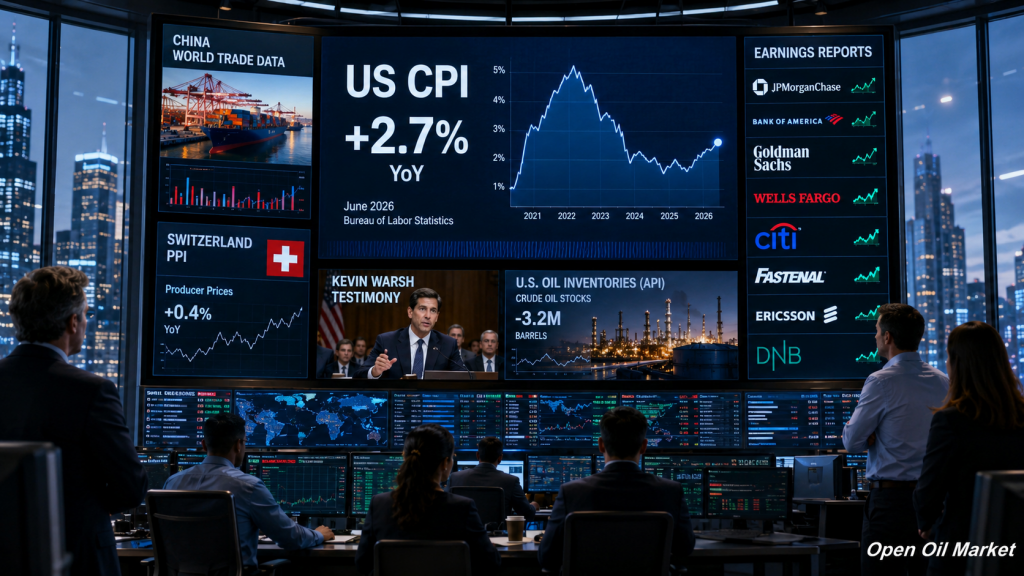
Tuesday, July 14, 2026, will be a pivotal day in July for global markets. Investors will focus on the US June CPI inflation data, China's global trade figures, Swiss producer prices, Federal Reserve Chairman Kevin Warsh's testimony before the House Financial Services Committee, and API oil inventory data in the United States. Additionally, the day marks the start of an intensive corporate earnings season: the largest American banks as well as notable public companies from Europe and the international industrial sector will release their Q2 results.
For investors in the CIS, this day is significant not only as a macroeconomic benchmark but also as a test of the resilience of the global financial system. The US inflation data will directly impact expectations regarding Federal Reserve interest rates, the dollar, Treasury yields, commodity prices, and the dynamics of gold, oil, bank stocks, the tech sector, and emerging markets.
The Key Intrigue of the Day: US CPI Inflation for June
The highlight of Tuesday will be the release of the US Consumer Price Index (CPI) for June at 15:30 MSK. For global investors, CPI remains the primary indicator determining the trajectory of Federal Reserve monetary policy. Following a period of heightened inflation volatility, markets will closely assess not only the headline index but also the core inflation excluding food and energy prices.
The most important parameters of the report include:
- month-over-month CPI change;
- year-on-year inflation in the US;
- core CPI as an indicator of persistent price pressures;
- housing, healthcare, transport, and insurance costs;
- market reactions in the bond market and the US dollar post-release.
If inflation is higher than expected, investors may increase their bets on a more hawkish Fed stance. This would support the dollar and bond yields but could pressure growth stocks, gold, and currencies of emerging countries. Conversely, a weaker CPI could revive demand for risk, supporting equity indices, commodity assets, and debt markets.
China: June Global Trade as an Indicator of Global Demand
At 06:00 MSK, China will release its global trade data for June. For investors, this serves as an early signal regarding the state of external demand, global supply chains, and the export activity of the world's largest industrial economy. Special attention will be paid to exports, imports, and the trade balance.
Chinese statistics are crucial for assessing demand for raw materials, industrial metals, oil, gas, container shipping, electronics, and components for AI infrastructure. Strong exports may confirm the resilience of global trade, while weak imports could indicate issues with domestic demand in China.
For CIS markets, Chinese data holds particular significance: China remains one of the key buyers of raw materials, energy resources, and industrial goods. Thus, weak trade statistics may intensify pressure on commodity currencies and companies focused on exports.
Switzerland: PPI and Signal for Europe
At 09:00 MSK, Switzerland will publish its producer price index (PPI) for June. Although this indicator is not among the most volatile for global markets, it is important as an indicator of industrial inflation in Europe. The Swiss economy is closely linked to pharmaceuticals, machinery, finance, and the export of high-value-added goods.
A decrease in PPI may confirm a weakening of production price pressures in Europe. Conversely, an increase in the index will signal that inflationary risks remain within supply chains. This is crucial for investors when evaluating the prospects of European bonds, the Swiss franc, industrial company stocks, and central bank policies.
Kevin Warsh's Speech: Signal on Fed Rate
At 17:00 MSK, Kevin Warsh's appearance before the House Financial Services Committee is anticipated. This event will be significant as it follows closely behind the CPI publication. The market will be looking for direct or indirect signals regarding the Fed's assessment of inflation, the labor market, credit conditions, and the resilience of the banking system.
Investors will be attentive to several key statements:
- Does the Fed consider the current inflation to be transitory or persistent?
- Is the regulator willing to keep the rate higher than expected for a longer period?
- Is there discussion regarding the risk of additional policy tightening?
- How does the Fed assess the impact of tariffs, commodity prices, and geopolitical factors?
- Will the regulator maintain a cautious or a more hawkish tone?
For the stock market, the primary risk is the combination of strong inflation and a tough Fed rhetoric. Such a scenario could intensify corrections in the technology sector and increase demand for defensive assets. However, if the CPI is moderate and Warsh's comments are balanced, the market may receive arguments for continued growth.
US Oil: API Inventories and the Commodity Market
At 00:30 MSK, the API inventory statistics for US oil will be published. For the oil market, this serves as a preliminary indicator ahead of the official data from the US Department of Energy. Given the geopolitical tensions, the sensitivity of Brent and WTI to news from the Middle East, and the high dependency of the market on demand in Asia, the API data may heighten intraday volatility.
An increase in oil inventories is typically interpreted as a signal of weaker demand or increased supply. Conversely, a decrease in inventories may support oil prices and the shares of oil and gas companies. For CIS investors, oil dynamics are important due to their influence on the ruble, budget expectations, oil company stocks, the oil services sector, and export revenues.
Corporate Reports in the US: Banking "Super Tuesday"
The main corporate block of the day will consist of earnings reports from the largest US banks for the second quarter of 2026. On Tuesday, results will be reported by JPMorgan Chase, Bank of America, Citigroup, Goldman Sachs, and Wells Fargo. For the S&P 500 index, this is one of the most crucial days of the earnings season, as banks provide the market with an overview of the credit cycle, consumer conditions, corporate demand, and investment banking activity.
Investors will analyze:
- net interest income and margin;
- dynamics of deposits and funding costs;
- provisions for potential credit losses;
- quality of consumer and commercial loan portfolios;
- income from trading, IPOs, M&A, and bond placements;
- management forecasts for the second half of 2026.
JPMorgan Chase remains a barometer of the resilience of the US banking sector. Bank of America will show the sensitivity of a large universal bank to interest rates and credit demand. Citigroup is important as a restructuring story and efficiency improvements. Goldman Sachs will provide insights into investment banking, capital markets, and transactions. Wells Fargo will be assessed through the lens of operational efficiency, credit quality, and rebuilding investor confidence.
Other Major Reports: Fastenal, Ericsson, and DNB
In addition to the American banks, companies from the industrial, technology, and European financial sectors will report on July 14. Fastenal will present results that are significant as an indicator of industrial demand in the US. The company operates at the intersection of industrial distribution, construction, infrastructure, and the manufacturing cycle, making its report valuable for assessing the state of the real sector.
Ericsson will release its Q2 report, which will be crucial for assessing telecommunications equipment, operator investments in networks, 5G infrastructure, and the margins of the European tech sector. For Euro Stoxx and the global tech market, this report is significant as a signal regarding operators' capital expenditures.
DNB, the largest financial group in Norway, will present its quarterly report, which will be of interest to investors as an indicator of the Scandinavian banking sector, Norway's oil and gas economy, credit quality, and the sensitivity of European banks to interest rates. Collectively, the reports from DNB, Ericsson, and Fastenal will broaden the picture for the day beyond the US.
The Russian Market and MOEX: External Environment More Significant Than Local Reporting
For the Russian market, the key factor on July 14 will be the external environment. There are few large reports from major American banks in the Russian corporate calendar for this day, so investors' attention will focus on global inflation, oil prices, the dollar, bond yields, and risk appetite.
The MOEX index may react to several channels:
- dynamics of Brent and expectations regarding US oil inventories;
- movements of the dollar and emerging market currencies following the CPI release;
- global appetite for risk after the earnings reports of US banks;
- sentiment in the commodity sector after China's trade statistics;
- dividend and corporate events of individual Russian issuers.
For CIS investors, it is essential to note that even in the absence of numerous local reports, the Russian market remains sensitive to global liquidity, oil prices, and inflation expectations in the US. Therefore, Tuesday may set the tone not only for American markets but also for commodity and emerging markets.
What Investors Should Pay Attention To
The main focus for investors on Tuesday will be the combination of three factors: US CPI, Fed rhetoric, and the earnings reports of the largest banks. If inflation turns out to be higher than expected, and Warsh confirms a hawkish stance, the market may begin to reassess rates and reduce risk appetite. In this scenario, growth stocks, high-yield bonds, and emerging market currencies may come under pressure.
Conversely, if inflation shows signs of slowing down, and the bank reports confirm the resilience of the credit cycle, investors may receive positive signals for stocks in the financial sector, industry, commodities, and cyclical assets. Particularly important will be management comments from JPMorgan Chase, Bank of America, Citigroup, Goldman Sachs, and Wells Fargo regarding credit losses, credit demand, and investment banking activity.
A practical checklist for the day:
- Before the US market opens, assess data from China and the reaction of commodity markets;
- At 15:30 MSK, monitor US CPI and Treasury yield movements;
- After the bank reports, compare the dynamics of interest income and reserves;
- At 17:00 MSK, keep an eye on Warsh's rhetoric regarding the Fed rate;
- In the evening, evaluate the reactions of oil, gold, the dollar, the S&P 500, Euro Stoxx 50, Nikkei 225, and MOEX.
Tuesday, July 14, 2026, could be the day when investors receive answers to several critical questions: how sustainable is inflation in the US, does China continue to play the role of a driver for global trade, how robust is the banking sector, and is the Fed prepared for a more hawkish policy? For portfolios with global exposure, this day promises heightened volatility and significant informational value.