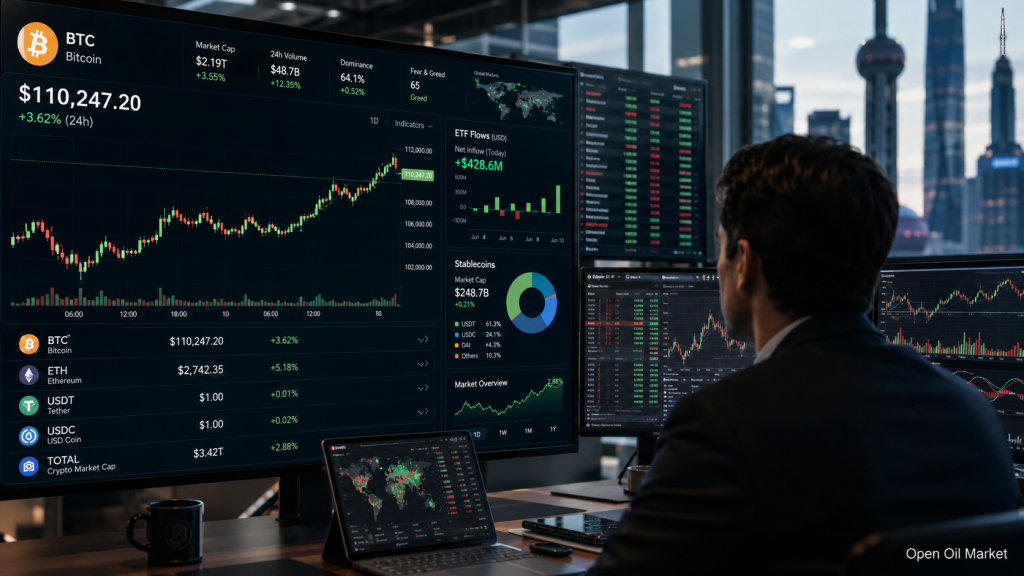
Cryptocurrency Market on June 10, 2026: Bitcoin Tests Market Resilience, Ethereum Maintains Infrastructure Role, and ETFs and Stablecoins Become Key Indicators for Global Investors
The cryptocurrency market approaches midweek, June 10, 2026, in a state of heightened volatility. Following a sharp downturn, Bitcoin, Ethereum, Solana, and other major digital assets are attempting to recover; however, investors remain cautious. The main topic of the day is not only the dynamics of price quotes but also the reallocation of capital among cryptocurrencies, ETFs, stablecoins, the AI sector, and significant tech IPOs.
For global investors, the cryptocurrency market now appears to be a zone of tactical opportunities rather than an unequivocal risk-on asset. Bitcoin continues to be the primary indicator of demand for digital assets, Ethereum retains its role as an infrastructure platform, and stablecoins are becoming one of the key channels of dollar liquidity in the blockchain economy.
Bitcoin Remains the Primary Barometer of the Crypto Market
Bitcoin has once again captured the attention of investors. After falling to local lows, the largest cryptocurrency is attempting to recover, but the market has yet to demonstrate sustainable momentum. For institutional participants, current BTC prices are not the only concern; the structure of demand is critical: inflows and outflows from spot Bitcoin ETFs, activity among large holders, liquidity in derivatives markets, and reactions to macroeconomic news.
The key issue for Bitcoin at present is competition for capital. Some investors are shifting their focus to stocks of companies connected with artificial intelligence, major IPOs, and traditional financial instruments. This reduces the inflow of new liquidity into cryptocurrencies, making BTC more sensitive to any negative signals.
Three levels of observation are crucial for investors:
- the dynamics of ETF flows and institutional demand;
- Bitcoin's reaction to the dollar, bond yields, and stock indices;
- the behavior of long-term holders and corporate treasuries.
Ethereum: Market Infrastructure Without Strong Market Momentum
Ethereum maintains its status as the underlying infrastructure for DeFi, stablecoins, asset tokenization, and smart contracts. However, ETH is currently underperforming compared to long-term growth expectations. Investors assess Ethereum not only as a cryptocurrency but also as a technological platform on which a significant portion of the blockchain economy is developing.
A critical factor for Ethereum is the network's ability to retain capital amidst competition from Solana, BNB Chain, Tron, Base, Arbitrum, and other ecosystems. If the market witnesses a sustainable increase in activity within stablecoins, tokenization of real assets, and on-chain private credit, Ethereum may gain additional support. Nonetheless, in the short term, investors remain cautious.
Stablecoins Become a Central Theme in Digital Finance
Stablecoins remain one of the most significant topics in the cryptocurrency market in June 2026. USDT and USDC are among the top 10 most popular cryptocurrencies and effectively serve as a digital dollar within the global blockchain infrastructure. They are used for trading, settlements, transfers, DeFi operations, and liquidity storage during periods of market uncertainty.
The increase in the share of stablecoins can have dual implications. On one hand, it reflects market maturity and the expansion of the practical application of digital assets. On the other hand, a rising share of USDT and USDC often indicates that investors are exiting risky cryptocurrencies and temporarily moving into dollar liquidity.
For the global market, the following points are particularly important:
- regulation of stablecoins in the USA, Europe, and the UK;
- the quality of reserves held by issuers;
- the use of stablecoins in international payments;
- the role of USDT and USDC in the liquidity of cryptocurrency exchanges.
Top 10 Popular Cryptocurrencies: The Focus of Major Capital
Investors continue to focus on the largest and most liquid digital assets. As of June 10, 2026, the primary cryptocurrencies being monitored by the global market include Bitcoin, Ethereum, Tether, BNB, USDC, XRP, Solana, Tron, Dogecoin, and Cardano.
Each asset serves its function within the crypto market:
- Bitcoin — the digital reserve asset and main indicator of market sentiment.
- Ethereum — the infrastructure for smart contracts, DeFi, NFTs, and tokenization.
- USDT — the largest stablecoin and primary instrument for dollar liquidity.
- BNB — the utility token of the Binance and BNB Chain ecosystem.
- USDC — the regulated stablecoin, crucial for institutional settlements.
- XRP — an asset linked to cross-border payments and banking infrastructure.
- Solana — a high-speed network for applications, payments, DeFi, and consumer services.
- Tron — a network with high activity in stablecoin transfers.
- Dogecoin — a speculative asset heavily reliant on market sentiment.
- Cardano — a blockchain platform focused on smart contracts and long-term ecosystem development.
Solana, BNB, and Tron: Competing for Speed, Payments, and Users
Beyond Bitcoin and Ethereum, investors are closely monitoring Solana, BNB, and Tron. These networks compete for users, transaction fees, stablecoin turnover, and the launch of new applications. Solana retains its reputation as a high-speed blockchain, BNB leverages a large exchange ecosystem, while Tron remains a significant channel for stablecoin transfers.
For venture and public investors, this segment of the market is particularly important, as it is here that practical demand is formed: payments, wallets, trading applications, DeFi services, tokenized assets, and infrastructure solutions for businesses.
ETFs and Institutional Capital: The Main Source of Volatility
Spot Bitcoin ETFs and other regulated instruments remain the most important bridge between traditional finance and the cryptocurrency market. When ETFs record inflows, Bitcoin receives support. When outflows begin, the pressure quickly spreads to Ethereum, Solana, XRP, BNB, and other major assets.
Institutional investors have become more selective. They no longer purchase cryptocurrencies solely based on overall market optimism. Capital is now assessing:
- liquidity depth;
- regulatory risks;
- the quality of custody infrastructure;
- tax implications;
- comparative returns against stocks, bonds, gold, and the AI sector.
This shift makes the cryptocurrency market more mature but simultaneously less predictable for short-term speculation.
Regulation: The USA, Europe, and the Global Digital Asset Market
The regulatory agenda remains a key factor for cryptocurrencies in 2026. The USA continues discussing a framework for oversight of digital assets, Europe is intensifying the implementation of MiCA, and the UK is seeking a balance between risk control and fostering financial innovation.
For investors, this indicates that cryptocurrencies are gradually transitioning from a gray area into a regulated financial sector. However, this transition is not always positive for all participants. Exchanges, stablecoin issuers, DeFi protocols, and custodial platforms will have to increase transparency and comply with reserve requirements, client identification, and risk management.
The largest players might benefit the most from regulation as they can engage with banks, auditors, lawyers, and institutional clients. Conversely, small projects may face rising costs and declining competitiveness.
Tokenization and On-Chain Finance: A New Long-Term Driver
One of the strongest long-term trends remains the tokenization of real assets. The market is gradually moving from speculative trading of cryptocurrencies to utilizing blockchain for settlements, lending, issuing tokenized bonds, funds, private credit, and other financial instruments.
For Ethereum, Solana, XRP Ledger, Polygon, Base, and other networks, this could become a new source of demand. If banks, payment systems, and asset management companies continue transitioning some operations into on-chain infrastructure, the cryptocurrency market will gain a more substantial foundation for growth.
However, investors must distinguish between two concepts: the development of blockchain infrastructure and the price increase of a specific token. Even a strong technological network does not guarantee immediate growth in the value of its coin if the tokenomics, fees, and revenue distribution do not create sustainable demand for the asset.
What to Watch For on June 10, 2026
Wednesday, June 10, 2026, may prove to be an important day for assessing the short-term resilience of the cryptocurrency market. The primary question is whether Bitcoin can maintain its recovery and regain investor confidence after a period of pressure. If BTC continues to exhibit instability, altcoins will remain under increased risk.
Investors should keep an eye on the following factors:
- inflows and outflows from Bitcoin ETFs and other cryptocurrency funds;
- the share of USDT and USDC in the overall market capitalization;
- the dynamics of Ethereum as an infrastructure asset;
- the behavior of Solana, BNB, XRP, and Tron as indicators of appetite for altcoins;
- news regarding the regulation of stablecoins and cryptocurrency exchanges;
- the condition of the stock market, especially AI companies and major IPOs;
- geopolitical risks, the dollar exchange rate, and bond yields.
The baseline scenario for cryptocurrencies on June 10 is cautious stabilization without a clear transition to a full-fledged bull market. Bitcoin remains the principal asset for assessing sentiment, Ethereum serves as an indicator of infrastructure demand, stablecoins represent liquidity, and the top 10 cryptocurrencies illustrate where global investors are reallocating capital.
For long-term investors, the crypto market retains potential but demands discipline: diversification, risk management, avoidance of excessive leverage, and careful liquidity analysis. For short-term traders, the main task is not to try to predict every movement but to monitor key demand zones, ETF flows, and the market's response to news from traditional finance.