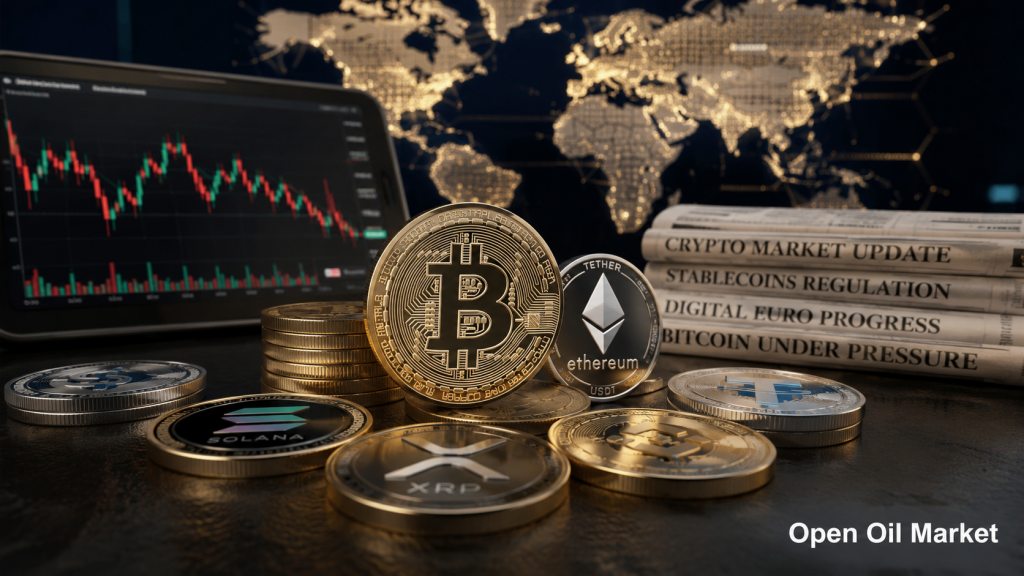
Global Cryptocurrency Market on June 24, 2026: Bitcoin Under Pressure, Ethereum, Stablecoins, Digital Euro, and Top Cryptocurrencies for Investors
The cryptocurrency market enters Wednesday, June 24, 2026, with heightened caution. Following significant declines in Bitcoin and Ethereum, investors are reassessing their risk positions, evaluating liquidity resilience, and closely monitoring digital asset regulation in the U.S., Europe, and the U.K. The day's main topic is not only Bitcoin's dynamics but also the structural shift in the global cryptocurrency market: capital is increasingly focusing on stablecoins, regulated ETFs, asset tokenization, and institutional settlement infrastructure.
For global investors, cryptocurrency news today is important not as short-term noise, but as an indicator of sector maturity. The digital asset market is moving closer to traditional finance, yet simultaneously losing some of its previous speculative autonomy. Cryptocurrencies are becoming more dependent on interest rates, technology stocks, ETF flows, regulatory decisions, and the behavior of institutional players.
Market Overview: Cryptocurrencies Continue to Be Under Pressure from Risk Assets
The global cryptocurrency market is wrapping up June in a state of consolidation and increased volatility. Bitcoin remains the primary sentiment indicator; however, its role is gradually changing: where Bitcoin was once seen as an almost independent digital asset, it now increasingly moves in sync with global risk instruments.
The pressures on cryptocurrencies are influenced by several factors:
- Weakness in the tech sector and capital flow to select AI companies;
- Decreased risk appetite ahead of the end of the quarter;
- Outflows from certain cryptocurrency ETFs;
- Increased attention to the regulation of stablecoins, CBDCs, and crypto payments;
- Profit-taking after previous phases of digital asset growth.
For investors, this means that cryptocurrencies can no longer be analyzed separately from macroeconomics. Cryptocurrency news in 2026 is increasingly linked not only to blockchain developments but also to central bank policies, capital movements in the stock market, banking regulations, and the competition between the U.S., Europe, and Asia for control over digital payments.
Bitcoin: Key Market Asset Testing Demand Resilience
Bitcoin remains the largest cryptocurrency by market capitalization and the primary benchmark for the entire sector. However, current dynamics show that Bitcoin faces a new set of challenges. Institutionalization via ETFs has made the asset more accessible to major investors, but it has simultaneously increased its dependence on capital flows into regulated investment products.
Presently, three questions are critical for Bitcoin:
- Will the market maintain long-term demand from institutional investors?
- Will Bitcoin remain a protective digital asset or become definitively a high-risk tech instrument?
- Can ETFs restore a consistent influx of capital after a period of outflows?
For investors, Bitcoin remains the foundational asset of the crypto market, but its investment profile is evolving. In the short term, the market is focused on liquidity levels, derivatives, and the quarterly expiration of options. In the medium term, the more pressing question becomes whether Bitcoin will maintain its status as digital gold amidst capital competing actively across cryptocurrencies, the AI sector, tech IPOs, and tokenized funds.
Ethereum: Structural Changes and Pressure on Ecosystem Trust
Ethereum remains the second key cryptocurrency in the global market and foundational infrastructure for DeFi, NFTs, stablecoins, asset tokenization, and smart contracts. However, recent news surrounding the Ethereum Foundation has heightened investor caution. Staff reductions and budget reevaluations indicate that even the largest blockchain ecosystems must adapt to a harsher market environment.
For the Ethereum market, this is an important signal. Investors will assess not only the price of ETH but also the quality of ecosystem management, the pace of technological updates, and competition from Solana, BNB Chain, Hyperliquid, and other networks. Ethereum retains a strong network effect, but its leadership is no longer viewed as unassailable.
Key factors for Ethereum in the coming weeks include:
- Activity dynamics in DeFi protocols;
- Institutional investors' interest in Ethereum ETFs;
- Development of Layer 2 networks;
- Reducing transaction fees and increasing scalability;
- Maintaining developer trust in the ecosystem.
Stablecoins Become the Central Theme of the Crypto Market
One of the main topics of the day is the growing role of stablecoins. USDT, USDC, and new regulated digital currencies are no longer merely auxiliary tools for trading but rather a fundamental infrastructure of the cryptocurrency market. Payments occur through stablecoins, liquidity is stored, DeFi protocols operate, and international payment solutions are formed.
The U.K. has softened its regulatory approach to stablecoins, easing some stringent restrictions for users and shifting the focus to issuer, reserve, and systemic stability requirements. For the global market, this is an important signal: major jurisdictions are not abandoning digital assets, but rather attempting to integrate them into the regulated financial system.
For investors, stablecoins matter for three main reasons:
- They demonstrate real demand for digital dollars and digital transactions;
- They enhance liquidity in the cryptocurrency market;
- They serve as a bridge between banks, fintech, exchanges, and blockchain infrastructure.
Stablecoins may indeed become the primary driver for the mass adoption of cryptocurrencies, even if speculative interest in individual tokens remains unstable.
The U.S. and Europe Diverge on Approaches to Digital Currencies
The regulatory agenda is amplifying the geopolitical significance of cryptocurrencies. In the U.S., resistance to the launch of a digital dollar from the Federal Reserve is increasing. Against this backdrop, private stablecoins are gaining more room to develop, especially if U.S. authorities continue to support dollar-denominated digital instruments issued by the private sector.
Europe is moving in a different direction. Support for the digital euro in the European Parliament indicates that the EU aims to reduce reliance on American payment networks and strengthen financial sovereignty. The potential launch of the digital euro by the end of the decade could alter the balance between public digital money, bank payments, and private stablecoins.
For the global cryptocurrency market, this creates a new configuration:
- The U.S. bets on private dollar stablecoins and market infrastructure;
- Europe promotes the digital euro and a more stringent regulatory model;
- Asia develops licensed crypto platforms and regulated exchange products;
- Global investors choose jurisdictions with clear rules, liquidity, and capital protection.
Top 10 Most Popular Cryptocurrencies: What's in Focus for Investors
Investors continue to focus on the largest digital assets by market capitalization and liquidity. The top 10 most popular cryptocurrencies in the global market reflect a balance between classic assets, stablecoins, payment networks, and new infrastructure projects.
- Bitcoin (BTC) — the leading digital asset and primary indicator of the crypto market.
- Ethereum (ETH) — the foundational network for smart contracts, DeFi, and tokenization.
- Tether (USDT) — the largest stablecoin and key source of market liquidity.
- BNB (BNB) — token of the Binance ecosystem and BNB Chain.
- USDC (USDC) — a regulated dollar stablecoin with strong institutional traction.
- XRP (XRP) — an asset for cross-border payments and banking infrastructure.
- Solana (SOL) — a high-performance network for DeFi, meme coins, applications, and payments.
- TRON (TRX) — a network with high activity in stablecoin transfers.
- Figure Heloc (FIGR_HELOC) — an example of the growth of tokenized financial assets.
- Hyperliquid (HYPE) — an infrastructure project associated with decentralized trading and derivatives.
This list indicates that the cryptocurrency market in 2026 has become more complex. The top segment includes not only Bitcoin, Ethereum, and classic altcoins, but also stablecoins, payment networks, DeFi infrastructure, and tokenized real assets.
Institutional Investors Strengthen Their Presence in Digital Assets
Large asset management firms continue to develop cryptocurrency directions despite market volatility. The acquisition of cryptocurrency investment platform 250 Digital by Franklin Templeton and the launch of a separate Franklin Crypto division suggest that traditional finance is not leaving the sector. On the contrary, they are seizing the market's weakness to strengthen their positions.
For investors, this is an important structural signal. Institutional capital increasingly enters not through direct token purchases, but through:
- ETFs and exchange-traded funds;
- Active crypto strategies;
- Custodial solutions;
- Tokenized money market funds;
- Blockchain settlement infrastructure;
- Regulated products for professional investors.
This maturation of the cryptocurrency market simultaneously reduces the space for uncontrolled speculation. The winners will be projects with liquidity, legal transparency, clear token economics, and real usage.
DeFi, Tokenization, and Payments: Where to Look for Long-Term Ideas
The DeFi sector remains under pressure after a period of rapid growth, but interest in decentralized financial protocols has not dissipated. The most promising directions are shifting from speculative farming to infrastructure: decentralized exchanges, derivatives, lending, tokenized bonds, liquidity funds, and settlements between financial institutions.
For long-term investors, three areas are particularly crucial:
- Tokenization of real assets. Banks and asset managers are transferring funds, bonds, and cash instruments to a blockchain format.
- Payment stablecoins. Corporate transfers, international trade, and fintech services are increasingly utilizing digital dollars.
- Infrastructure for institutions. Custody, compliance, analytics, security, and interbank blockchain settlements are becoming a separate asset class.
Cryptocurrencies are gradually transforming from a token market into a market for digital financial infrastructure. This shifts the focus of asset evaluation, making it increasingly important for investors to consider not only capitalization and price charts but also real cash flows, fees, users, regulatory status, and the resilience of business models.
What Investors Should Pay Attention to on June 24, 2026
Wednesday, June 24, may prove to be an important day for assessing sentiment in the cryptocurrency market. Investors should pay attention not only to the short-term movements of Bitcoin and Ethereum, but also to deeper changes in the sector's structure.
Key factors of the day include:
- Bitcoin's behavior after recent pressure and buyers' reactions to declines;
- Ethereum's dynamics amid the restructuring of the Ethereum Foundation;
- Flows into cryptocurrency ETFs and institutional investor activities;
- Regulation of stablecoins in the U.S., EU, and U.K.;
- Advancements of the digital euro and constraints surrounding the digital dollar;
- Liquidity in Solana, XRP, BNB, TRON, and Hyperliquid;
- Development of real asset tokenization and banking blockchain settlements.
The main takeaway for global investors is that the cryptocurrency market remains high-risk, but its investment logic is becoming more institutional. Bitcoin and Ethereum continue to set the tone, yet the next growth phase may be tied not only to price increases of coins but also to the development of stablecoins, ETFs, tokenization, regulated payment solutions, and infrastructure for traditional finance.
Cryptocurrency news on June 24, 2026, indicates that the digital asset market is undergoing a maturity test. For investors, this underscores the need for more stringent asset selection, risk management, and the understanding that cryptocurrencies have become an integral part of the global financial system rather than a mere experimental sector.