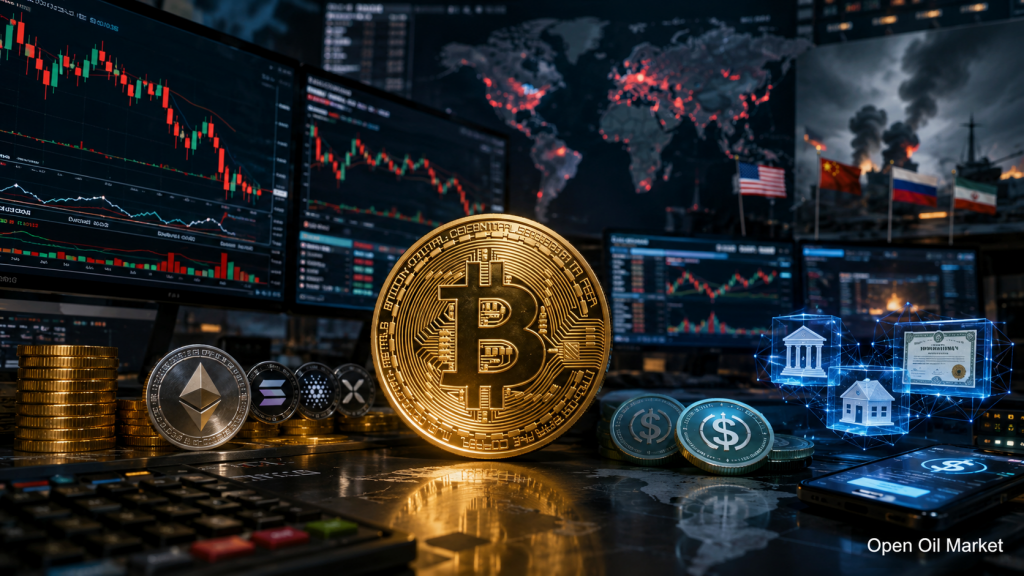
Cryptocurrency Market on July 14, 2026: Dynamics of Bitcoin and Ethereum, Demand through ETFs, Development of Stablecoins, Tokenization of RWA, Regulation, and Top 10 Popular Cryptocurrencies
The global cryptocurrency market enters Tuesday, July 14, 2026, with heightened caution. After a recovery attempt at the beginning of the month, digital assets have once again come under pressure due to a global risk-off sentiment: investors are assessing geopolitical risks, the dynamics of the dollar, yields on U.S. bonds, prospects for monetary policy, and the sustainability of demand for spot cryptocurrency ETFs.
For global investors, the key intrigue of the day extends beyond the movements of Bitcoin, Ethereum, and the largest altcoins. The focus has shifted to a broader institutional agenda: the regulation of stablecoins in the U.S., the preparation of new rules for crypto assets in the U.K., the development of real asset tokenization, and the competition among major financial centers for the role of an infrastructure hub for digital capital markets.
Key terms of the day: cryptocurrencies, cryptocurrency news, Bitcoin, Ethereum, cryptocurrency ETFs, stablecoins, digital assets, tokenization, RWA, Solana, XRP, BNB, USDT, USDC, global crypto market, cryptocurrency regulation.
Today's Key Topic: Bitcoin Remains the Barometer of Global Risk
Bitcoin continues to serve as the primary indicator of sentiment in the crypto market. In recent sessions, the leading cryptocurrency has remained in a zone of heightened volatility as the market reacts to geopolitical tensions, declining risk appetite, and capital movements between equities, bonds, gold, oil, and digital assets.
It is important for investors to note that Bitcoin is currently trading not as an isolated technological asset, but as part of a global risk portfolio. Its movements are increasingly dependent on three factors:
- inflows and outflows of capital to spot Bitcoin ETFs;
- the yield on U.S. Treasury bonds and interest rate expectations;
- overall demand for protective and alternative assets amid geopolitical considerations.
If ETFs continue to demonstrate steady inflows, this could limit the depth of any correction. However, should institutional investors decide to take profits, Bitcoin could once again become a source of pressure on the entire cryptocurrency market.
Ethereum: Market Infrastructure Bet Remains in Question
Ethereum maintains its status as the second key cryptocurrency and foundational infrastructure for DeFi, tokenization, NFTs, stablecoins, and corporate blockchain solutions. However, in July 2026, Ethereum finds itself in a more complex position than Bitcoin: investors are assessing not only the price of ETH but also competitive pressures from Solana, BNB Chain, TRON, Hyperliquid, and new specialized networks.
The main investment rationale surrounding Ethereum is built on three theses:
- Demand for Infrastructure. If asset tokenization and DeFi continue to grow, Ethereum receives fundamental support.
- Fees and Network Activity. Low fees may be convenient for users, but investors care about the monetization of the blockchain.
- Layer 1 and Layer 2 Competition. Capital is increasingly distributed across multiple networks rather than concentrated solely in ETH.
For long-term investors, Ethereum remains more than just a cryptocurrency; it represents a bet on the development of decentralized financial infrastructure. However, the market is increasingly demanding from ETH proof of real usage rather than just the status of the historical leader in smart contracts.
Cryptocurrency ETFs: Institutional Capital Keeps the Market from a Sharp Decline
Spot cryptocurrency ETFs remain one of the main channels of institutional demand. This is particularly important for global investors: through ETFs, digital assets become part of regulated portfolios, pension strategies, wealth management, and alternative risk hedging.
In the short term, flows into Bitcoin and Ethereum ETFs may be more significant than news regarding individual altcoins. If institutional funds continue to buy the dips, the market receives support. Conversely, if ETFs experience substantial outflows, pressure on Bitcoin, Ethereum, and second-tier cryptocurrencies intensifies.
What Investors Should Monitor Regarding ETFs:
- net daily inflows and outflows;
- behavior of the largest asset managers;
- the share of ETFs in the overall trading volume of Bitcoin and Ethereum;
- expansion of product offerings for altcoins and multi-asset crypto indices.
Stablecoins: USDT and USDC Become the Center of Regulatory Competition
Stablecoins remain the largest payment infrastructure in the crypto market. USDT and USDC are used for trading, settlement, DeFi operations, cross-border transfers, and holding dollar liquidity outside the traditional banking system. In 2026, stablecoins are becoming the primary focus of regulation in the U.S., EU, U.K., and Asia.
This is a crucial point for investors. The market is gradually transitioning from an era of unregulated tokens to a model where stablecoin issuers must prove the quality of their reserves, transparency in redemptions, operational resilience, and compliance with financial supervision requirements.
Potential implications for the market include:
- an increase in the role of licensed stablecoin issuers;
- redistribution of market shares among USDT, USDC, and new regulated digital dollars;
- increased requirements for exchanges, custodians, and payment providers;
- the convergence of the cryptocurrency market with banking infrastructure.
Tokenization of Real Assets: RWA Becomes the Bridge Between Banks and Blockchain
One of the most significant topics in July 2026 is the tokenization of real assets, or RWA. Major banks, asset management companies, and financial centers are increasingly exploring the application of blockchain for tokenized bonds, repo transactions, equity instruments, money markets, and settlements among institutional participants.
For the cryptocurrency market, this could become a more significant theme than another speculative cycle in meme coins. If tokenization receives support from regulators and major banks, blockchain will solidify its status as an infrastructural technology for the traditional financial market.
The most promising areas for RWA include:
- tokenized government bonds;
- digital money market funds;
- tokenized repo instruments;
- settlements between banks and brokers on blockchain infrastructure;
- corporate debt instruments in digital form.
Top 10 Most Popular Cryptocurrencies for Investors
As of July 14, 2026, investors should monitor not only Bitcoin and Ethereum but also the entire top tier of the market. Below is a list of the top 10 most significant cryptocurrencies and digital assets based on a combination of market capitalization, liquidity, recognition, and influence on market structure.
Top 10 Cryptocurrencies and Digital Assets
- Bitcoin (BTC) — the main reserve asset of the crypto market and a key indicator of risk appetite.
- Ethereum (ETH) — the foundational infrastructure for smart contracts, DeFi, tokenization, and Web3.
- Tether USDt (USDT) — the largest stablecoin and a primary instrument for cryptocurrency liquidity.
- BNB (BNB) — the token of the Binance ecosystem and one of the largest assets in trading infrastructure.
- USDC (USDC) — a regulated dollar stablecoin, crucial for institutional settlements.
- XRP (XRP) — an asset associated with cross-border payments and banking infrastructure.
- Solana (SOL) — a high-performance blockchain popular in DeFi, trading, and consumer applications.
- TRON (TRX) — a network with high activity in stablecoin transfers and settlements.
- Hyperliquid (HYPE) — a representative of the new generation of trading and derivatives crypto infrastructure.
- Dogecoin (DOGE) — the largest meme coin maintaining liquidity and speculative interest among retail investors.
Altcoins: The Market Becomes More Selective
Altcoins remain the most volatile part of the cryptocurrency market. In 2026, investors are purchasing less randomly and are increasingly selecting projects with clear liquidity, real use cases, sustainable token economics, and access to institutional capital.
The strongest themes for altcoins include:
- DeFi and derivatives infrastructure;
- high-throughput blockchains;
- tokenization of real assets;
- payment solutions based on stablecoins;
- crypto infrastructure for banks, brokers, and market makers.
The weakest segments are projects without revenue, a sustainable user base, and high token inflation. For investors, this signifies that the cryptocurrency market is transitioning from a "narrative" phase to a phase of business model validation.
Global Regulation: The U.S., U.K., EU, and Asia Formulate New Rules
In 2026, cryptocurrency regulation is becoming less of a fear factor and more of an institutional admission factor. The U.S. is clarifying rules for stablecoins and digital assets, the U.K. is preparing a new regulatory regime for crypto companies, the European Union continues the implementation of MiCA, and Asian jurisdictions are competing for licensed crypto exchanges and payment platforms.
For global investors, this creates a new map of the cryptocurrency landscape. Capital will flow into jurisdictions where clear rules, customer protection, transparent reserve requirements, and the opportunity to legally develop products for institutional clients exist.
What Investors Should Pay Attention to on July 14, 2026
On Tuesday, July 14, 2026, investors should maintain discipline and monitor not only the daily fluctuations of Bitcoin or Ethereum but also the market structure. Cryptocurrencies remain a high-risk asset class, but their role in the global financial system is maturing.
Key Signals of the Day:
- Bitcoin dynamics amid geopolitical shifts and dollar movements;
- net flows into Bitcoin ETF and Ethereum ETF;
- Ethereum's performance relative to Solana, BNB, and TRON;
- news regarding stablecoin regulation in the U.S. and EU;
- developments in the tokenization of real assets in the U.K. and other financial centers;
- liquidity of top 10 cryptocurrencies and stability of second-tier altcoins.
The main conclusion for investors: the cryptocurrency market in July 2026 remains volatile, but its fundamental agenda is increasingly institutional. Bitcoin remains the barometer of risk, Ethereum is an infrastructural bet, stablecoins act as the monetary layer of the market, and tokenization of RWA serves as a bridge between traditional finance and blockchain. These themes will shape cryptocurrency news not only on July 14 but also throughout the second half of 2026.