Cryptocurrency News for Thursday, January 22, 2026: Bitcoin at Key Levels, Ethereum and Altcoin Dynamics, Institutional Investments, and Global Cryptocurrency Market Trends
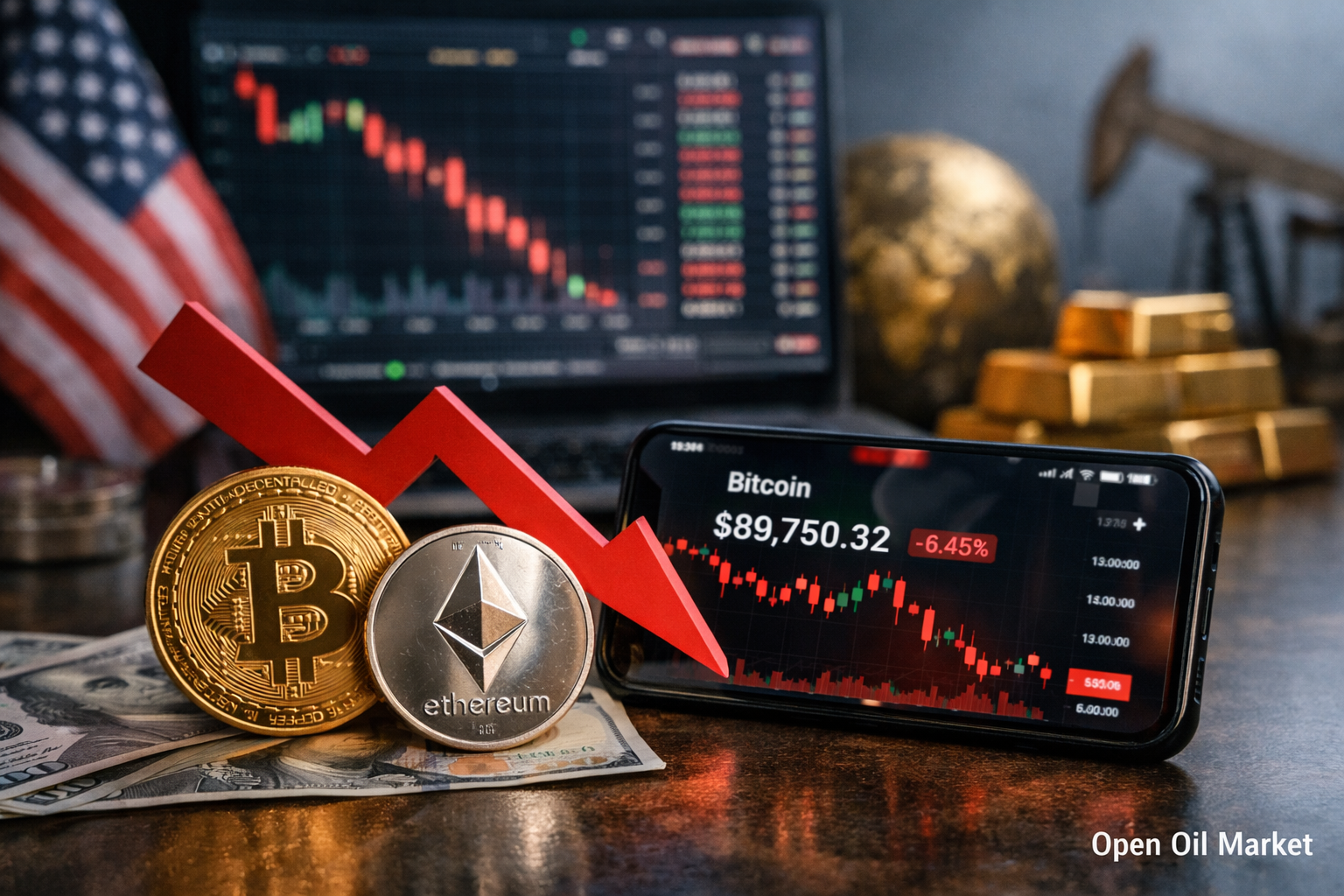
The global cryptocurrency market is exhibiting a corrective dynamic this week amid heightened macroeconomic uncertainty. Leading digital assets have significantly declined in value: Bitcoin (BTC) is consolidating around the $90,000 mark after recent peaks, while Ethereum (ETH) has dropped below $3,000. The overall market capitalization of cryptocurrencies has shrunk to approximately $3 trillion, and the Fear and Greed Index has fallen into the “fear” zone, reflecting investors’ concerns. Market participants are assessing how deep the current correction will go and which factors will determine future price movements.
Bitcoin Under Pressure After Rally
Bitcoin is trading around $90,000 mid-week, retreating from its historical maximum reached in early January (around $100,000). The BTC price has declined for six consecutive sessions, marking the longest downturn in the past year.
The primary driver of the decline has been a general deterioration in risk appetite across global markets: news about potential escalation in trade relations between the U.S. and Europe (the U.S. ultimatum regarding Greenland and tariff threats) has triggered sell-offs in the cryptocurrency market as well. Over the past few days, margin positions worth over $2 billion have been liquidated, exacerbating the asset's downward movement. Technically, the critical support level is now around $90,000; maintaining this level is crucial to avoid a more significant decline (down to approx. $75,000, according to some analysts). For now, BTC is showing a high correlation with risk assets and is not fulfilling its role as "digital gold": amid uncertainty, investors prefer to retreat to real protective assets.
Altcoin Market: Broad Decline
The altcoin market is also experiencing widespread decline. Ethereum (ETH), the second-largest cryptocurrency by market capitalization, has dropped more than 3% in the last 24 hours and is trading below $3,000, reflecting the vulnerability of altcoins to overall market corrections. The overwhelming majority of leading tokens are in the "red zone": market data indicates that over 90 of the top 100 cryptocurrencies have decreased in value in recent days.
For instance, XRP (the token of Ripple) has fallen to ~$1.90 after seven consecutive days of decline; BNB has lost about 4% in one day, and Solana (SOL) has retreated to ~$128, despite the fact that the share of staked coins in its network has reached a record 70%. Investors are partially transferring funds into stablecoins (digital dollar equivalents), which increases the share of such coins in circulation amid market turbulence. Overall, the future dynamics of altcoins largely depend on Bitcoin's behavior: if the flagship stabilizes around current levels, the alternative coin market may find a local bottom and start recovering.
Top 10 Most Popular Cryptocurrencies
The top 10 largest and most popular cryptocurrencies as of today include the following digital assets:
- Bitcoin (BTC) – the leading cryptocurrency with a dominant market share (about 60% of total capitalization). Price around $90,000; after a powerful rally in 2025, Bitcoin is undergoing a correction from historical highs but continues to confidently hold first place.
- Ethereum (ETH) – the second largest crypto asset, a base platform for smart contracts (decentralized finance, NFT). Current price around $3,000; Ethereum is under pressure following Bitcoin's decline, but retains a key role in the industry, and many experts expect increased interest in ETH in 2026.
- Tether (USDT) – the largest stablecoin pegged to the U.S. dollar (1 USDT ≈ $1). Capitalization of about $80 billion; USDT is widely used by investors to exit volatility – during periods of uncertainty, funds flow into this digital dollar equivalent.
- BNB (BNB) – the native token of the Binance ecosystem (largest cryptocurrency exchange and BSC blockchain). Price around $874; due to its widespread use on the Binance platform, BNB firmly remains in the top 5, although it has also seen declines in recent days due to the negative overall sentiment.
- USD Coin (USDC) – the second-largest stablecoin, issued by the Centre consortium (Circle). Fully backed by dollar reserves (capitalization around $50 billion) and widely used in trading operations and on DeFi platforms, making it one of the most reliable digital dollars.
- XRP (XRP) – cryptocurrency associated with fintech company Ripple (solutions for international payments). Rate around $1.90; after Ripple’s victory over the SEC in 2025, XRP significantly increased and returned to the top ten, but the current market correction has partially offset this growth.
- Solana (SOL) – a rapidly growing blockchain platform focused on high transaction speed. Price around $128; Solana has secured its position in the top 10 thanks to the development of its own DeFi/NFT ecosystem, with a record ~70% of SOL coins currently utilized in staking, reflecting community confidence.
- Tron (TRX) – a popular platform for smart contracts and digital content in Asia. TRX price around $0.30; thanks to the active use of the Tron network (including the issuance of stablecoins and fast fund transfers with minimal fees), this token maintains its place among the largest cryptocurrencies.
- Dogecoin (DOGE) – a meme cryptocurrency originally created as a joke but gained widespread popularity. Rate around $0.12; despite its playful origins, Dogecoin remains one of the most capitalized coins, though its price is highly volatile and depends on community sentiment.
- Cardano (ADA) – a blockchain platform for smart contracts, evolving based on academic research and phased updates. ADA trades around $0.36; the project continues technical development (for example, recent updates have improved network scalability), allowing Cardano to maintain its position among market leaders.
Geopolitical and Macroeconomic Risks
External factors are intensifying pressure on cryptocurrencies. The unexpected escalation of trade disagreements between the U.S. and Europe has become one of the triggers for the sell-off: at the economic forum in Davos, the U.S. president delivered the ultimatum “Greenland or tariffs,” threatening to impose tariffs, which has brought transatlantic relations to the brink of a trade war. In response, the European Union stated it was prepared to take strong retaliatory measures, heightening investors' fears about global repercussions. As a result of this geopolitical noise, market participants have begun to exit risk assets (such as stocks and cryptocurrencies) in favor of protective instruments.
Additional pressure is created by monetary factors. Yields on U.S. and European government bonds have risen to multi-year highs, signaling potential tightening of financial conditions. Traditional "safe havens" are attracting capital inflows: the price of gold has reached new historical highs, surpassing $4,600 per ounce, while silver is also experiencing a record price surge. Simultaneously, the VIX volatility index has hit a two-month high, reflecting increased uncertainty in the markets. The combination of these macro risks has induced a “risk-off” regime, during which crypto assets temporarily lose their appeal in the eyes of global investors.
Investor Sentiment and Volatility
Against the backdrop of the described events, market sentiment in the crypto industry has noticeably deteriorated. The sentiment index (Fear & Greed Index) is currently in the “fear” territory, signaling a prevailing sense of caution. Since the beginning of the week, the total market capitalization of the cryptocurrency market has decreased by approximately $200 billion, and volatility has increased. According to Coinglass, in just the last day, over $1.7 billion in positions have been forcibly closed (liquidated) due to the sharp drop in prices – indicating a significant reduction in risk and a cleansing of the market from excessive leverage.
Nevertheless, some analysts note that the current weakness may represent a temporary consolidation rather than full-blown panic. Following the explosive growth of recent months, such a correction may serve as a healthy regrouping: long-term investors use it to seek entry points, while speculators exit overheated positions. If external threats do not escalate, market stabilization in the near future is quite possible – supported by actions from large players willing to buy assets at lower prices.
Institutional Interest and Adoption
Despite current volatility, institutional interest in digital assets remains historically high. Just last week, capital inflows into cryptocurrency funds reached $2.17 billion (a record since October 2025), including $1.55 billion into Bitcoin funds and around $45 million into Solana funds, according to CoinShares. However, in the last couple of days, there has been a reversal: U.S. spot Bitcoin ETFs have recorded an outflow of around $500 million in just two sessions, indicating an exit of some short-term speculators from the market.
Meanwhile, the penetration of cryptocurrencies into traditional financial institutions and services continues:
- The U.S. Treasury Secretary Janet Yellen announced that seized government bitcoins will now be included in strategic state reserves (instead of being sold at auctions), indicating growing recognition of Bitcoin at the state level.
- One of the major insurance companies, Delaware Life, has integrated the Bitcoin index into its annuity products, allowing clients to indirectly invest in cryptocurrency through insurance instruments.
- The investment company Grayscale has applied to convert its NEAR Protocol cryptocurrency trust into an ETF, expanding the range of exchange-traded funds on digital assets beyond Bitcoin and Ethereum.
- The New York Stock Exchange (NYSE) has announced plans to launch a platform for 24/7 trading of tokenized securities, blurring the lines between traditional stock markets and cryptocurrency markets.
Such steps affirm that even during corrections, major players continue to develop infrastructure and products around cryptocurrencies. Regulators are also gradually establishing the rules of the game – from discussions on the role of stablecoins in the financial system to creating a regulatory framework for crypto ETFs – which may provide more transparency and attract new participants in the future.
Outlook and Predictions
The current correction raises questions for investors about future prospects: will it serve as a short-term breather or herald a more prolonged decline? Much will depend on external factors – resolution of trade disputes and central bank rhetoric – as well as Bitcoin’s ability to hold above key levels. The psychological barrier of $100,000 is currently a vital indicator for the return of bullish sentiment, while breaking the ~$90,000 support may exacerbate seller pressure.
Analysts caution that if the downturn deepens, the next target for Bitcoin could be around $75,000 and below. In an extremely negative scenario, levels of approximately $50,000 are even mentioned, although such a sharp drop would require a prolonged confluence of unfavorable factors. On the other hand, the emergence of positive drivers – such as de-escalation of geopolitical tensions or easing of financial policies – could bring buyers back into the market. The cryptocurrency sector has already demonstrated fundamental resilience: increased institutional participation, technological development of blockchains, and expansion of use cases (from payments to asset tokenization) create preconditions for a new growth phase after the current correction. Many investors are taking a wait-and-see approach, ready to build positions once volatility calms down and signs of stabilization emerge.