Cryptocurrency News on March 17, 2026: Bitcoin, Ethereum, and Major Altcoins Market Analysis, Institutional Demand, Stablecoins, and Top 10 Digital Assets
The cryptocurrency market approaches trading on Tuesday, March 17, 2026, in a much more constructive state than a week before. The key theme for investors remains the resurgence of institutional demand for digital assets: Bitcoin once again holds its status as the market's key benchmark, Ethereum is gaining additional attention against the backdrop of an expanded lineup of exchange products, and major altcoins are gradually regaining the capital spotlight. In this context, cryptocurrencies are perceived not only as a speculative segment but as part of a broader financial infrastructure linked to stablecoins, tokenization, and global liquidity flows.
For global investors, it is important not only to note the growing interest in cryptocurrencies but also to understand how the structure of this demand is changing. While previous cycles were primarily driven by retail participants, the current phase sees ETFs, regulated platforms, custodial solutions, and large corporate players taking center stage. Consequently, cryptocurrency news on March 17, 2026, should be viewed not as a collection of disjointed information, but as part of a deeper transformation of the digital financial market.
Bitcoin Sets the Tone for the Entire Crypto Market Again
Bitcoin remains the main barometer of sentiment in the digital asset market. At the start of the new week, investors are once again focused on whether BTC can solidify its recovery after a volatile start to March. This is crucial for the market: a strong Bitcoin not only supports sector capitalization but also lays the groundwork for a shift in interest toward Ethereum, Solana, XRP, and other major altcoins.
From a market logic perspective, the current phase appears to transition from a defensive behavior model to one that embraces more selective risk. This means that investors are now evaluating Bitcoin not just as digital gold, but also using it as an indicator of willingness to increase positions in the broader crypto segment. If this trend continues, BTC will remain the key driver of cryptocurrency news on Tuesday.
Institutional Demand and ETFs Become Central Factors Again
One of the most important narratives of recent days has been the renewed inflow of capital through exchange-traded cryptocurrency products. For the global market, this signals maturity: digital assets are increasingly being included in portfolios through familiar channels for institutional investors. This format of participation reduces entry barriers, simplifies compliance, and enhances trust among major market participants.
From an investment perspective, this changes the very structure of the crypto market. Now, a significant portion of demand is generated not from impulsive retail, but from more systematic allocations. For investors, this means:
- Bitcoin and Ethereum garner a more stable demand base;
- Market liquidity becomes deeper;
- Reactions to macroeconomic events increasingly resemble the behavior of traditional asset classes;
- Cryptocurrencies are becoming more actively integrated into the global capital distribution system.
This is why cryptocurrency news in March 2026 cannot be analyzed separately from ETFs, the stock market, and major asset management companies. It is no longer a peripheral market, but a segment closely linked to global investment flows.
Ethereum Strengthens Its Position as an Infrastructure Asset
Ethereum remains the second most significant cryptocurrency and simultaneously the primary infrastructure asset of the digital economy. On March 17, the dynamics of ETH are vital, but so is the changing attitude of institutional investors toward the Ethereum network. The growing interest in staking, tokenization, and infrastructure solutions reinforces the perception of Ethereum as a base for long-term financial applications.
If Bitcoin is the primary macro asset of the crypto market, Ethereum is increasingly viewed as the technological and financial foundation of the sector. For investors, this signifies that ETH remains a key asset in strategies focused on:
- Tokenization of real assets;
- Development of DeFi infrastructure;
- Staking and yield models within blockchain ecosystems;
- Institutional adoption of smart contracts.
In the short term, Ethereum may benefit from the overall market recovery, but in the medium term, its investment narrative is increasingly building around its infrastructural value, rather than just speculative demand.
Stablecoins Transition from a Supporting Segment to a Strategic Theme
Stablecoins are becoming one of the most critical themes in the global cryptocurrency market. Just recently, they were mainly viewed as trading infrastructure for exchanges, but their role has significantly expanded. USDT, USDC, and other major stablecoins are increasingly used in cross-border transactions, corporate transfers, settlement models, and new formats for digital payments.
For investors, this signals an important shift: cryptocurrencies are no longer merely a market of volatile assets. A second layer of the industry is forming—payment and infrastructure—potentially becoming the next major growth stage of the sector.
Key takeaways regarding stablecoins as of March 17, 2026, include:
- Stablecoins are becoming a bridge between traditional finance and blockchain;
- Regulation in this area will directly impact future market leaders;
- The growth in stablecoin turnover enhances the resilience of the overall crypto-economy;
- The success of ecosystems increasingly depends not only on the token but also on the quality of the payment infrastructure.
Regulation Takes Center Stage and Alters the Competitive Landscape
Cryptocurrency regulation in 2026 is no longer a distant topic. For the global market, it is a current and pragmatic factor in valuing assets, exchanges, issuers, and stablecoin platforms. The focus remains on European MiCA regulations, the UK's approach to stablecoins, and the overall trend of major jurisdictions aiming to integrate digital assets into the formal financial system.
For investors, this implies that future winners will be not only the most technologically advanced projects, but also those that can operate under stringent compliance conditions. The market is gradually dividing into two groups:
- Large regulated platforms and assets with stable access to institutional capital;
- More risky segments with limited access to banking and financial infrastructure.
This shift is particularly important for assessing the long-term outlook of major cryptocurrencies. Regulatory resilience is emerging as a factor that may support capitalization just as effectively as technological advancements or short-term market hype.
Tokenization of Real Assets Becomes a New Growth Point
One of the most notable trends in 2026 remains the tokenization of traditional financial instruments. The attraction of a 24/7 trading model, reducing settlement cycles, and digital representations of stocks, bonds, and other assets positions blockchain as part of the broader modernization of the global financial architecture.
For the crypto market, this is especially significant for two reasons. Firstly, the topic of tokenization broadens the application of blockchain well beyond classical cryptocurrencies. Secondly, it enhances the importance of infrastructure networks, primarily Ethereum and other ecosystems vying for a foundational role in digital finance.
Investors should recognize that tokenization is no longer an abstract concept but a subject increasingly penetrating the strategies of exchanges, asset management companies, and infrastructure providers. This is why cryptocurrencies are currently assessed not just as a separate market, but as the technological foundation for the future financial system.
Top 10 Most Popular Cryptocurrencies: Who the Market is Watching
For most global investors, the largest segment of the market remains the benchmark. The top assets define overall risk appetite, liquidity, and capital distribution. At this stage, the following largest and most discussed cryptocurrencies are in the spotlight:
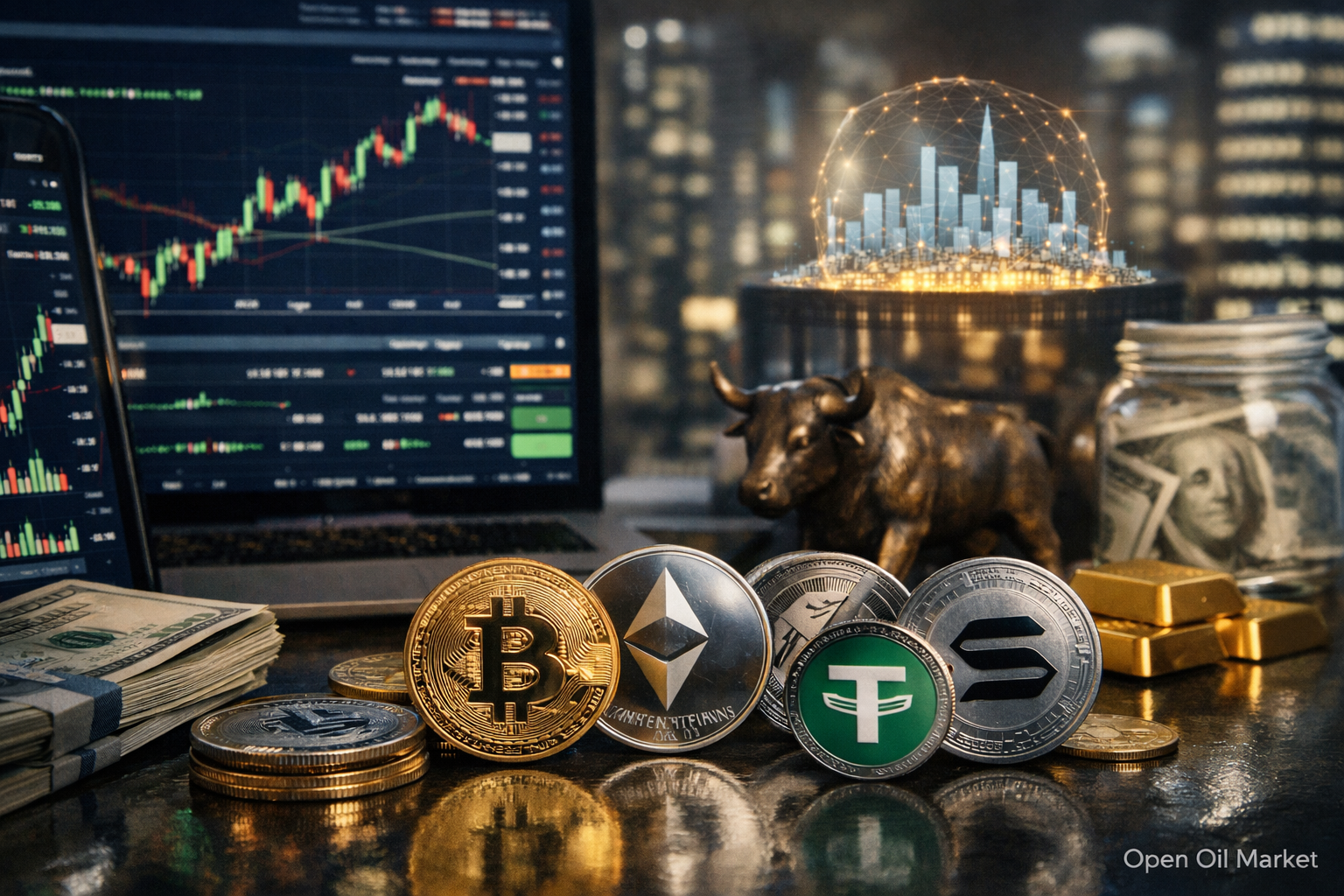
- Bitcoin (BTC) — the key macro asset of the crypto market and main benchmark for institutional capital;
- Ethereum (ETH) — the foundational infrastructure for smart contracts, DeFi, and tokenization;
- Tether (USDT) — the largest stablecoin, critically important for market liquidity;
- XRP — an asset closely monitored in the context of international payments and regulation;
- BNB — an essential element of one of the largest global crypto ecosystems;
- USDC — a stablecoin with growing institutional significance;
- Solana (SOL) — one of the leading representatives of high-performance blockchain platforms;
- TRON (TRX) — a prominent player in stablecoin traffic and payment infrastructure;
- Dogecoin (DOGE) — an asset maintaining widespread recognition and high retail engagement;
- Cardano (ADA) — a project that continues to capture investor interest as a major alternative blockchain ecosystem.
For the investor, the list is important not only for what it includes but also for the varying investment narratives currently forming within it: Bitcoin as a macro asset, Ethereum as infrastructure, stablecoins as the payment layer, and Solana and XRP as bets on alternative growth scenarios for ecosystems and international settlements.
What This Means for Investors on Tuesday, March 17
The key takeaway for global investors is that the cryptocurrency market is becoming layered once again. The growth or stabilization of Bitcoin is important, but it is no longer sufficient for a comprehensive analysis. Today, it is necessary to consider four levels simultaneously:
- The dynamics of BTC as the primary market indicator;
- The condition of Ethereum and infrastructure ecosystems;
- The development of stablecoins and the payment layer;
- Regulatory signals and institutional products.
If a constructive environment persists in the upcoming sessions, the market may transition from a defensive phase to a broader recovery, where not only Bitcoin and Ethereum will benefit, but also the major liquid altcoins. However, investors must continue to account for the high sensitivity of cryptocurrencies to macroeconomic factors, monetary policy, and geopolitical events.
What to Look For in the Next 24 Hours
Cryptocurrency news on Tuesday, March 17, 2026, establishes several key benchmarks for the market. First, institutional demand remains the primary factor for the sector's resilience. Second, Ethereum and stablecoins are increasingly enhancing their investment significance. Third, regulation and tokenization are gradually reshaping the architecture of the digital market.
In the coming hours, investors should pay special attention to whether the momentum in Bitcoin is sustained, whether interest in major altcoins from the top 10 expands, and whether there continues to be a shift in focus toward infrastructural themes—ETFs, staking, stablecoins, and tokenization. These directions are currently defining what the next stage of the global cryptocurrency market will be like.