Current Cryptocurrency News for Thursday, December 25, 2025: Bitcoin Holds at $87,000, Altcoins Under Pressure, Institutional Investors Maintain Interest, Top 10 Cryptocurrencies.
As of the morning of December 25, 2025, the cryptocurrency market is showing relative stability following the volatile fluctuations of recent days. Bitcoin stabilizes around $87,000, consolidating after a significant autumn correction. Ethereum and most major altcoins are trading with slight declines, remaining under pressure amid cautious investor sentiment. The total market capitalization of cryptocurrencies hovers around $3 trillion. Despite the temporary cooling of the market, institutional participants continue to show interest in digital assets, supporting long-term confidence in the industry.
Market Overview: Consolidation and Pressure on Altcoins
This week, Bitcoin (BTC) is consolidating within the mid-$80,000 range, holding a key support level around $85,000. Mid-week, BTC attempted to rise towards $90,000; however, the momentum quickly waned—indicating a fatigue in the pre-New Year rally. Concurrently, Ethereum (ETH) has stabilized around $3,000, trying to recover from the decline at the end of autumn. Many large altcoins—from Binance Coin to Solana—remain under pressure: their prices have dropped by 1-3% over the past few days, leading to a slight increase in Bitcoin's market share (to ~58%). Some technical indicators suggest that certain altcoins are oversold, allowing for the possibility of short-term rebounds. Overall, the cryptocurrency market is balancing between caution and hopes for growth: low liquidity during the holiday period amplifies volatility, and participants are closely monitoring external factors, including central bank decisions. On the other hand, ongoing institutional inflows (see below) instill moderate optimism and support the market from deeper declines.
Bitcoin After the Peak: Searching for Balance
In 2025, Bitcoin has experienced an impressive surge followed by a correction. In early October, BTC reached an all-time high, exceeding $126,000; however, a sharp market pullback of more than 30% occurred subsequently. Currently, the first cryptocurrency hovers around $87,000, significantly below its peak but still close to the values at the end of the previous year. Bitcoin's market capitalization is estimated at around $1.7 trillion, accounting for about 57-58% of the total cryptocurrency capitalization. Bitcoin remains the primary "barometer" of the digital market and is viewed by many institutional investors as a store of value over the long term. Experts note that in the short term, for BTC to continue its growth, it needs to confidently surpass the $90,000 mark, while the $85,000 zone serves as the nearest support. Breaking this level could intensify downward pressure down to the psychological marker of $80,000, while a recovery above $90,000 would signal market stabilization. Despite recent weakness, fundamental factors—limited issuance (21 million BTC) and institutional interest—continue to favor the largest cryptocurrency.
Ethereum and Leading Altcoins: Mixed Dynamics
Ethereum (ETH), the second-largest digital asset by market capitalization, is attempting to recover from the autumn downturn. The current price of ETH is around $2,900, which is below early November levels (earlier, Ethereum was confidently trading above $3,200). Nevertheless, Ethereum still occupies about 12% of the market and remains the foundational platform for DeFi and NFT ecosystems, reinforcing its position through the transition to a Proof-of-Stake algorithm. Other major altcoins have exhibited divergent dynamics in recent weeks. For instance, Solana (SOL), after a rapid surge in the first half of the year, has retraced to ~$120, correcting from local highs (earlier in December, SOL exceeded $130). Binance Coin (BNB) is holding around $835, demonstrating relative stability amid legal risks surrounding Binance. XRP token, after a summer surge following Ripple's victory over the SEC, is now trading at ~$1.85 and shows no distinct trend. Meanwhile, riskier coins are suffering more significantly; for example, the NFT token sector has collectively declined by more than 9% over the last week. The rotation of capital from altcoins into Bitcoin and Ethereum is a notable trend at the year's close, reflecting investors' desire to reduce risks. Analysts do not rule out that if sentiment improves, some funds may return to quality altcoins; however, until global uncertainty decreases, Bitcoin's dominance is likely to remain elevated.
Institutional Investments and ETF Funds
One of the main trends of 2025 has been the increased presence of large investors in the cryptocurrency market. In the U.S., after a prolonged wait, the first spot exchange-traded funds (ETFs) for Bitcoin and Ethereum have been launched, simplifying access to digital assets for institutional players. Throughout the year, these funds have attracted billions of dollars; however, by late December, there are also signs of profit-taking. As reported, on December 23, the total outflow from U.S. Bitcoin spot ETFs amounted to approximately $188 million, while the Ether ETF experienced an outflow of about $95 million within a single day. Nevertheless, major organizations are not retreating from their long-term plans regarding cryptocurrencies. For example, global investment giant BlackRock has announced the expansion of its digital asset team, opening new vacancies in New York, London, and Singapore—this step reflects a strategic vision for the industry's prospects. Additionally, new exchange products are in the works: regulators are considering applications for launching ETFs for other cryptocurrencies (including Solana and Cardano), indicative of ongoing institutional interest in the market.
Regulation and Global Factors
The regulatory environment for cryptocurrencies in 2025 has significantly evolved worldwide. In the United States, after several years of uncertainty, progress has been made: authorities have provided clearer guidelines regarding the status of digital assets, and a legal precedent in the XRP case clarified the boundaries of SEC oversight. Furthermore, the U.S. administration has shown interest in the sector (previously discussing the possibility of forming a strategic Bitcoin reserve and allowing pension funds to invest in crypto assets). The European Union implemented comprehensive regulations (the MiCA regulation) in 2025, which aims to standardize oversight of the industry and enhance the transparency of operations. In major Asian jurisdictions—from Singapore to Hong Kong—regulatory standards continue to be implemented, balancing innovation stimulation and investor protection. Despite the overall increase in clarity, regulatory pressure on the industry persists: for instance, major cryptocurrency exchanges still face demands for tighter control and reporting. Concurrently, incidents related to security (including a recent hack on the prediction platform Polymarket) serve as reminders of risks, encouraging regulators to intensify focus on consumer protection. Ultimately, the global picture is mixed: on one hand, clearer rules attract institutional investors; on the other hand, the market must adapt to new requirements to achieve sustainable growth.
Top 10 Most Popular Cryptocurrencies
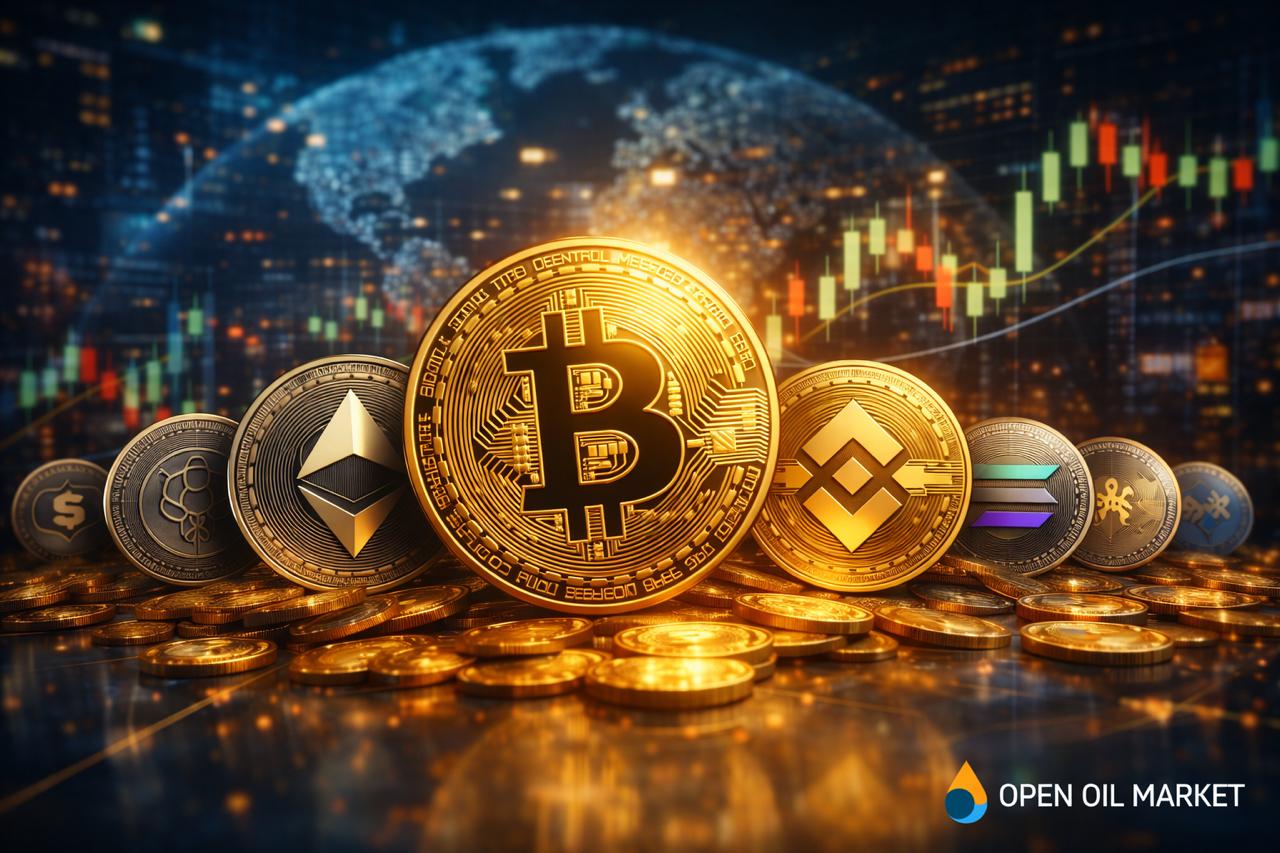
Despite current fluctuations, investors still focus primarily on the ten largest digital assets, which largely set the tone for the entire market. As of December 25, 2025, the top 10 cryptocurrencies by market capitalization are as follows:
- Bitcoin (BTC) – the first and largest cryptocurrency, often referred to as "digital gold." BTC has a fixed issuance limit of 21 million coins and remains the primary indicator of market sentiment (≈58% of total capitalization). Thanks to its status as a safe-haven asset, Bitcoin attracts significant institutional investments as a means of value preservation.
- Ethereum (ETH) – the leading altcoin and smart contract platform, which underpins the decentralized finance (DeFi) and NFT ecosystems. Ethereum confidently holds the second position by capitalization (~12% of the market) and has transitioned to an energy-efficient Proof-of-Stake algorithm since 2022, enhancing its appeal as the "digital oil" of the blockchain industry.
- Tether (USDT) – the largest stablecoin pegged to the U.S. dollar at a 1:1 ratio. USDT provides high trading liquidity on cryptocurrency exchanges, allowing participants to quickly convert capital into dollar equivalents and back for settlements and hedging against volatility. USDT's market capitalization is around $150 billion; the coin reliably maintains a price near $1.00.
- Binance Coin (BNB) – the native token of the largest cryptocurrency exchange, Binance, and the associated BNB Chain blockchain network. BNB is used for paying fees on the exchange and participating in ecosystem services (Launchpad, DeFi applications, etc.), enabling it to remain among market leaders. Despite regulatory pressures on Binance in several countries, the token's wide range of applications supports its demand and position in the top five.
- Ripple (XRP) – a token of the Ripple payment network designed for fast cross-border transactions between banks. XRP has attracted increased attention following Ripple's legal victory over the SEC: a U.S. court confirmed that XRP sales do not violate securities laws. The removal of this uncertainty has strengthened XRP's market position (token capitalization is estimated at about $110 billion), though its price is still significantly below historical highs.
- USD Coin (USDC) – the second-largest stablecoin issued by the Centre consortium (comprising Circle and Coinbase) and fully backed by dollar reserves. USDC enjoys the trust of institutional investors due to regular audits of reserves and transparency. The coin is widely used for settlements, trading, and in the DeFi sector as a reliable digital equivalent of the U.S. dollar.
- Solana (SOL) – a high-performance blockchain platform for decentralized applications (dApps), known for its fast transaction speeds and low fees. After the crisis in 2022, Solana managed to regain significant market share in 2025: new DeFi and NFT projects have launched on its platform, and the potentially approved first ETF for SOL enhances investor interest. A slight price correction at the year's end has not hindered SOL's position among the largest crypto assets.
- TRON (TRX) – a blockchain platform popular primarily in Asia, used for creating smart contracts, entertainment content, and issuing stablecoins. TRX maintains a spot in the top 10 thanks to steady user base growth and development of decentralized applications on the platform. Additionally, a significant portion of USDT is issued on the TRON blockchain, supporting the demand for this network and its token.
- Dogecoin (DOGE) – the most well-known meme cryptocurrency that originated as an internet joke. Despite its initially parodic nature, DOGE has become a significant asset thanks to its devoted community and periodic endorsements from well-known entrepreneurs (such as Elon Musk) on social media. Dogecoin's volatility remains high, but its mass recognition and network effect allow it to stay among the largest coins, demonstrating sustained investor interest.
- Cardano (ADA) – a blockchain platform for smart contracts developed based on academic research and code audits. ADA possesses one of the most active communities and retains its place among the top ten, although the real-world deployment of applications on its platform progresses slower than anticipated. The project attracts long-term investors looking for reliability and scalability of the network in the future.
Cryptocurrency Market on the Morning of December 25, 2025
Prices of major cryptocurrencies:
- Bitcoin (BTC): $86,800
- Ethereum (ETH): $2,920
- XRP (XRP): $1.85
- BNB (BNB): $830
- Solana (SOL): $121
- Tether (USDT): ₽85.00
Market metrics:
- Total market capitalization of cryptocurrencies: $3.02 trillion
- Bitcoin dominance: 58.1%
- Fear and Greed Index: 27 (fear)
Leaders in change over 24 hours:
- Growth: Quantum Resistant Ledger (QRL) — +31%
- Decline: ApeCoin (APE) — -9%
Analysis: Bitcoin and Ethereum exhibit relative stability at current levels, while sentiment in the market remains cautious (the fear index confirms the predominance of caution among investors). The sharp rise of the lesser-known token QRL indicates that even in a calm market, specific projects with strong news backgrounds can attract speculative interest. Meanwhile, the decline in the price of ApeCoin underscores weakness in the NFT sector as profit-taking and waning enthusiasm take their toll. In the context of low trading volumes and holidays, market participants prefer to diversify risks while awaiting new drivers for more definitive price movements.