Cryptocurrency News: Thursday, August 6, 2026 - Bitcoin Consolidates Above $64,000 as U.S. Senate Pushes CLARITY Act to Crucial Vote
The cryptocurrency market enters Thursday, August 6, 2026, with the most constructive sentiment seen in recent weeks. Bitcoin has firmly established itself above $64,000, institutional inflows into exchange-traded funds (ETFs) have surged, and in Washington, the fate of a key piece of legislation regarding the structure of the digital asset market hangs in the balance: the Senate Majority Leader has confirmed that the CLARITY Act will go to a vote before the parliamentary recess. Additional support for the global risk appetite is provided by progress in negotiations to unlock the Strait of Hormuz. We examine the latest cryptocurrency news, fresh quotes of the top-10 digital assets, and scenarios that will dictate market movement until the end of the week.
Key Facts as of Thursday Morning
- Bitcoin is trading in the range of $64,000–64,500 after a confident rebound from August lows; the asset's market capitalization is approaching $1.3 trillion.
- Spot Bitcoin ETFs in the U.S. attracted over $170 million during the session on August 4—almost as much as the total for July; the leader was IBIT from BlackRock, with inflows of $111 million.
- Senate Majority Leader John Thune confirmed that a vote on the CLARITY Act will take place before the August recess; a procedural vote may happen as early as August 7.
- The U.S. and Qatar are making strides in restoring the ceasefire with Iran; a deal to open the Strait of Hormuz could be announced in the coming days.
- The Fear and Greed Index has risen to 27 points, moving out of the "extreme fear" zone.
Bitcoin: Institutional Demand Returns
The turnaround in ETF flows has been the key internal event for the leading cryptocurrency. After a week of outflows totaling $61.5 million, U.S. spot Bitcoin ETFs attracted over $170 million in a single session—a signal that institutional investors have perceived the drop to $62,000 as a buying opportunity. This demand absorbed selling pressure, including the movement of around 32,000 BTC to exchanges—potential overhead supply that the market continues to monitor.
The technical picture is improving, but crucial levels still lie ahead:
- Prices are holding above the 20-day moving average ($63,900), but for the third consecutive week, they are facing resistance at the 50-day moving average near $64,600.
- A breakout above this level would open the road to $66,000–67,000—a zone where the question of a change in the medium-term trend will be resolved.
- Support levels are at $63,900, then $62,700, and the strategic zone of $59,300–62,400, maintaining the scenario for forming a bottom in the cycle.
Bitcoin's correlation with the S&P 500 (63%) and gold (58%) remains high, so macro statistics and geopolitical developments continue to directly influence the dynamics of digital assets.
CLARITY Act: Crucial 48 Hours for Cryptocurrency Regulation
The legislative intrigue has reached its peak. Senate Majority Leader John Thune has publicly confirmed that the Digital Asset Market Clarity Act will receive a vote in the Senate before the start of the recess: a procedural vote to initiate debates could occur as soon as Friday, August 7. For the market, this shifts the issue from the category of "likely" to "scheduled"—a significant change following a week of uncertainty that had reduced the market's chances of the law passing to around 30%.
The primary hurdle is the 60-vote threshold: Republicans need to attract around seven Democrats, while three substantive disputes (including a ban on earning income from stablecoins) remain unresolved. Industry participants remind us of the precedent set by the GENIUS Act, which initially did not pass procedural votes but was then approved with 68 votes to 30. The stakes are high for the entire global market: the law would establish the status of digital goods for 16 assets—from XRP and Ethereum to Solana, Cardano, and Dogecoin—and would set the rules for a segment valued at approximately $680 billion, whose legal status remains ambiguous. A failure would delay reform until at least mid-September.
Geopolitics: The Strait of Hormuz as a Catalyst for Risk Appetite
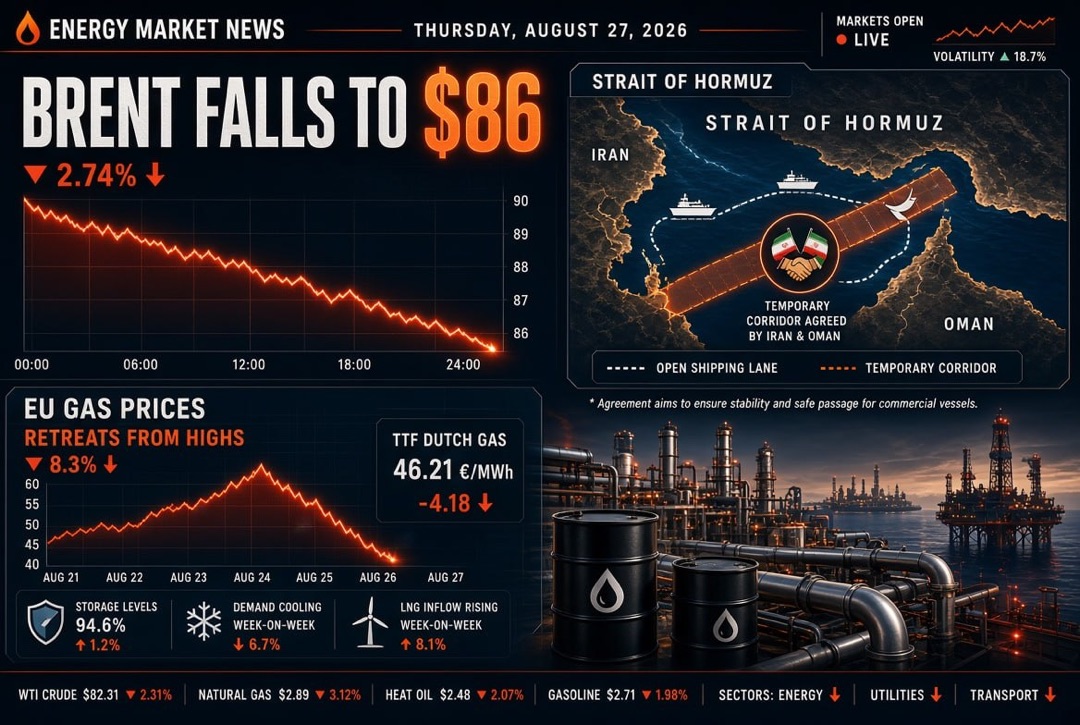
The second driver this week is de-escalation in the Middle East. According to statements from the White House, an agreement to resume shipping through the Strait of Hormuz may be reached within days; Qatar is acting as a mediator in restoring the ceasefire with Iran. For the markets, this means a reduction in the geopolitical risk premium, easing pressure on oil prices, and—indirectly, through inflation expectations—softening the arguments of "hawks" within the Fed. Risk assets, including cryptocurrencies, are responding positively to this narrative: news of negotiations helped Bitcoin rise back above $64,000.
Top 10 Cryptocurrencies: Latest Quotes
The prices of leading digital assets as of the morning of August 6, 2026 (rounded):
- Bitcoin (BTC) – approximately $64,200; market capitalization around $1.29 trillion, dominance around 56%.
- Ethereum (ETH) – approximately $1,880; market capitalization around $230 billion.
- Tether (USDT) – $1.00; the total market for stablecoins is estimated at $302 billion.
- XRP – approximately $1.07; accumulated inflows into XRP funds reached $1.51 billion.
- BNB – trading significantly below January levels amid the overall market correction.
- Solana (SOL) – approximately $74; Western Union has chosen the network for its stablecoin settlement platform.
- USD Coin (USDC) – $1.00.
- TRON (TRX) – approximately $0.34; key infrastructure for stablecoin transfers.
- Dogecoin (DOGE) – approximately $0.07; included in the list of digital goods by SEC-CFTC.
- Hyperliquid (HYPE) – approximately $52; among the leaders in growth among major altcoins at the start of the week.
Altcoins: XRP Awaiting Resolution, Solana Strengthens Fundamentals
XRP remains an asset with maximum sensitivity to the outcome of the Senate vote: the law will transition the March classification of the token as a digital good from an annulling agency interpretation to federal statute. Institutional analysts estimate potential inflows into XRP funds upon the passage of the law at $4–8 billion for the first year; notably, buyers already dominate on Asian exchanges—with demand in South Korea exceeding supply by about twofold.
Solana reinforces the investment case with corporate news: Western Union is building a stablecoin settlement platform on its network for over 150 million customers, while BlackRock has deployed over $600 million in tokenized on-chain instruments. Cardano is consolidating near monthly highs after a rally earlier in the week—with a focus on the development of the scalable Ouroboros Leios protocol. Ethereum is holding around $1,880 amid continued inflows into specialized funds.
Security: Conclusion in the Coldcard Incident
The incident involving Coldcard hardware wallets has received its final assessment: hackers withdrew 1,596 BTC, making this attack the largest failure of hardware wallets in the industry's history. However, the market has demonstrated maturity—the panic phase has ended, the manufacturer has released fixes, and Bitcoin prices have fully retraced the losses associated with the exploit. A long-term consequence of the incident is the accelerated shift of the industry towards multi-signature standards and diversified asset storage.
Calendar: Key Events Until the End of the Week
- August 6–7 – procedural steps and possible voting on the CLARITY Act in the U.S. Senate; publication of U.S. labor market data.
- August 7–10 – the Senate enters recess: if the vote is postponed, lawmakers will not return to the issue before September 14.
- August 8 – expected downward difficulty adjustment of the Bitcoin network.
- August 12–13 – reports on consumer (CPI) and producer (PPI) inflation in the U.S.
Investor Takeaways
As of August 6, 2026, the balance of risks in the cryptocurrency market is shifting toward a constructive position: the return of institutional inflows, geopolitical de-escalation, and the scheduled vote on the CLARITY Act create potential for a relief rally. However, none of the three factors have yet fully materialized: the law must overcome the 60-vote threshold, the Strait of Hormuz deal has not been signed, and Bitcoin must break the 50-day moving average near $64,600. A successful resolution across all three fronts could drive BTC to $66,000–67,000 and initiate leading altcoin growth, spearheaded by XRP. A negative scenario—a failure of the procedural vote—would return the market to defend support at $62,700, although the precedent of the GENIUS Act suggests that even the first setback in the Senate does not mean a definitive defeat for reform.
This material is for informational purposes only and does not constitute individualized investment advice. Cryptocurrencies are a highly volatile asset class; when making investment decisions, assess risks independently.