Current Cryptocurrency News as of April 30, 2026: Market Analysis of Bitcoin ETF Trends, Regulatory Developments, and Dynamics of Top Cryptocurrencies for Investors and Stablecoin Regulation Set the Market Tone
The cryptocurrency market enters Thursday, April 30, 2026, with a sense of cautious optimism. The main intrigue of the day is whether Bitcoin can solidify its position above the psychologically significant $80,000 mark, or if the market will once again turn to profit-taking. For global investors, cryptocurrency news today is significant not only in terms of price movements but also as an indicator of risk appetite in the global markets.
After several weeks of increased volatility, digital assets have regained the spotlight among institutional investors. Bitcoin remains the primary benchmark, Ethereum is attempting to recover from a period of underperformance, while Solana, XRP, and BNB continue to compete for capital in the largest altcoin segment. At the same time, the role of ETFs, stablecoins, and regulation is gaining prominence: these themes are shaping the long-term architecture of the global cryptocurrency market.
Bitcoin Tests a Key Resistance Zone Again
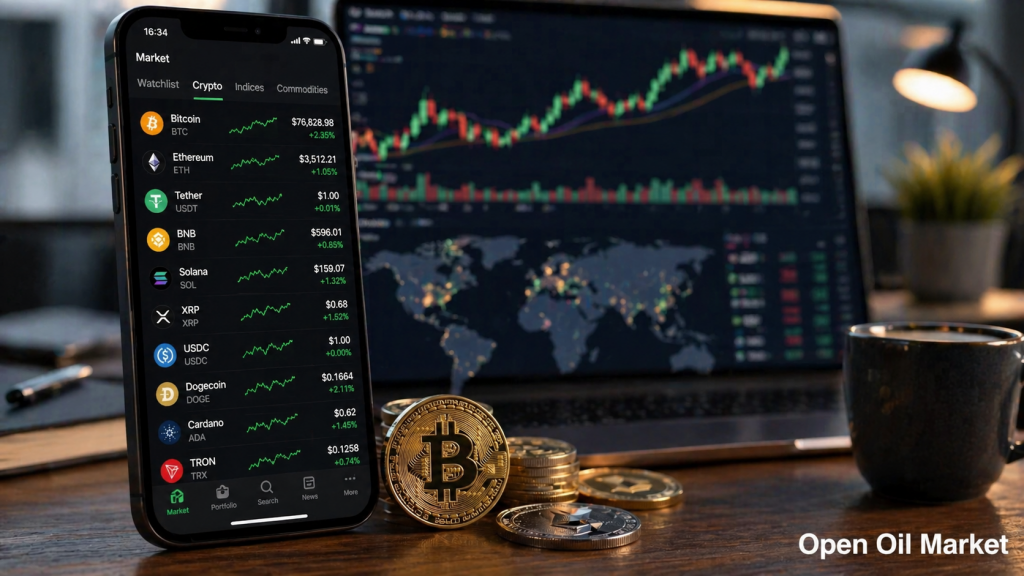
Bitcoin continues to be a central focus for investors. The market benchmark for BTC hovers around the $76,000–$78,000 range, with the $80,000 zone becoming an important psychological and technical level. For short-term traders, this is a potential breakout boundary; for long-term investors, it’s a test of institutional demand resilience.
The rising interest in Bitcoin is attributed to several factors:
- inflow of capital into spot Bitcoin ETFs;
- expectations of a softer monetary policy in the U.S.;
- decline in geopolitical risk premiums in global markets;
- shortage of BTC available on exchanges;
- increased attention from asset managers and major financial platforms.
However, the market remains sensitive to any signals from the Federal Reserve, U.S. Treasury yields, and the performance of technology stocks. For Bitcoin, it is crucial not only to approach the $80,000 mark but also to demonstrate the ability to maintain its position above that zone amid rising volumes and sustained demand.
ETFs Become the Main Channel for Institutional Demand
One of the key themes for the cryptocurrency market continues to be ETFs. Institutional capital is increasingly entering digital assets not directly through cryptocurrency exchanges but via regulated exchange-traded products. This is changing the market structure: Bitcoin is gradually becoming not only a speculative asset but also a part of portfolio allocation alongside stocks, bonds, gold, and commodity instruments.
It is essential for investors to understand that ETF flows can work both ways. When funds see inflows, Bitcoin gains support; when outflows commence, the market quickly senses a cooling demand. Thus, cryptocurrency news in the coming days will heavily depend on ETF statistics, the behavior of major asset managers, and the interest from pension funds, hedge funds, and family offices.
Ethereum Remains Under Pressure but Retains a Fundamental Role
Ethereum is trading significantly below historical highs and is currently underperforming Bitcoin in its recovery strength. Nevertheless, ETH remains the foundational infrastructure for DeFi, asset tokenization, stablecoins, NFT infrastructure, and corporate blockchain solutions. For long-term investors, Ethereum is still seen as more than just a cryptocurrency; it's a technological platform.
The relative weakness of ETH against Bitcoin can be explained by several factors:
- some capital is flowing into the more liquid and comprehensible Bitcoin;
- investors are being more cautious about DeFi returns after major hacks and liquidity outflows;
- competition from Solana and other high-performance networks is intensifying;
- the market is awaiting more apparent drivers for increased fees and activity within the Ethereum network.
Nevertheless, Ethereum remains a critically important asset for the global cryptocurrency market. If the demand for tokenization, stablecoins, and decentralized financial applications continues to grow, ETH may once again become one of the principal beneficiaries of the next market phase.
Solana, XRP, and BNB: Competing for Capital in the Large Altcoin Segment
Altcoins continue to move unevenly. Solana maintains its status as one of the most prominent networks for fast transactions, consumer applications, and meme coin activity. XRP remains an asset closely watched by investors focused on payment infrastructure and cross-border settlements. BNB is supported by the Binance ecosystem and remains one of the largest tokens by market capitalization.
However, investors need to consider: the further an asset is from Bitcoin and Ethereum, the higher its dependence on news flow, liquidity, and market sentiment. In periods of growth, altcoins can exhibit outperforming dynamics, but during downturns, they typically fall faster than the market.
Top 10 Cryptocurrencies to Watch
As of April 30, 2026, investors should keep an eye on the largest and most liquid cryptocurrencies in the global market. The ranking may fluctuate based on market capitalization and short-term dynamics, but these assets remain at the forefront for global market participants:
- Bitcoin (BTC) — the primary benchmark for the digital asset market and the largest cryptocurrency by market capitalization.
- Ethereum (ETH) — the key platform for smart contracts, DeFi, and asset tokenization.
- Tether (USDT) — the largest dollar stablecoin and a primary liquidity tool on cryptocurrency exchanges.
- XRP (XRP) — an asset linked to cross-border payments and banking infrastructure.
- BNB (BNB) — the token of the Binance ecosystem and one of the largest assets in the crypto market.
- USD Coin (USDC) — a regulated dollar stablecoin, essential for institutional settlements.
- Solana (SOL) — a high-performance blockchain network competing for developers and consumer applications.
- TRON (TRX) — a network actively used for stablecoin transfers and settlement liquidity.
- Dogecoin (DOGE) — the largest meme cryptocurrency with high recognition among retail investors.
- Cardano (ADA) — a blockchain platform maintaining a strong community and long-term technological agenda.
Stablecoins Become the Center of Regulation
Stablecoins remain one of the main elements of the crypto economy. A significant portion of trading liquidity, exchange settlements, and cross-border transfers flows through USDT, USDC, and other dollar tokens. This is why regulators in the U.S., Europe, the Middle East, and Asia are tightening oversight of reserves, disclosure, licensing, and sanctions compliance.
For investors, this signifies a transition of the market into a more mature phase. The stricter the requirements for stablecoin issuers, the lower the likelihood of systemic failures, but the higher the barriers for new players. In the long run, regulation may enhance the trust of large investors in digital assets; however, in the short term, it can create pressure on individual exchanges, DeFi projects, and unregulated platforms.
Sanctions and Compliance Reinforce the Importance of "Clean" Liquidity
The global cryptocurrency market is increasingly integrating into the traditional financial system. This means that sanctions compliance, source of funds checks, wallet monitoring, and requirements for exchanges are becoming a permanent part of the industry rather than a temporary measure. For large investors, this is a positive signal: the more transparent the infrastructure, the easier it is for banks, brokers, and asset managers to work with digital assets.
On the flip side, increased compliance reduces the attractiveness of gray schemes, anonymous transfers, and unregulated platforms. This could lead to a redistribution of liquidity favoring large licensed exchanges, custodians, and ETF products.
What Investors Should Note on April 30, 2026
The main question of the day is whether Bitcoin can break out of its range and confirm movement above $80,000. If the breakout is supported by volume and inflows into ETFs, the cryptocurrency market may receive a new impulse. Conversely, if investors begin to take profits, a consolidation phase with heightened volatility in altcoins is likely.
Investors should pay attention to four key indicators:
- the dynamics of Bitcoin relative to the $80,000 zone;
- inflows and outflows of capital in Bitcoin ETFs and Ethereum ETFs;
- the behavior of Ethereum and Solana as indicators of demand for infrastructure blockchains;
- regulatory news regarding stablecoins, sanctions, and cryptocurrency exchanges.
For conservative investors, the optimal strategy is not to chase short-term movements but to assess asset quality, liquidity, regulatory risks, and the share of cryptocurrencies in their overall portfolio. For active traders, the coming days may present opportunities, but only with strict risk management.
The Crypto Market Becomes More Institutional but No Less Volatile
The cryptocurrency news as of Thursday, April 30, 2026, reflects the maturity of digital asset markets. Bitcoin remains a key indicator of global demand for cryptocurrencies, Ethereum retains its fundamental technological role, and stablecoins and ETFs are becoming the infrastructural core of the new financial system.
However, investors should not interpret the current growth as a clear signal for aggressive buying. The cryptocurrency market remains dependent on macroeconomic conditions, central bank decisions, stock market behavior, regulation, and liquidity. Strong institutional demand increases market resilience but does not eliminate the potential for sharp corrections.
The key scenario for the next few days is Bitcoin's struggle to secure itself above $80,000 and to test investors' willingness to increase the share of digital assets in their portfolios. If ETF flows remain stable and the macroeconomic backdrop does not deteriorate, cryptocurrencies might maintain their upward momentum. Conversely, if the market faces profit-taking, altcoins are likely to be the most vulnerable segment.