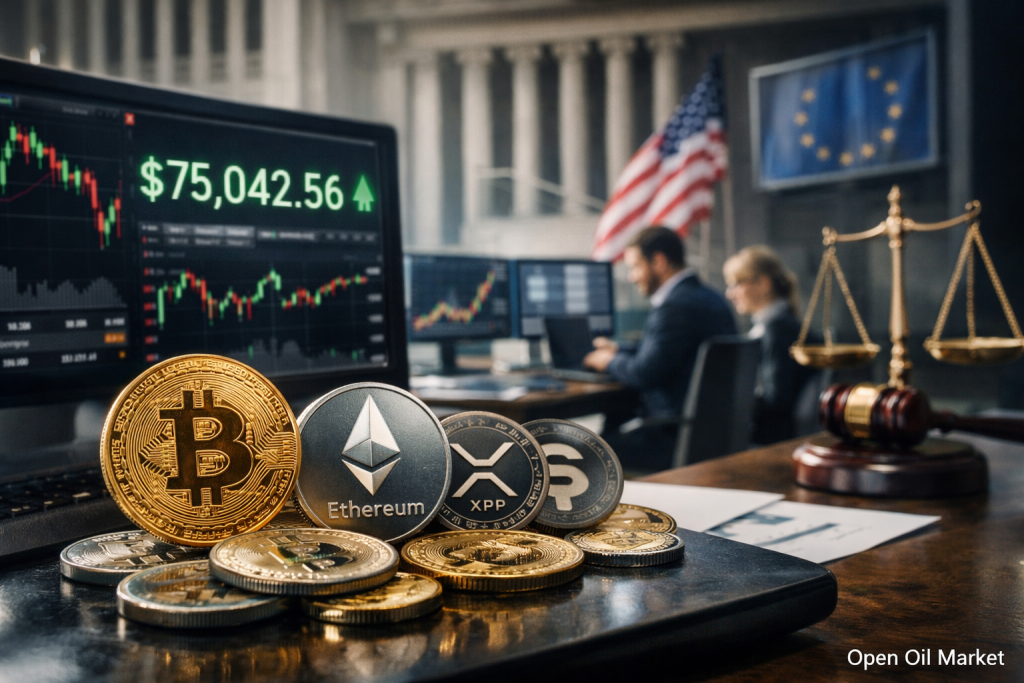
Current Cryptocurrency News as of April 16, 2026: Bitcoin Dynamics, Rising Institutional Demand, Regulation, and a Review of the Top 10 Cryptocurrencies
The cryptocurrency market is entering Thursday, April 16, 2026, in a state of cautious recovery. The main intrigue for investors is whether Bitcoin can maintain its position above the psychologically significant level of $75,000 and convert the recent rebound into a sustained upward momentum. Simultaneously, the market is receiving several strong signals: major financial institutions are expanding their presence in digital assets, regulators in leading jurisdictions are accelerating their work on sector rules, and Ethereum alongside several large altcoins are starting to appear significantly stronger than at the beginning of the spring.
For the global audience of investors, this signifies one key point: cryptocurrencies are again in the spotlight not only of speculative capital but also of traditional financial markets. However, the movement's structure remains selective. Funds are concentrating on the most liquid assets, and the market continues to operate under a logic of quality, scale, and institutional accessibility.
Bitcoin Remains the Guiding Star of the Cryptocurrency Market
Bitcoin continues to hold its status as the foundational asset of the digital market and the primary indicator of investor risk sentiment. Ahead of Thursday, attention is focused on the $75,000 zone, which the market perceives as an important technical and psychological threshold. If buyers can establish themselves above this level, it will reinforce expectations of continued growth across the cryptocurrency segment. If not, the market may revert to a phase of sideways movement with heightened volatility.
For investors, three key takeaways are crucial at this moment:
- Bitcoin continues to lead in liquidity, capitalization, and institutional attention;
- The movement of BTC sets the tone for Ethereum, Solana, XRP, and other large cryptocurrencies;
- Any acceleration in capital inflow into ETFs and Bitcoin-related products may quickly alter short-term market expectations.
Against this backdrop, the market appears not as a persistent upward trend but rather as a selective revaluation of the strongest assets. This characteristic is typical of a mature phase in the digital market, where investors prefer large and familiar instruments over an aggressive search for risk across the spectrum of altcoins.
Institutional Capital Strengthens Cryptocurrency Market Positions
One of the main drivers for the week is a new wave of institutionalization in the industry. Major financial groups and exchange infrastructure are not reducing their presence in digital assets but are, on the contrary, expanding it. This is particularly significant for the global cryptocurrency market as it alters the very logic of sector assessment: cryptocurrencies are increasingly viewed not as a peripheral asset class but as more frequently integrated into traditional investment solutions.
The current focus is on:
- The expansion of exchange-traded products oriented towards Bitcoin;
- The growing interest of traditional exchanges and financial groups in cryptocurrency exchanges and tokenized markets;
- The strengthening of ties between digital assets, derivatives, and regulated market infrastructure.
For investors, this represents a strong mid-term signal. Even amid local volatility, the sector is gaining deeper access to capital, thereby increasing the likelihood of further liquidity expansion, audience reach, and product lines.
Ethereum Attempts to Capture Part of the Market Initiative
Ethereum is among the key beneficiaries of the current market phase. While Bitcoin remains the primary indicator of trust in cryptocurrencies as an asset class, Ethereum is increasingly viewed as an infrastructure bet on the development of the blockchain economy, tokenization, and smart contract-based applications.
In recent days, investors have been paying attention to several factors:
- Improvement in ETH's relative dynamics compared to Bitcoin;
- Increased network activity and more sustainable interest in the Ethereum ecosystem;
- A revival of interest in ETH-related ETF products.
This does not indicate the beginning of a full-fledged altcoin season but highlights an important aspect: substantial capital is once again ready to differentiate positions within the market instead of exclusively purchasing Bitcoin. For investors with a horizon of more than a few weeks, this is particularly significant, as Ethereum typically becomes the first major asset to confirm the expansion of demand beyond BTC.
Regulation Becomes a Factor of Market Maturity Rather Than a Threat
Another important theme as of April 16, 2026, is the amplification of the regulatory agenda. For the cryptocurrency market, this no longer seems like mere pressure. On the contrary, the closer the sector gets to formalized rules, the higher the likelihood of new institutional money entering, especially from jurisdictions with a developed financial system.
The market is currently evaluating regulation in two dimensions:
- USA: Investors are awaiting the advancement of bills that can provide a clearer framework for the circulation of digital assets;
- Europe and the UK: Discussions about rules for trading platforms, staking, custody, and the circulation of crypto assets are making the sector more predictable for business and capital.
For the global market, this is critically important. The less legal uncertainty there is, the greater the chances that cryptocurrencies will be more deeply integrated into banking, investment, and exchange ecosystems. This directly influences the valuations of companies, demand for ETFs, liquidity of major tokens, and the development of infrastructure projects.
The Market Remains in Bitcoin Season Mode, Not Altcoin Season
Despite improved sentiments in certain segments, the cryptocurrency market currently does not provide grounds to speak of a widespread altcoin rally. The movement's structure remains conservative: capital is primarily concentrated in Bitcoin, Ethereum, and the largest liquid assets. This is logical for a phase when investors are still assessing macroeconomic risks, regulatory trajectories, and the sustainability of demand from institutional participants.
Such market phases usually exhibit the following characteristics:
- Bitcoin rises faster or is more stable than most altcoins;
- Capital initially flows into the largest cryptocurrencies;
- Only after BTC stabilizes does interest expand to medium and higher-risk projects.
This is why it is important for investors not to confuse local surges in interest in specific tokens with a full market turnaround. As of April 16, 2026, the cryptocurrency market appears more as a quality and liquidity-driven landscape rather than one of indiscriminate exuberance.
Top 10 Most Popular Cryptocurrencies: What the Market is Watching
In terms of capitalization, liquidity, and global investor attention, the center of the market remains with the following cryptocurrencies:
- Bitcoin (BTC) — the main market benchmark and primary digital reserve asset;
- Ethereum (ETH) — a key infrastructure platform for smart contracts and tokenization;
- Tether (USDT) — the largest stablecoin and a crucial source of market liquidity;
- XRP (XRP) — one of the largest payment digital assets;
- BNB (BNB) — the system token of a major exchange ecosystem;
- USDC (USDC) — the second-largest dollar stablecoin, significant for institutional turnover;
- Solana (SOL) — one of the main large altcoins with high network activity;
- TRON (TRX) — a large network with a stable role in the transactional and stablecoin segment;
- Dogecoin (DOGE) — a highly liquid meme asset with a large global audience;
- Hyperliquid (HYPE) — a rapidly strengthened major asset in the crypto-derivatives and trading infrastructure segment.
This list is important not only as a ranking. It shows where real capital interest is currently concentrated. For investors, it serves as a convenient market map, highlighting which segments are currently dominant — digital gold, infrastructure, stablecoins, payment solutions, exchange ecosystems, and trading platforms.
What This Means for Investors Worldwide
On a global level, the cryptocurrency market in mid-April appears more mature than in previous growth cycles. It is now driven not only by retail interest but also by institutional infrastructure: ETFs, custody solutions, exchange transactions, regulatory consultations, and corporate investments in crypto platforms.
For investors, this translates into several practical conclusions:
- The cryptocurrency market remains high-risk, but the quality of the infrastructure has significantly improved;
- Bitcoin and Ethereum retain their status as foundational assets for global positioning;
- Stablecoins and major ecosystem tokens continue to play an increasingly important role in real capital turnover;
- Regulatory changes are becoming not only a risk factor but also a driver for the legitimization of the industry.
From a strategic perspective, this is a market where discipline becomes more important than hype. Priority is given to liquidity, scale, transparency, and ecosystem resilience. For professional investors, this represents a much clearer environment compared to the one that existed during previous cryptocurrency boom cycles.
Conclusion: The Sentiment of the Cryptocurrency Market as It Enters April 16, 2026
As Thursday approaches, the cryptocurrency market is approaching with a moderately positive but not euphoric sentiment. Bitcoin maintains its leadership and sets the overall vector. Ethereum shows signs of strengthening. Institutional participants continue to enhance their presence in the sector. The regulatory agenda is gradually transforming from being a hindrance into a structural driver.
The main takeaway for the day is that the cryptocurrency market is becoming part of the larger financial system once again. For investors, this indicates a growing importance of fundamental factors: capital inflow, infrastructure, regulation, and liquidity concentration in key assets. These elements will define the agenda of the cryptocurrency market in the coming weeks.




