Cryptocurrency News, Wednesday, April 1, 2026: The Market Balances Between Risk Pressure and the Return of Institutional Demand
As we enter April, cryptocurrencies remain sensitive to external news. Bitcoin maintains its status as the primary market benchmark, yet capital flow within the sector has become more selective. Investors no longer react uniformly to the entire market, as is often the case during phases of strong bullish momentum. Currently, the focus has shifted to:
- the direction of institutional capital;
- which assets retain liquidity amid cautious demand;
- how resilient top coins are to macroeconomic pressure;
- whether there are signs of renewed interest in altcoins beyond speculative surges.
This environment is making the cryptocurrency market more professional. A simple bet on overall sector growth no longer appears to be a sufficient strategy. For global investors, the quality of positioning is more crucial than the quantity of open ideas.
Bitcoin Remains the Market's Center, but No Longer Appears as an Unconditional Hedge
Bitcoin continues to be the largest cryptocurrency in the world and the main indicator of capital's perception of digital assets. However, the end of March revealed that, in the current cycle, BTC is not always viewed as a classical safe-haven asset. During periods of heightened global anxiety, it can maintain relative stability better than some altcoins, but it still does not fully escape correlation with the broader segment of risk assets.
This is a significant signal for the market. Investors are increasingly evaluating Bitcoin not only as digital gold but also as an institutional macro asset that can serve both as a hedging instrument and a source of heightened volatility. Therefore, any changes in ETF flows, corporate purchases, and the behavior of large holders currently have a more substantial impact on sentiment than local speculative news.
ETFs Back in Focus: Institutional Demand Sends Mixed but Important Signals
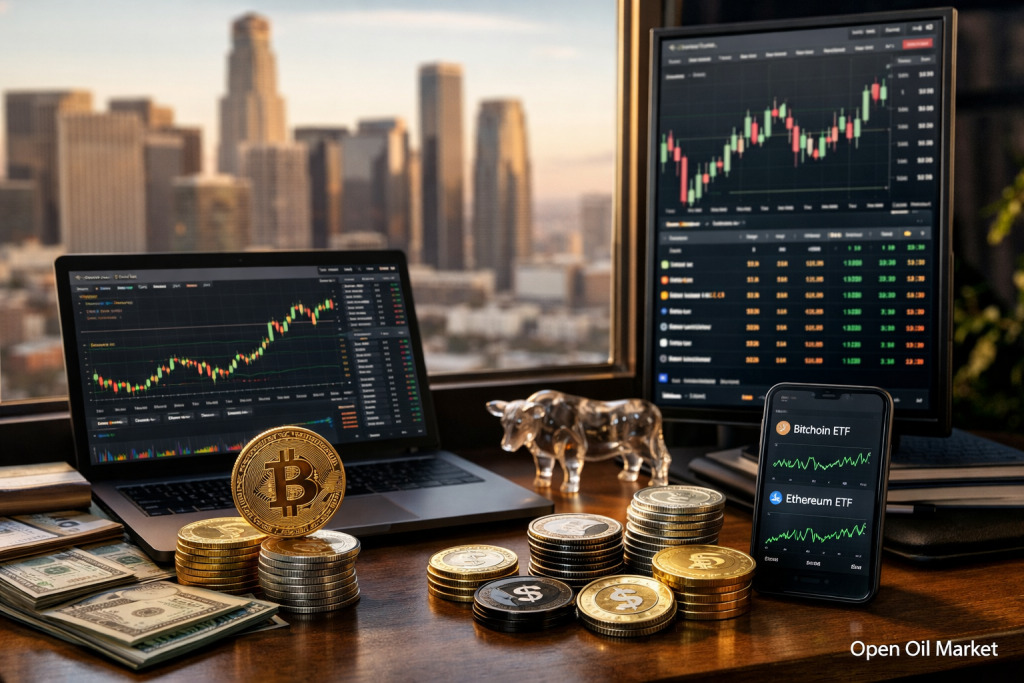
One of the key drivers of the cryptocurrency market in recent months has been exchange-traded funds (ETFs). At the end of March, U.S. spot Bitcoin ETFs recorded a positive net inflow, marking an important signal after a series of weaker sessions. For the market, this does not automatically indicate a turnaround upwards but suggests that institutional capital has not departed from the asset class and continues to use downturns for selective entries.
The outlook for Ethereum also appears cautiously optimistic: after significant pressure in previous days, the market observed a modest positive inflow into spot ETFs. This is particularly important from a market psychology perspective. When demand returns simultaneously to BTC and ETH, investors are reassured that interest in fundamental digital assets persists even in a more nerve-racking external environment.
Top 10 Most Popular Cryptocurrencies: Where Market Attention Is Currently Focused
As of April 1, 2026, investor focus remains concentrated on the ten largest assets by market capitalization. These assets constitute the core of the global cryptocurrency market and drive industry dynamics.
- Bitcoin (BTC) — the main benchmark of the sector and primary recipient of institutional interest.
- Ethereum (ETH) — the key platform for smart contracts, DeFi, and tokenization.
- Tether (USDT) — the largest stablecoin, reflecting the level of liquidity and turnover in the crypto market.
- BNB — a significant exchange and ecosystem asset, maintaining relevance due to its extensive infrastructure.
- XRP — an asset with strong international recognition and a stable trading base.
- USDC — the second systemically important dollar stablecoin, crucial for institutional settlements.
- Solana (SOL) — one of the leading representatives of high-performance blockchain networks.
- TRON (TRX) — an asset consistently positioned in the upper market tier due to its payment and stablecoin infrastructure.
- Dogecoin (DOGE) — a meme coin that still retains high recognition and liquidity.
- Bitcoin Cash (BCH) — an asset that has re-entered the top ten amid a contraction in capitalization among weaker competitors.
It is important for investors to understand that the composition of the top ten currently reflects not only technological development but also the structure of liquidity. The role of stablecoins has noticeably increased at the top, indicating a more defensive market character and a high proportion of capital awaiting clearer directions.
Ethereum, Solana, and XRP: The Battle for Capital Among Major Altcoins
If Bitcoin sets the general direction, among major altcoins, Ethereum, Solana, and XRP remain key targets for evaluation by global investors. Each of these assets carries its own investment logic.
- Ethereum remains the foundational infrastructure bet on the development of the blockchain economy, tokenization, and institutional use of smart contracts.
- Solana is perceived as a more dynamic growth story, where investors seek acceleration in turnover, user activity, and speculative interest.
- XRP maintains its position due to its strong brand, high turnover, and the long-term bet of some market participants on cross-border settlements.
At this stage, none of these assets demonstrates unequivocal leadership over the others across all parameters. This is why capital distribution among them often becomes an indicator of market style: defensive, neutral, or aggressive.
Stablecoins Are Becoming More Important: This is Not a Weakness of the Market but a Reflection of Its Structure
The rising role of USDT and USDC in the top ten largest cryptocurrencies is one of the most indicative trends. Many private investors mistakenly view the dominance of stablecoins as a sign of a lack of ideas in the market. In practice, this also reflects the maturity of the infrastructure.
Today, stablecoins serve multiple functions:
- acting as the primary settlement instrument within cryptocurrency ecosystems;
- serving as a temporary safe haven for capital in periods of uncertainty;
- providing liquidity for rapid market entry when a signal arises;
- supporting global turnover between centralized and decentralized platforms.
This is why their significant share in the capital structure indicates not only caution but also the market's readiness for subsequent capital redistribution.
What Changes for Investors on April 1: The Market Demands Greater Discipline
The current cryptocurrency environment requires investors to adopt a more stringent approach to risk management. The strategy of "buying all large caps and waiting" is becoming less effective than in earlier stages of the bull cycle. Currently, the priority is given to:
- assets with stable liquidity;
- coins showing visible institutional interest;
- segments where the fundamental story is supported by cash flows;
- entry points validated by market structure rather than emotion.
For the global investment audience, this is especially important as the cryptocurrency market becomes increasingly integrated into the global financial system. This means that the influence of interest rates, dollar liquidity, regulatory decisions, and ETF flows will remain heightened.
The Main Takeaway of the Day: April Begins with the Selection of Strong Assets, Not a General Rally
Cryptocurrency news as of April 1, 2026, paints a moderately constructive but not euphoric picture. Bitcoin retains its leadership and remains the primary indicator of market confidence. Ethereum maintains its status as a key infrastructure asset. Solana, XRP, and other major coins continue to vie for capital redistribution within the altcoin segment. Simultaneously, the role of stablecoins remains high, underscoring the cautious stance of market participants.
For investors, this implies that cryptocurrencies enter April without a mass unconditional impulse, but with notable signs that strong assets may gain an advantage in the event of an improved external backdrop. In such an environment, the focus shifts to selection quality, risk control, and attention to institutional capital flows. It is this, rather than noise surrounding short-term price fluctuations, that will determine market sentiment in the coming days.